Razer defines the future of the ultimate home setup with Project Sophia and Enki Pro HyperSense


Razer, the world’s leading lifestyle brand for gamers (Hong Kong Stock Code: 1337), today unveiled its vision for the future of gaming and home computing with Project Sophia, the world’s first true gaming desk concept, and the Enki Pro HyperSense, an advanced gaming chair with built-in high-fidelity haptics from D-BOX. Created by Razer’s visionary R&D department, both Project Sophia and the Enki Pro HyperSense introduce new innovative solutions to level up any home setup.
With working from home more widespread than ever, many people find it a challenge to configure their set-ups for the multiple different uses required of their systems throughout the day. From being a pure office productivity set-up through to a gaming, streaming or editing suite, each use has a host of extra peripherals and devices to enhance and improve that experience.
With a highly adaptable, modular design allowing users to quickly reconfigure their workspace for the tasks at hand – be that churning through emails and Word docs for work, blasting through enemies on their way to the objective when gaming, or tearing it up on Twitch with their squad whilst streaming to their viewers, Project Sophia provides a seamless solution to all of these challenges.
Fully modular. Completely customizable.
Central to Project Sophias flexibility is a highly modifiable desk capable of supporting up to 13 separate modules for an untold level of personalization. This allows each section to be configured with an array of task-specific components, such as secondary screens, system monitoring tools, touch-screen hotkey panels, pen tablets and audio mixer units, or even external capture cards, so the user’s set-up can be reconfigured in seconds for the specific situation.

“Project Sophia is our futuristic vision of a multi-purpose gaming and workstation set-up which meets the very different needs of a variety of PC uses, negating the need to move between workspaces,” said Richard Hashim, VP of Growth at Razer. “The hot-swappable modular system allows users to quickly reconfigure their desk with near infinite flexibility, adapting Project Sophia not just for the task at hand, but also to the user’s particular preference. This is the future of the battlestation.”
Desktop power. In your desk.
At the heart of Project Sophia is a customized PCB fitted with cutting-edge core components, including the latest Intel processor and NVIDIA GPU to support the most resource-intensive tasks. To maximize desk space, all of this is housed in a slim chassis that magnetically snaps in underneath the glass tabletop, which can be just as easily detached to install new upgrades, allowing the user to quickly create the system required for the task at hand.
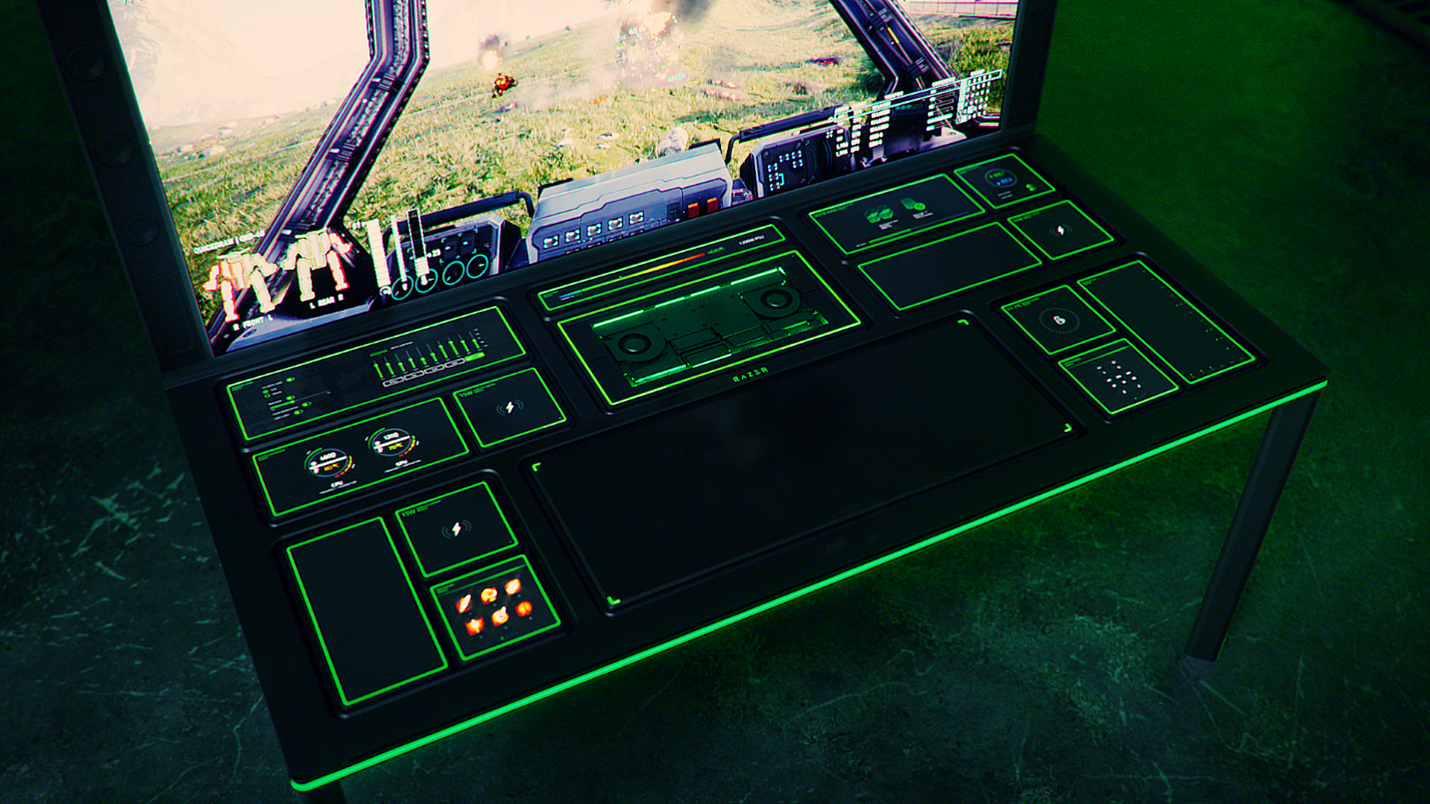
Modules have been designed for all types of users, with creators being able to slot in touchscreen digitizers, tablets, and creative input tools to streamline hotkeys and macros, while gamers can instead focus on modules for high-fidelity audio and blistering visual performance by adding a THX Surround Sound system and high refresh rate monitor. Streamers can transform Project Sophia into a full broadcast setup complete with camera, microphone, and stream control, while those looking for a more an efficient work environment can multitask effectively and comfortably with a productivity hotkey module, wireless charger, and cup warmer.
For enhanced immersion and customization, the spacious desk is lined with LEDs that can be synced with the Razer Chroma™ RGB ecosystem, and comes equipped with a next-gen OLED display that features self-lit pixels and the latest technologies to ensure a brighter, sharper picture for the ultimate viewing experience in 65”.
Because of its highly adaptable and versatile design, Project Sophia is able to provide the optimal configuration for gaming, creating, streaming, and working, combining many traditional setups into one single desktop.
All Day Comfort. All In Immersion.
Also announced today is the Enki Pro HyperSense, an advanced gaming chair incorporating high-fidelity haptics, allowing users to experience a new dimension of immersion in gaming. Based on the popular Enki Pro chair design, the Enki Pro HyperSense features a haptic feedback unit developed with D-BOX, to give the most authentic, lifelike feedback when gaming, and also integrates a Chroma RGB headrest that allows users to personalize their chair when in use.
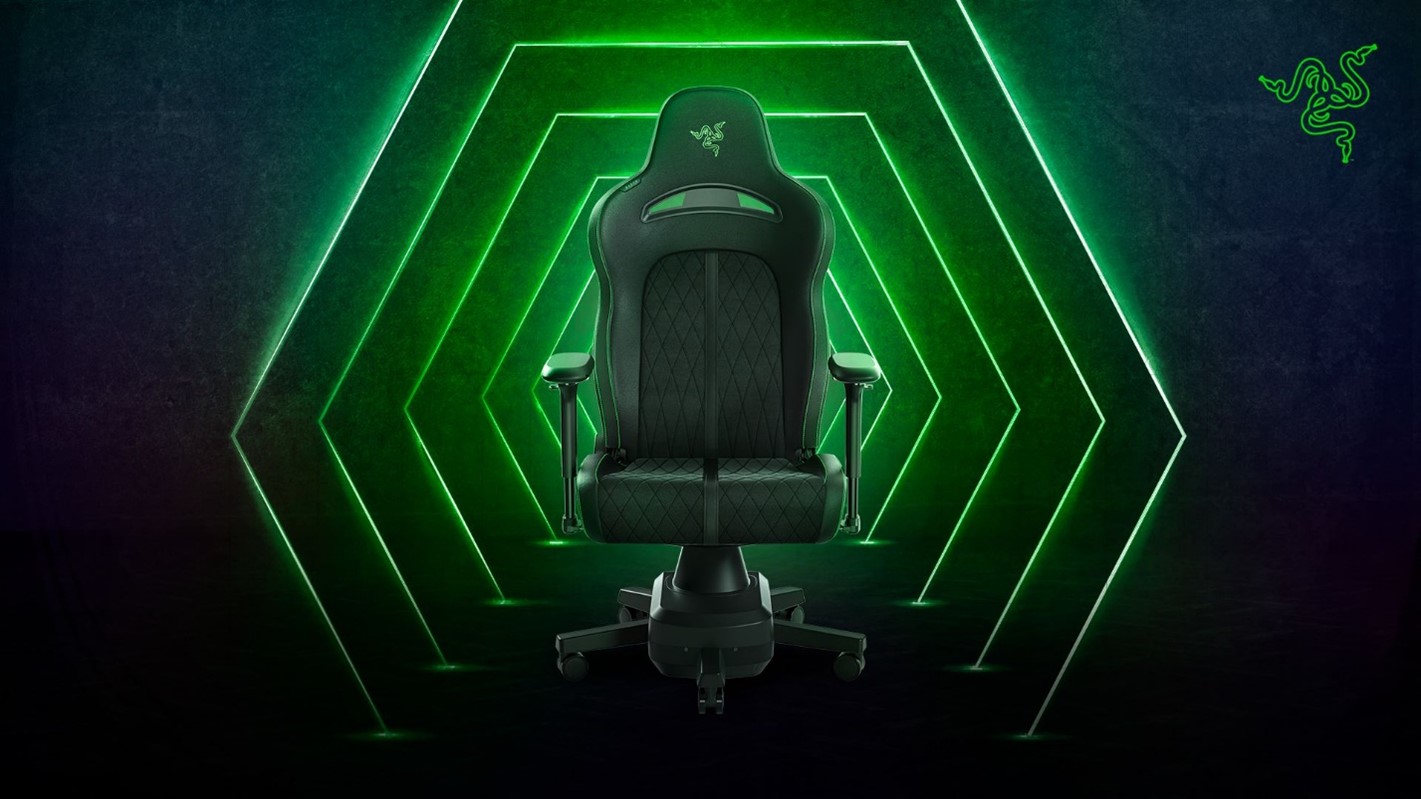
“With the Enki Pro HyperSense, Razer and D-BOX have built the most advanced gaming chair to date,” said Sébastien Mailhot, President and CEO of D-BOX. “Our combined efforts have resulted in a product that physically transforms the experience of games, movies and music through the use of cutting-edge high-fidelity haptic feedback. Razer’s unparalleled attention to detail and striking design, alongside D-BOX’s unmatched experience in haptic technology is laying the groundwork for the next generation of innovative home entertainment.”
With native support for over 2,200 games, movies and music titles, including games such as F1 2021, Forza Horizon 5 and Assassin’s Creed Valhalla, players will not only be able to feel every corner on the track, but will also be enveloped in their game surroundings thanks to the physical feedback provided by the Enki Pro HyperSense haptics. Even games not directly supported through the software can still be enjoyed with haptic feedback through Direct Input Haptics, where controller, keyboard and mouse-inputs will generate physical feedback when used.
The haptic feedback isn’t just limited to gaming, as media consumption also benefits from an extra layer of immersion, with many of the most popular streaming platforms being automatically supported. Viewers and listeners will enjoy greater depth and envelopment as music, sound effects and soundtracks can be felt as well as heard.
The Enki Pro HyperSense is powered by an advanced haptic engine that has been developed to simulate a range of vibrations, textures, and motions. With 65,000 haptic variations it has the tactile feedback of +/- 1 G-Force and can create 1.5 inches of vertical and backward tilt in your seat. Real time synchronization ensures that all the feedback is delivered immediately, with a responsiveness of up to 5ms.
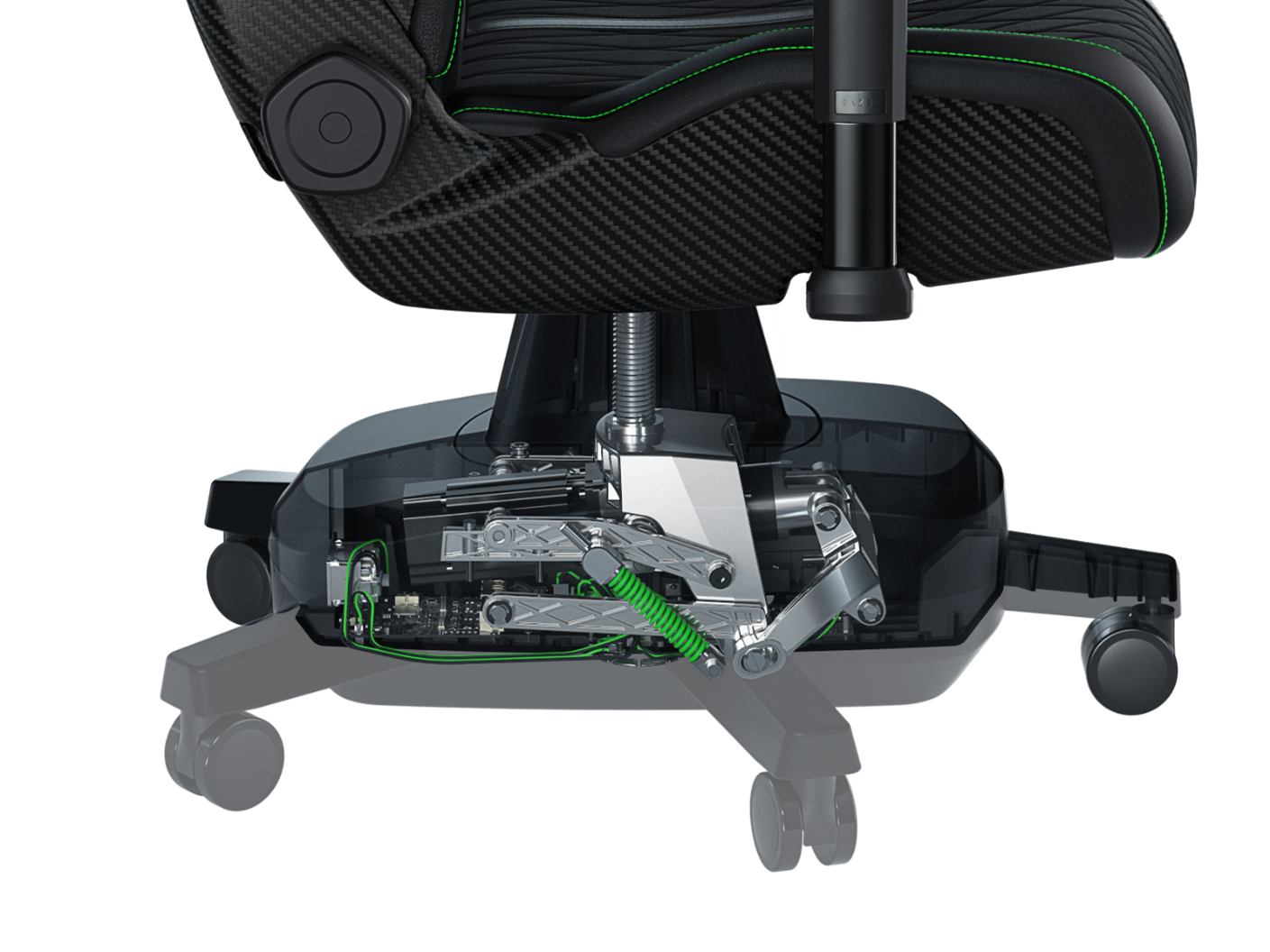
The Enki Pro HyperSense is based on the award-winning features that made previous models of the Enki gaming chair a favorite. It optimizes body touch points through a 22” ultrawide seat base, 100 degrees shoulder arches and built-in lumbar arch – providing optimal weight distribution and an ideal foundation for an all-encompassing HyperSense integration. The result is a chair that combines the best of haptic feedback with all-day gaming comfort, for a highly immersive, next-level gaming experience.
Using the latest technologies, both Project Sophia and the Enki Pro HyperSense add new dimensions to any gaming- and workspace, offering a glimpse into the future of the modern home setup. Project Sophia and the Enki Pro HyperSense are part of the continuing expansion of the Razer ecosystem, which includes the newly introduced Razer Chroma Smart Home Program that was also announced today.
PRODUCT ASSETS
Download Project Sophia Assets here
Download Enki Pro HyperSense Assets here
ABOUT RAZER
Razer™ is the world’s leading lifestyle brand for gamers.
The triple-headed snake trademark of Razer is one of the most recognized logos in the global gaming and esports communities. With a fan base that spans every continent, the company has designed and built the world’s largest gamer-focused ecosystem of hardware, software and services.
Razer’s award-winning hardware includes high-performance gaming peripherals and Blade gaming laptops.
Razer’s software platform, with over 150 million users, includes Razer Synapse (an Internet of Things platform), Razer Chroma RGB (a proprietary RGB lighting technology system supporting thousands of devices and hundreds of games/apps), and Razer Cortex (a game optimizer and launcher).
Razer also offers payment services for gamers, youth, millennials and Gen Z. Razer Gold is one of the world’s largest game payment services, and Razer Fintech provides fintech services in emerging markets.
Founded in 2005, Razer is headquartered in Irvine (California) with regional headquarters in Hamburg, Shanghai and Singapore. Razer has 18 offices worldwide and is recognized as the leading brand for gamers in the US, Europe and China. Razer is listed on the Hong Kong Stock Exchange (Stock Code: 1337).
about D-BOX
D-BOX creates and redefines realistic, immersive entertainment experiences by moving the body and sparking the imagination through effects: motion, vibration and texture. D-BOX has collaborated with some of the best companies in the world to deliver new ways to enhance great stories. Whether it’s movies, video games, music, relaxation, virtual reality applications, metaverse experience, themed entertainment or professional simulation, D-BOX creates a feeling of presence that makes life resonate like never before.
D-BOX Technologies Inc. (TSX: DBO) is headquartered in Montreal with offices in Los Angeles, USA and Beijing, China. Visit D-BOX.com