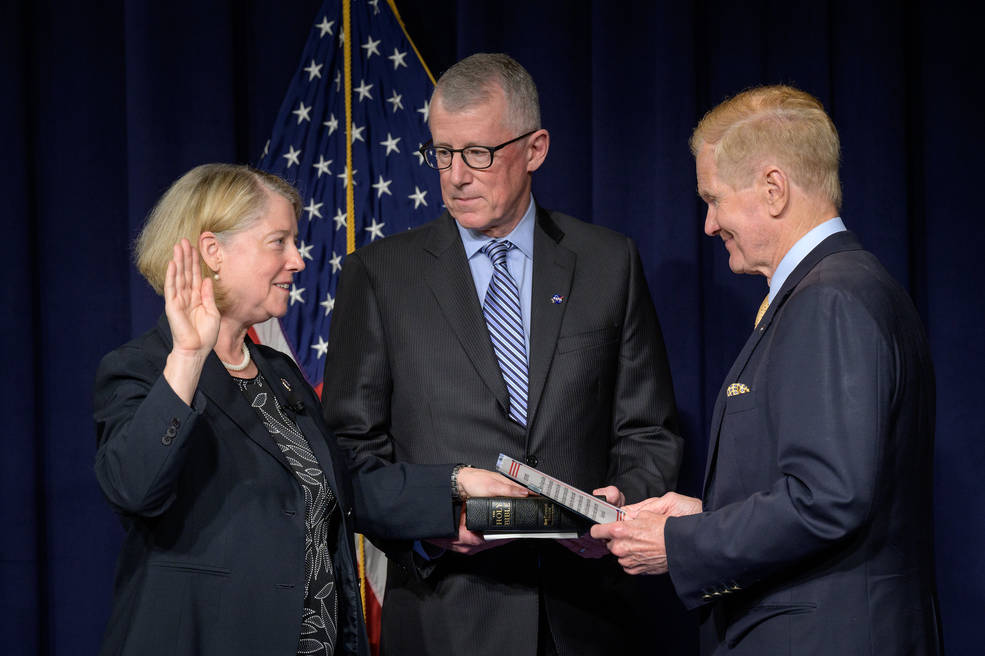
NASA Deputy Administrator Pam Melroy took office Monday after she was given the oath of office by NASA Administrator Bill Nelson during a ceremony at the Mary W. Jackson NASA Headquarters building in Washington.
“It is a joy to be back in the NASA family, the smartest and most dedicated workforce of any place that I’ve ever worked. I always knew this was the most exciting place to work from the time I was a child, inspired by the first landing on the Moon,” Melroy said. “I’m very honored to be teamed with Administrator Nelson and our Associate Administrator Bob Cabana and rest of the NASA team. We do have a lot of work to do, but it’s our intention not to just lead today’s NASA, but also lead us forward into the future and support the generations of fantastic things that NASA will continue to do.”
Melroy was nominated in April by President Biden and confirmed by the Senate on June 17. Along with Nelson, Melroy is responsible for providing overall leadership, planning, and policy direction for NASA.
“What a grand occasion for us! Pam is extremely skilled, experienced, and ready for this job,” Nelson said. “Pam is an ROTC graduate and an Air Force officer. She was one of two female test pilots for the Air Force and one of two female NASA astronaut commanders; she’s logged over 6,000 hours in aircraft and she has logged many, many days in space. And, now, Pam is the first woman astronaut to serve as deputy administrator here at NASA.”
“I can’t think of anybody more qualified to be the deputy administrator. Pam’s service this country is amazing, and it just gives me great pleasure to be able to work with you in this leadership team; I can’t say enough good things,” Associate Administrator Bob Cabana said. “It’s a real honor having Pam as part of this leadership team. We have a lot of work to do, so let’s get to it!”
“Pam was my boss for a good period of time, as we worked on advanced vehicles. And I can tell you this, the folks that are going to be working for Pam now are very fortunate. She’s incredibly competent – one of the best bosses I’ve ever had,” Sen. Mark Kelly said. “So, I’m looking forward to the next several years and beyond to see what NASA can accomplish. NASA has big goals: going back to the Moon and going on to Mars someday. It’s really exciting, and with Senator Nelson, Pam Melroy, and Bob Cabana, you guys have great leadership here, and the future looks great.”
“Pam is uniquely qualified to help lead NASA. It has been a privilege to work with Pam throughout her career, and now to see her assume this leadership role. I couldn’t be more proud,” said former NASA Administrator Maj. Gen. Charlie Bolden.
“Pam has integrity, humility, empathy, courage, and a sense of humor. And I remember many, many occasions where she was a person who would speak up. She would have the courage to come forward when it would have been just as easy to sit back. And she would always do it with some humor and some grace,” said Defense Advanced Research Projects Agency Administrator Stefanie Kelly. “I think that today, more than ever, those are qualities we need and I’m so proud of the fact that she is going to be helping to lead NASA.”
Melroy will perform the duties and exercises the powers delegated by the administrator, assist the administrator in making final agency decisions, and act for the administrator in his absence by performing all necessary functions to govern NASA operations. Melroy also is responsible for outlining the agency’s vision and representing NASA to the Executive Office of the President, Congress, heads of federal and other appropriate government agencies, international organizations, and external organizations and communities.
One of only two women to command a space shuttle, Melroy logged more than 38 days in space. She served as pilot on two flights, STS-92 in 2000 and STS-112 in 2002, and was the mission commander on STS-120 in 2007. All three of her missions were assembly missions to build the International Space Station.
After graduating from United States Air Force Test Pilot School, Melroy logged more than 6,000 flight hours in more than 50 different aircraft. She is a veteran of Operation Desert Shield/Desert Storm and Operation Just Cause, with more than 200 combat and combat support hours.
After serving more than two decades in the Air Force and as a NASA astronaut, Melroy took on a number of leadership roles, including at Lockheed Martin, the Federal Aviation Administration, the Defense Advanced Research Projects Agency, Nova Systems Pty, Australia, and as an advisor to the Australian Space Agency. She also served as an independent consultant and a member of the National Space Council’s Users Advisory Group.
She holds a bachelor’s degree in physics and astronomy from Wellesley College and a master’s degree in Earth and planetary sciences from the Massachusetts Institute of Technology.
For more information about NASA’s projects and missions, visit: