TVU Networks to Showcase 8K IP and Enhanced 5G REMI Solutions at NAB 2022

TVU Networks, the market and technology leader in cloud and IP-based live video solutions, has announced two significant developments with the company’s transmission technology that has been introduced at the 2022 NAB. TVU has adapted its TVU G-Link platform to now support low-latency, 8K IP video transmission over commodity internet connections, and new to the TVU Remote Production System (RPS) family is the TVU RPS Link Encoder which allows multi-channel REMI production over cellular networks.
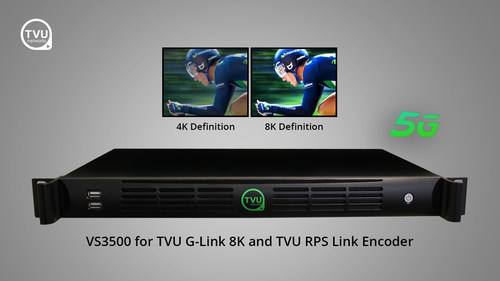
TVU G-Link is a powerful, point-to-point IP video transmission platform designed to provide high-quality, low-latency video over commodity internet connections. G-Link utilizes TVU’s renowned IS+ protocol, link aggregation, and HEVC VBR encoding to produce a stable transmission – even under harsh network conditions. While the TVU G-Link family already supports up to 10-bit 4k 50/60p, TVU has been able to quickly adapt the platform to support 8k 50/60p transmission. 8k support is currently a technology demonstration, but TVU expects to productize the solution in the future.
“The flexibility of our IS+ protocol and modular design that forms the basis of TVU G-Link made it easy to adapt the platform to support 8K encoding/decoding,” said Paul Shen, CEO, TVU Networks. “We are starting to see increased demand for 8K acquisition over IP for applications such as sports and event broadcasts. We’re very encouraged about the global need for this kind of enabling technology.”
The TVU G-Link platform uses the HEVC codec to encode at bit rates up to 300Mb/s with sub-second latency over the commercial internet. It also features VBR encoding for transmission stability on variable bandwidth connections and can transmit an 8K signal at as low as 60Mb/s.
Other TVU G-Link features:
- Encoder and decoder units are packaged in a 1RU chassis and feature 4 x 12G-SDI inputs (square division and 2SI mode) on the encoder and 4 x 12G-SDI outputs on the decoder with up to 16-channels of embedded audio
- When combined with TVU’s Rack Router, it can aggregate up to six 5G modems along with ethernet, WiFi, satellite or more to provide bandwidth in remote locations
- In addition to 8K transmission, the unit can also be adapted to multi-camera, synchronized 4K50/60p REMI production, providing a powerful solution for 4K sports, events or remote studio workflows.
Another multi-camera transmission breakthrough from TVU Networks is the TVU RPS line of multi-channel REMI solutions. Being introduced at NAB is the TVU RPS Link Encoder. The TVU RPS Link Encoder provides multi-camera, synchronized remote production capability (up to 1080p) using IS+ aggregating up to 12 connections, including embedded 5G/LTE modems, WIFI, ethernet or satellite. Ideal for use in remote locations where reliable wired IP connections are unavailable or inadequate, the TVU RPS Link Encoder features a 2RU chassis configurable for up to six 5G modems with external, high-gain antennas. RPS Link Encoder comes in both four-channel and six-channel models with up to two channels of return video.
The TVU RPS Link Encoder is compatible with the existing TVU RPS hardware decoder as well as TVU’s complete Cloud Production ecosystem, including the TVU Producer live production platform, TVU Partyline video collaboration tool and TVU Command Center for centralized signal monitoring. All RPS transmissions in the Cloud can be controlled and monitored using its built-in encoder web interface or via the TVU Command Center.
Other TVU RPS Link Encoder features include:
- Glass-to-glass latency over commodity internet as low as 500ms and low latency source preview (200-300ms) for CCU or remote camera operation
- H264 or HEVC encoding up to 15Mb/s per channel (VBR and CBR)
- VLAN tunnel connectivity for connecting IP-based peripherals between the studio and the field, including talkback systems, CCU, Switcher Tally, and remote camera
- H264 or HEVC encoding up to 15Mb/s per channel (VBR and CBR)
About TVU Networks®
TVU Networks is a global organization with more than 3,000 customers using its IP and cloud-based workflow solutions across multiple industries including news, entertainment media, sports, corporate, streaming, houses of worship and government. Through the use of AI and automation driven technology, TVU helps broadcasters realize an efficient metadata and story-centric workflow through its TVU MediaMind platform for live video content acquisition, indexing, production, distribution and management. The company has been on the forefront of developing the tools needed to revolutionize and streamline the Media Supply Chain. TVU is a critical part of the operations of many major media companies worldwide and is a Technology and Engineering Emmy® Award winner.