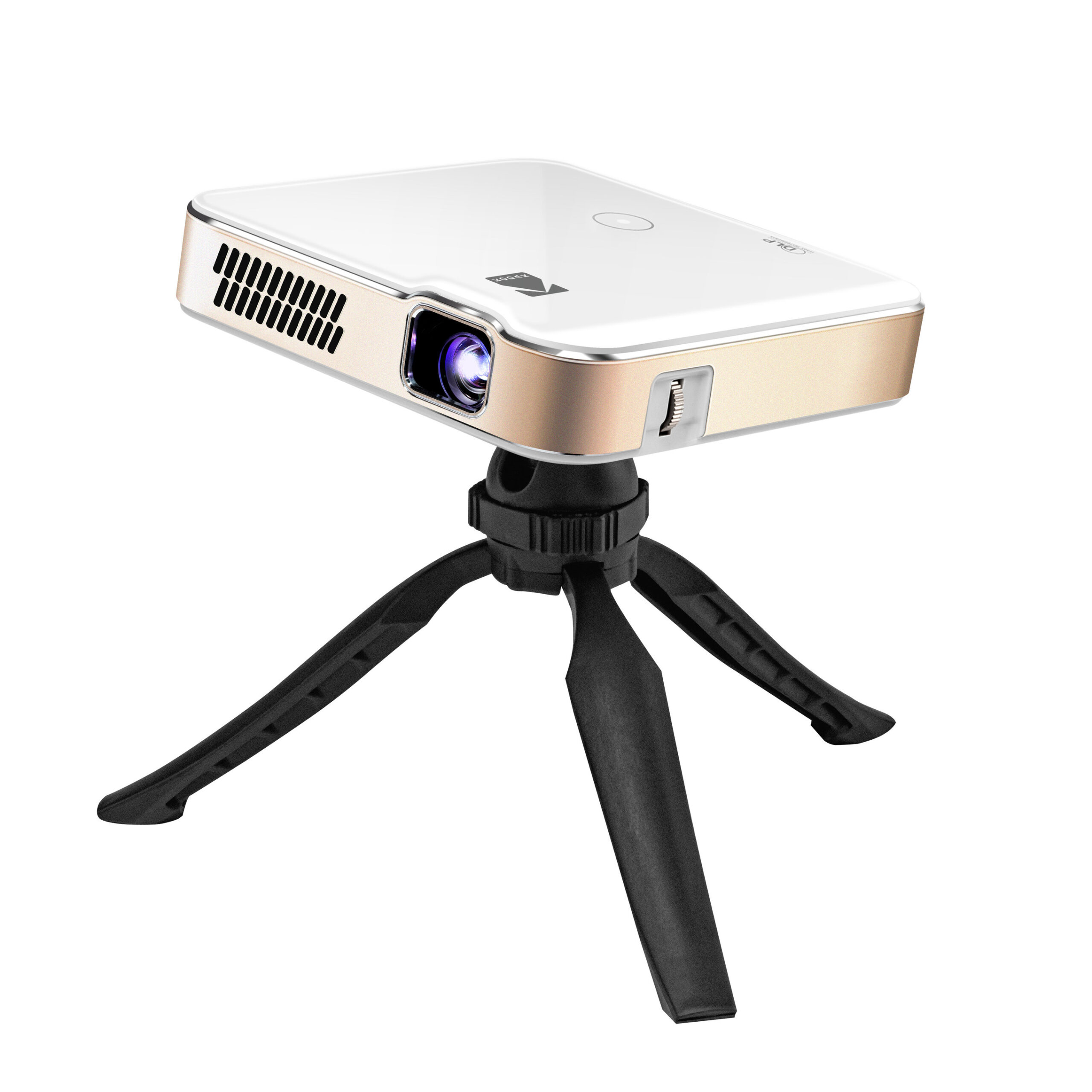
Today, C+A Global, an authorized brand licensee of Eastman Kodak Company, announced the availability of the KODAK LUMA 400 Portable HD Smart Projector; the newest addition to their LUMA line of projectors, which includes the LUMA 75, LUMA 150, LUMA 350 and LUMA 450, delivering big-screen quality with small-screen portability. Travel-friendly and equipped with a tripod, the LUMA 400 now available on Amazon, is perfect for recreating the movie theater experience in your backyard, camping trips and everywhere in between, allowing you to instantly stream your favorite movies and shows in HD.
The KODAK LUMA 400 offers a cinematic movie-watching experience from the comfort of your home, eliminating the enclosed movie theater space and complexities, at a time when safety and social distance is top of mind. Like its counterpart the LUMA 450, the LUMA 400 supports 4K resolution, HDMI®, VGA, USB, and SDTM card inputs that can be connected to various media devices to play movies, stream shows, view images, all in native 720p quality. Its compact size and longer battery life of 2.5 hours, lets you take the big picture anywhere.
“The new LUMA 400 brings Kodak’s unmatched heritage in motion pictures into a contemporary context,” said Clara Fort, VP of Brand Licensing at Kodak. “We are proud to collaborate with partners like C+A Global who are bringing exciting technology to today’s consumers.”
A truly all-in-one theater system, the KODAK LUMA 400 can project up to 150″ inches onto any clear surface and is equipped with dual 1-Watt speakers for an optimal listening experience. The projector comes equipped with a tripod, power cable, HDMI cable, DC adapter, and is compatible with TV smart sticks, Chromecast, USB drives, smartphones, laptops and more. By downloading the KODAK LUMA companion app, users can now use their phone as a remote control.
The KODAK LUMA 400 is available now for $449.99.
For more info, please visit kodakphotoplus.com or to receive a media kit review unit, please contact Cat Soroush at [email protected].
About C+A Global
C&A Marketing, Inc., doing business as C+A Global, is a leading manufacturer, distributor and online reseller of consumer products, electronics, cameras, and photographic equipment. Headquartered in Edison, N.J, C+A Global operates with over 50+ years of industry experience in its management team. The depth and breadth of C+A Global’s inventory is constantly expanding, as is its presence and reputation in the consumer products marketplace.
For additional information on these Kodak products, visit us at kodakphotoplus.com, follow us on Twitter @KodakPlus, like us on Facebook at Kodak Plus, and follow @KodakPlus on Instagram.
SOURCE C+A Global