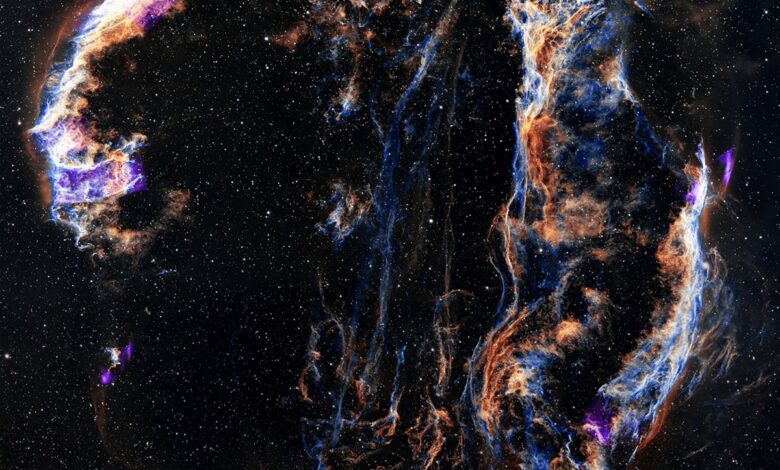
The Cygnus Loop, also known as the Veil Nebula, is a supernova remnant – the remains of the explosive death of a massive star. Studying images like these leads to discovery, but NASA’s Chandra X-ray Observatory provides another way to experience this data: three-dimensional (3D) models that allow people to explore – and print – examples of stars in the early and end stages of their lives.
The 3D model of the Cygnus Loop is the result of a simulation describing the interaction of a blast wave from the explosion with an isolated cloud of the interstellar medium (that is, dust and gas in between the stars). Chandra sees the blast wave and other material that has been heated to millions of degrees. These 3D models are based on state-of-the-art theoretical models, computational algorithms, and observations from space-based telescopes like Chandra that give us accurate pictures of these cosmic objects and how they evolve over time.
See more 3D printable models of cosmic objects.
Image credit: X-ray: NASA/SAO/CXC; Optical: John Stone (Astrobin); Image Processing: NASA/SAO/CXC/L. Frattre, N. Wolk
About The Author