ispace, inc. (ispace) (TOKYO: 9348), a global lunar exploration company, announced today that its RESILIENCE lunar lander successfully entered lunar orbit on May 7, 2025,at 5:41 a.m. JST (May 6, 2025, 20:41 UTC). This marks the completion of Success 7 milestone of Mission 2 “SMBC x HAKUTO-R Venture Moon.”
ispace engineers performed the injection maneuver from the Mission Control Center in Nihonbashi, Tokyo, Japan in accordance with the mission operation plan. The orbital maneuver required a main thruster burn lasting approximately 9 minutes, the longest to date during Mission 2. RESILIENCE is now maintaining a stable attitude in its planned orbit above the lunar surface. Mission operations specialists are now preparing for final orbit maneuvers after reaffirming ispace’s ability to deliver spacecraft and payloads into lunar orbit. A lunar landing is scheduled for no earlier than June 5, 2025 (UTC) (June 6, 2025, JST).
“First and foremost, we are extremely pleased that the RESILIENCE lander successfully reached lunar orbit as planned today,” said Takeshi Hakamada, Founder & CEO of ispace. “We have successfully completed maneuvers so far by leveraging the operational experience gained in Mission 1, and I am very proud of the crew for successfully completing the most critical maneuver and entering lunar orbit. We will continue to proceed with careful operations and thorough preparations to ensure the success of the lunar landing.”
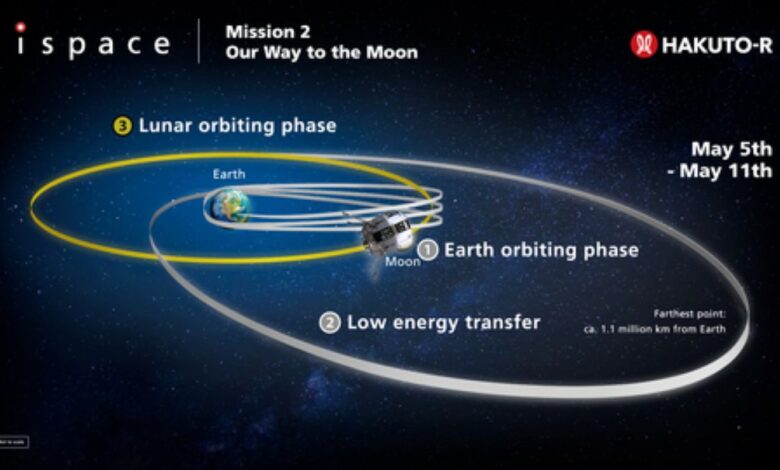
Previously, RESILIENCE completed all deep space orbital maneuvers at 10:00 UTC on April 24, 2025, returning the lander from deep space near to the Moon in order to complete the orbit injection. At its furthest distance, RESILIENCE was 1.1 million kilometers from Earth. Before that RESILIENCE completed a lunar flyby, verifying operation of the main propulsion system, as well as the related guidance, control, and navigation system. Following the flyby, the lander continued its deep space journey, spending approximately two months in a low-energy transfer orbit.
RESILIENCE was launched on a SpaceX Falcon 9 rocket at 6:11:39 UTC, Jan. 15, 2025, and was successfully deployed from the rocket at 7:44:24 UTC. The RESILIENCE lander has completed the Earth orbit (Phase 1 in the figure) as well as the lunar flyby, known as Success 5. It has completed the low energy transfer orbit (Phase 2 in the figure) with completion of all deep space maneuvers and is now in lunar orbit.
Mission 2 Milestones
ispace has released a transparent set of criteria known as Mission 2 Milestones between launch and landing and aims to achieve the success criteria established for each of these milestones. The results from this mission as part of the HAKUTO-R lunar exploration program, will be weighed and evaluated against the criteria and lessons learned will be incorporated into future missions already in development.
| Milestone | Milestone Success Criteria | ||
| Success 1 | Complete | Completion of Launch Preparations | Complete all development processes of the RESILIENCE lunar lander before flight operationsContract and prepare launch vehicle, and complete integration of lunar lander into the launch vehicleProve ability to flexibly manufacture and assemble landers in various geographic locations of the world |
| Success 2 | Complete | Completion of Launch and Deployment | Complete successful separation of the lunar lander from the launch vehicleReaffirm that ispace’s lander design and structure is capable of withstanding the harsh conditions during launch on its second mission, offering valuable information towards future development and missions |
| Success 3 | Complete | Establishment of Steady Operation State | Establish communication link between the lander and Mission Control Center, confirm a stable attitude as well as start stable generation of electrical power in orbit |
| Success 4 | Complete | Completion of first Orbital Control Maneuver | Complete the first orbit control maneuver, setting the lander on a course towards the Moon |
| Success 5 | Complete | Completion of Lunar Flyby | Complete a lunar flyby approximately one month after launchBegin Deep Space Flight operations |
| Success 6 | Complete | Completion of all Deep-Space Orbital Control Maneuvers before LOI | Complete all planned deep space orbit control maneuvers by utilizing gravity assist effects and successfully target the first lunar orbit insertion maneuverReaffirm the deep-space survivability of ispace’s lander designs, as well as the viability of space’s lunar planning |
| Success 7 | Complete | Enter Lunar Orbit | Complete the first lunar orbit insertion maneuver and confirm that the lander is in a lunar orbitReaffirm the ability of ispace to deliver spacecraft and payloads into stable lunar orbits |
| Success 8 | Completion of all Orbital Control Maneuvers in lunar orbit | Complete all planned lunar orbital control maneuvers before the landing sequenceConfirm the lander is ready to start the landing sequence | |
| Success 9 | Completion of Lunar Landing Sequence | Complete the landing sequence, verifying key landing abilities for future missions | |
| Success 10 | Establish Steady System after Landing | Establish a steady telecommunication and power supply on the lunar surface after landing |
Mission 2 Payloads
On board the RESILIENCE lunar lander will be commercial customer payloads including:
- Water electrolyzer equipment: From Takasago Thermal Engineering Co.
- Food production experiment: A self-contained module from Euglena Co.
- Deep space radiation probe: Developed by the Department of Space Science and Engineering, National Central University, Taiwan
- Commemorative alloy plate: Developed by Bandai Namco Research Institute, Inc. and modeled after “Charter of the Universal Century” from the animation Mobile Suit Gundam UC
- TENACIOUS micro rover: Developed by ispace-EUROPE, this rover will explore the landing site, collect lunar regolith, and relay data back to the lander. It will be equipped with a forward-mounted HD camera and a shovel.
- Moonhouse: A model house by Swedish artist Mikael Genberg that will be mounted on the rover.
The RESILIENCE lander will serve as a cultural artifact, carrying a UNESCO memory disk that preserves linguistic and cultural diversity.
ispace is leveraging its global presence through its three business units in Japan, the U.S., and Luxembourg, for the simultaneous development of upcoming missions. Mission 2, featuring the RESILIENCE lunar lander, is led by ispace Japan and was launched on Jan. 15, 2025. In this mission, TENACIOUS micro rover developed by ispace Europe SA to be deployed on the lunar surface to conduct technological demonstration of regolith extraction as well as mobility on the lunar surface Mission 3, debuting the APEX 1.0 lunar lander, is led by ispace-U.S. and is expected to launch in 2026. The company’s fourth mission, which will utilize the Series 3 lander, currently being designed in Japan, is scheduled to be launched by 2027.
About ispace, inc. (https://ispace-inc.com)
ispace, a global lunar resource development company with the vision, “Expand our planet. Expand our future.”, specializes in designing and building lunar landers and rovers. ispace aims to extend the sphere of human life into space and create a sustainable world by providing high-frequency, low-cost transportation services to the Moon. The company has business entities in Japan, Luxembourg, and the United States with more than 300 employees worldwide. For more information, visit: www.ispace-inc.com and follow us on X: @ispace_inc.
About The Author