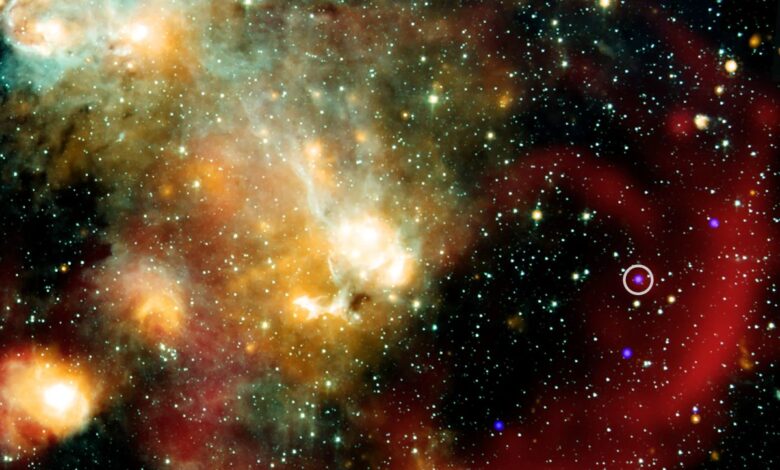
An unusual star (circled in white at right) behaving like no other seen before and its surroundings are featured in this composite image released on May 28, 2025. A team of astronomers combined data from NASA’s Chandra X-ray Observatory and the Square Kilometer Array Pathfinder (ASKAP) radio telescope on Wajarri Country in Australia to study the discovered object, known as ASKAP J1832−0911 (ASKAP J1832 for short).
ASKAP J1832 belongs to a class of objects called “long period radio transients” discovered in 2022 that vary in radio wave intensity in a regular way over tens of minutes. This is thousands of times longer than the length of the repeated variations seen in pulsars, which are rapidly spinning neutron stars that have repeated variations multiple times a second. ASKAP J1832 cycles in radio wave intensity every 44 minutes, placing it into this category of long period radio transients. Using Chandra, the team discovered that ASKAP J1832 is also regularly varying in X-rays every 44 minutes. This is the first time that such an X-ray signal has been found in a long period radio transient.
Image credit: X-ray: NASA/CXC/ICRAR, Curtin Univ./Z. Wang et al.; Infrared: NASA/JPL/CalTech/IPAC; Radio: SARAO/MeerKAT; Image processing: NASA/CXC/SAO/N. Wolk
About The Author