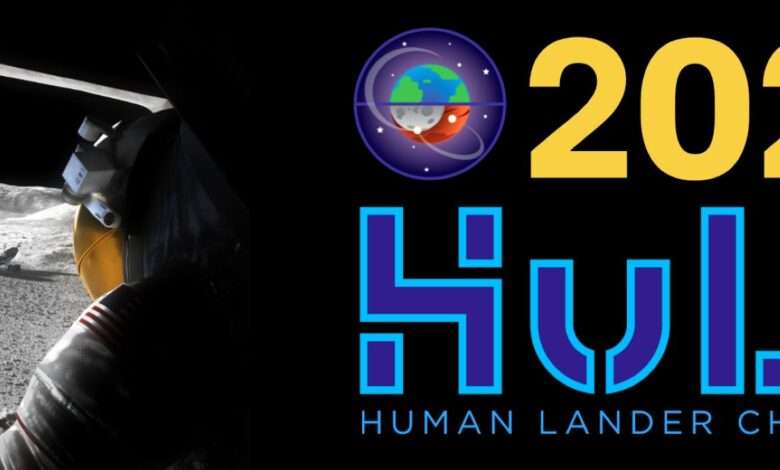
NASA’s 2026 Human Lander Challenge is seeking ideas from college and university students to help evolve and transform technologies for life support and environmental control systems. These systems are critical for sustainable, long-duration human spaceflight missions to the Moon, Mars, and beyond.
The Human Lander Challenge supports NASA’s efforts to foster innovative solutions to a variety of areas for NASA’s long-duration human spaceflight plans at the Moon under the Artemis campaign. The Human Lander Challenge is sponsored by the Human Landing System Program within the Exploration Systems Development Mission Directorate.
The 2026 competition invites undergraduate and graduate-level teams based in the U.S., along with their faculty advisors, to develop innovative, systems-level solutions to improve aspects for a lander’s ECLSS (Environmental Control and Life Support System) performance. These air, water, and waste systems provide vital life support so future Artemis astronauts can live and work safely and effectively on the Moon during crewed missions.
Each proposed solution should focus on one of the following long-duration ECLSS subtopics:
- Noise suppression and control
- Sensor reduction in hardware health monitoring systems
- Potable water dispenser
- Fluid transfer between surface assets on the Moon and Mars
“A robust ECLSS transforms a spacecraft like a lander from just hardware into a livable environment, providing breathable air, clean water, and safe conditions for astronauts as they explore the Moon,” said Kevin Gutierrez, acting office manager for the Human Landing Systems Missions Systems Management Office at NASA Marshall. “Without ECLSS we can’t sustain human presence on the Moon or take the next steps toward Mars. The subtopics in the 2026 Human Lander Challenge reflect opportunities for students to support the future of human spaceflight.”
2026 Competition
Teams should submit a non-binding notice of intent by Monday, Oct. 20, if they intend to participate. Proposal packages are due March 4, 2026.
Based on proposal package evaluations in Phase 1, up to 12 finalist teams will be selected to receive a $9,000 stipend and advance to Phase 2 of the competition, which includes a final design review near NASA’s Marshall Space Flight Center in Huntsville, Alabama, June 23-25, 2026. The top three placing teams from Phase 2 will share a total prize of $18,000.
Landers are in development by SpaceX and Blue Origin as transportation systems that will safely ferry astronauts from lunar orbit to the Moon’s surface and back for the agency’s Artemis campaign. NASA Marshall manages the Human Landing System Program.
The challenge is administered by the National Institute of Aerospace on behalf of the agency.
Through the agency’s Artemis campaign, NASA will send astronauts to explore the Moon for scientific discovery, economic benefits, and to build the foundation for the first crewed missions to Mars – for the benefit of all.
For more information on NASA’s Human Lander Challenge and how to participate, visit:
About The Author