NASA and its partners recently tested a tool for remotely piloted operations that could enable operators to transport people and goods more efficiently within urban areas.
The team’s goal is to ensure that when these remotely piloted aircraft – including electric vertical takeoff and landing vehicles (eVTOLs) – take to the skies, air traffic controllers won’t be overburdened by increased flight operations and safety is maintained across the national airspace.
On Aug. 21, NASA’s Air Traffic Management eXploration Project (ATM-X) assisted Wisk Aero when they flew a Bell 206 helicopter in Hollister, California. The purpose of the flight test was to evaluate and fine-tune a ground-based radar developed by Collins Aerospace. The radar, which provides aircraft location data, could be used during future remotely piloted operations to detect and avoid other aircraft in the vicinity. NASA, Wisk, and Collins researchers also used the flight to test data exchange capabilities across different geographic locations between the groups, a critical capability for future remotely piloted operators in a shared airspace. This work builds on a November 2024 flight test NASA performed with Reliable Robotics and Collins Aerospace.
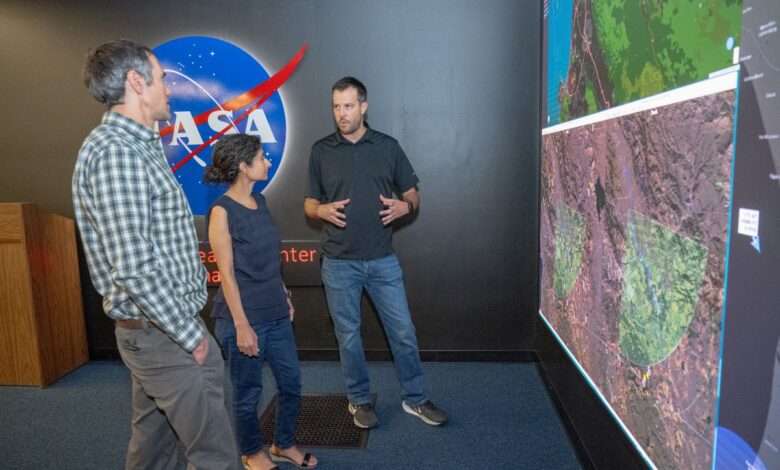
Initial analysis of the August testing of Collins’ ground-based radar actively and accurately surveilled the airspace during the aircraft’s flight test. The Collins radar system also successfully transmitted these data to NASA’s Mission Visualization Research Command Center lab at NASA’s Ames Research Center in California’s Silicon Valley. NASA, Wisk, and Collins will further analyze the flight data to better understand the radar’s performance and data exchange capabilities for future remotely piloted flight tests. This testing is a part of ATM-X’s remotely piloted testing campaign, designed to identify the infrastructure and technologies needed for the Federal Aviation Administration to safely integrate drones and air taxis into the airspace, bringing the movement of people and goods off the ground, and into the sky.
Remotely piloted eVTOL aircraft could bridge the gap for urban communities by offering a more affordable and accessible method of transportation and delivery services in congested, highly-populated areas.
NASA and Wisk will continue to collaborate on emerging eVTOL technologies to safely integrate advanced aircraft, into the national airspace. Together, the teams will gather data on eVTOL performance and characteristics during a flight test of a helicopter, which will act as a “surrogate” simulating an eVTOL flight. This work will mark another critical step towards better connecting communities across the globe.
About The Author