From the voyages of spacecraft to the Moon and beyond, to the launches of satellites that help us navigate, communicate, and understand our planet and the universe, the use of liquid-fueled rockets has been key to humanity’s use and exploration of space. Today marks 100 years since the first successful test of this technology.
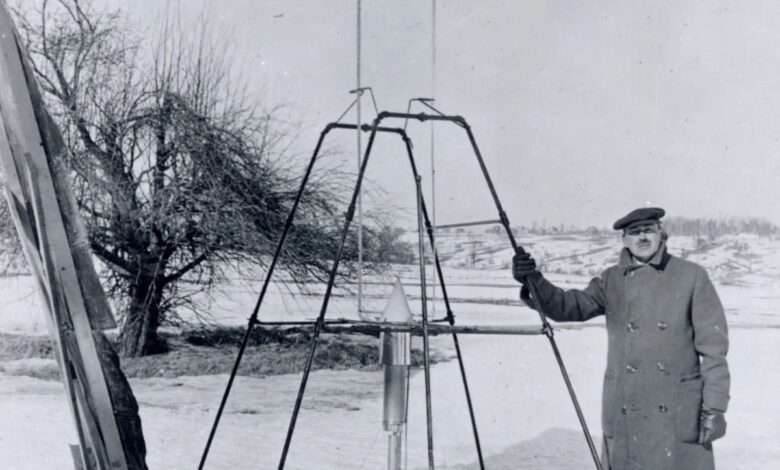
On March 16, 1926, physicist and inventor Dr. Robert H. Goddard achieved a small but significant success when he launched a liquid-fueled rocket for the first time. His rocket, fueled by liquid oxygen and gasoline, was tested at his Aunt Effie’s farm in Auburn, Massachusetts.
While unimpressive by most measures—the rocket flew for just 2.5 seconds, reaching 41 feet (12.5 meters) in altitude and landing in a cabbage patch 184 feet (56 meters) away—it was a breakthrough that heralded the exploration of space.
Over his lifetime, Goddard improved on his design and went on to create other technologies for space travel, including systems to steer rockets, pumps for rocket fuels, and engines that could pivot for better control. His pioneering work laid an important foundation for our achievements in space today.
Photo Credit: Esther Goddard, from the Clark University archive.
About The Author