
NASA
-
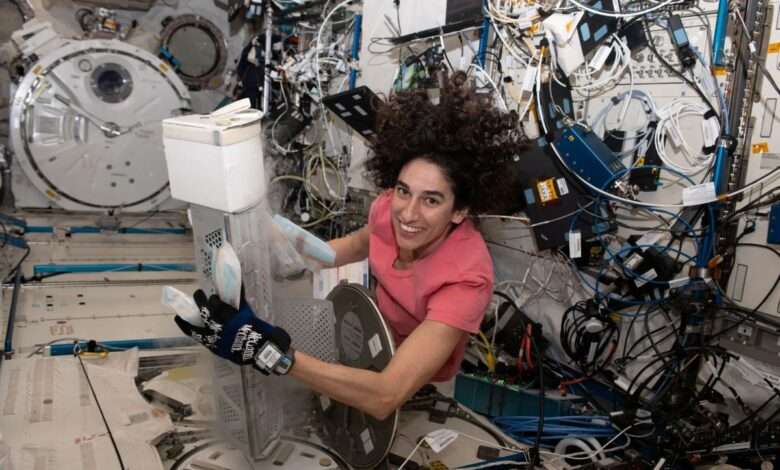
25 Years in Orbit: Science, Innovation, and the Future of Exploration
NASA and its partners have supported humans continuously living and working in space since November 2000. A truly global endeavor, the International Space Station has been visited by more than 290 people from 26 countries and a variety of international and commercial spacecraft. The unique microgravity laboratory has hosted more than 4,000 experiments from over 5,000 researchers from 110 countries.…
Read More » -
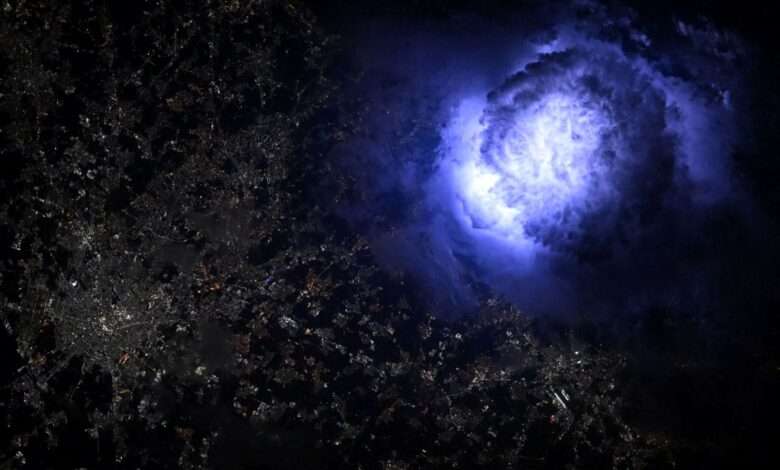
Lightning from Above
NASA astronaut Nichole Ayers captured this image of lightning while orbiting aboard the International Space Station more than 250 miles above Milan, Italy on July 1, 2025. Storm observations from space station help scientists study Earth’s upper atmosphere, which can improve weather models and protect communication systems and aircraft. Space station crew take photographs of Earth that record how the…
Read More » -

Algae Swirls Across a South African Reservoir
On clear days in Hartbeespoort, South Africa, satellite images often reveal a reservoir with shades of deep blue interrupted by drifting patches of vivid green. These shifting features indicate algae blooms, which can affect water quality, ecosystems, and nearby human communities. In this animation, from June 2022 to July 2023, an algal bloom grows, moves around the reservoir, and then…
Read More » -

NASA Awards Launch Range Contract for Wallops Flight Facility
NASA has selected ARES Technical Services Corporation of McLean, Virginia, to provide launch range operations support at the agency’s Wallops Flight Facility in Virginia. The Wallops Range Contract has a total potential value of $339.8 million with a one-year base period expected to begin Tuesday, Feb. 10, and four one-year option periods that if exercised would extend it to 2031.…
Read More » -
Supernova Remnant Video From NASA’s Chandra Is Decades in Making
Play Video A new video shows changes in Kepler’s Supernova Remnant using data from NASA’s Chandra X-ray Observatory captured over more than two and a half decades with observations taken in 2000, 2004, 2006, 2014, and 2025. In this video, which is the longest-spanning one ever released by Chandra, X-rays (blue) from the telescope have been combined with an optical…
Read More » -
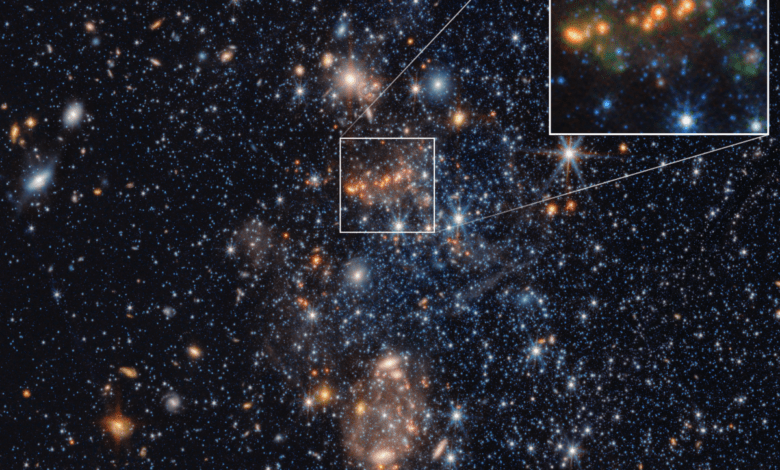
NASA Webb Finds Early-Universe Analog’s Unexpected Talent for Making Dust
Using NASA’s James Webb Space Telescope, astronomers have spotted two rare kinds of dust in the dwarf galaxy Sextans A, one of the most chemically primitive galaxies near the Milky Way. The finding of metallic iron dust and silicon carbide (SiC) produced by aging stars, along with tiny clumps of carbon-based molecules, shows that even when the universe had only…
Read More » -

NASA Marshall Prepares for Demolition of Historic Test, Simulation Facilities
NASA is preparing for the demolition of three iconic structures at the agency’s Marshall Space Flight Center in Huntsville, Alabama. Crews began demolition in mid-December at the Neutral Buoyancy Simulator, a facility built in the late 1960s that once enabled NASA astronauts and researchers to experience near-weightlessness. The facility was also used to conduct underwater testing of space hardware and…
Read More » -
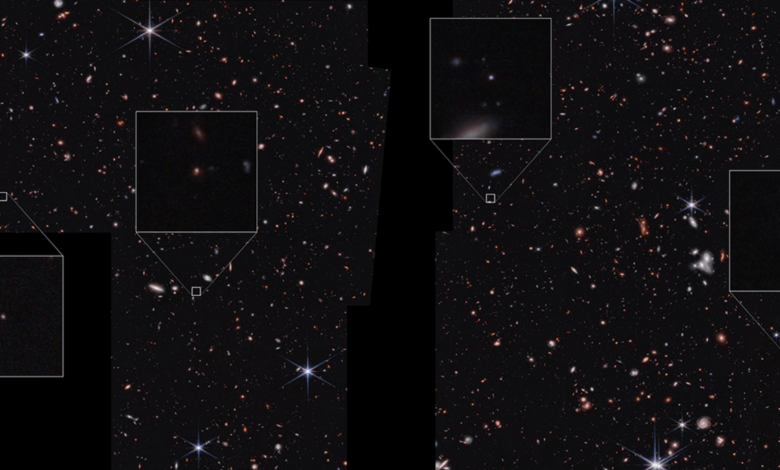
Scientists Identify ‘Astronomy’s Platypus’ with NASA’s Webb Telescope
After combing through NASA’s James Webb Space Telescope’s archive of sweeping extragalactic cosmic fields, a small team of astronomers at the University of Missouri says they have identified a sample of galaxies that have a previously unseen combination of features. Principal investigator Haojing Yan compares the discovery to an infamous oddball in another branch of science: biology’s taxonomy-defying platypus. “It seems…
Read More » -
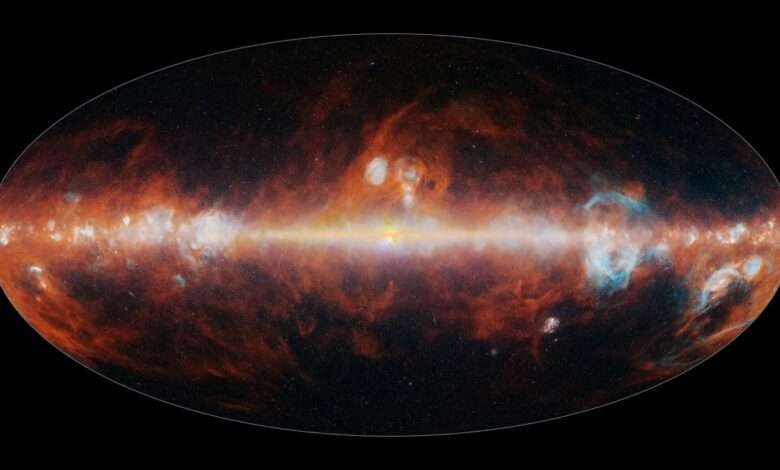
First Sky Map from NASA’s SPHEREx Observatory
NASA’s SPHEREx Observatory has mapped the entire sky in 102 infrared colors, as seen here in this image released on Dec. 18, 2025. This image features a selection of colors emitted primarily by stars (blue, green, and white), hot hydrogen gas (blue), and cosmic dust (red). While not visible to the human eye, these 102 infrared wavelengths of light are prevalent…
Read More » -
Diving Into Human Spaceflight Safety with NASA Johnson’s Craig Shannon
Growing up in Houston, Craig Shannon was always inspired by NASA and the spirit of exploration the agency represents. Yet it was a passion for scuba diving that unexpectedly led to his more than 23-year career at NASA’s Johnson Space Center. Shannon became a certified diver and scuba instructor while earning his bachelor’s degree in communications from Stephen F. Austin…
Read More »