
NASA
-

Apollo 13 Launch: 55 Years Ago
NASA astronauts Jim Lovell, Fred Haise, and Jack Swigert launch aboard the Apollo 13 spacecraft from NASA’s Kennedy Space Center in Florida on April 11, 1970. The mission seemed to be going smoothly until 55 hours and 55 minutes in when an oxygen tank ruptured. The new mission plan involved abandoning the Moon landing, looping around the Moon and getting the crew home safely…
Read More » -
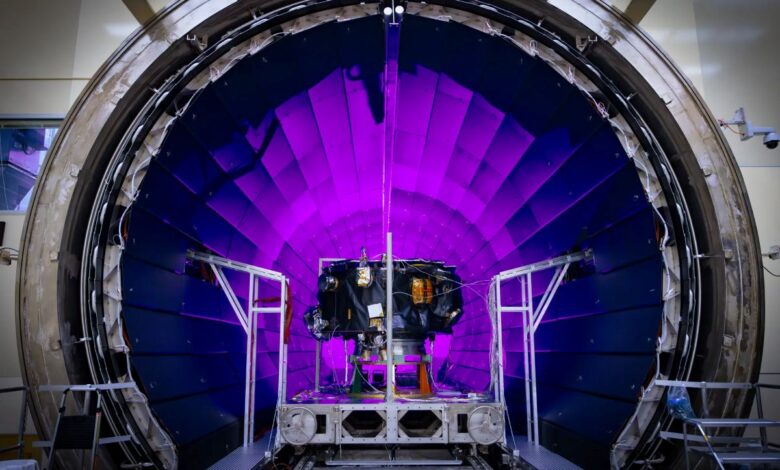
NASA’s IMAP Arrives at NASA Marshall For Testing in XRCF
On March 18, NASA’s IMAP (Interstellar Mapping and Acceleration Probe) arrived at NASA’s Marshall Space Flight Center in Huntsville, Alabama, for thermal vacuum testing at the X-ray and Cryogenic Facility, which simulates the harsh conditions of space. The IMAP mission is a modern-day celestial cartographer that will map the solar system by studying the heliosphere, a giant bubble created by the…
Read More » -
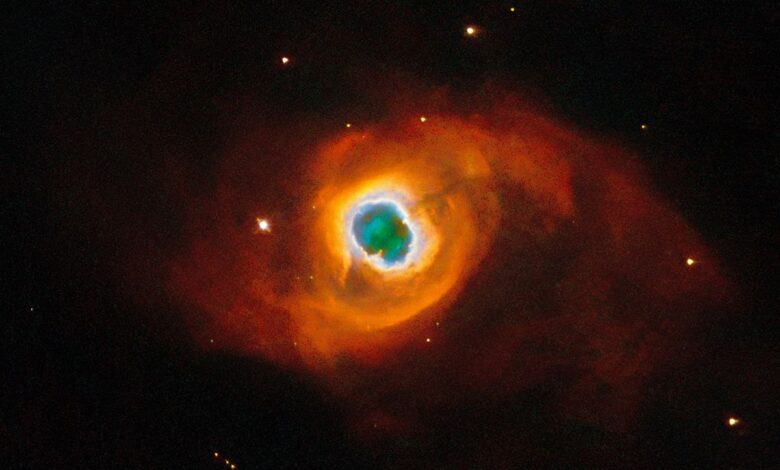
Hubble Captures a Star’s Swan Song
The swirling, paint-like clouds in the darkness of space in this stunning image seem surreal, like a portal to another world opening before us. In fact, the subject of this NASA/ESA Hubble Space Telescope image is very real. We are seeing vast clouds of ionized atoms thrown into space by a dying star. This is a planetary nebula named Kohoutek 4-55, a…
Read More » -

How NASA Science Data Defends Earth from Asteroids
The asteroid 2024 YR4 made headlines in February with the news that it had a chance of hitting Earth on Dec. 22, 2032, as determined by an analysis from NASA’s Center for Near Earth Object Studies (CNEOS) at the agency’s Jet Propulsion Laboratory in Southern California. The probability of collision peaked at over 3% on Feb. 18 — the highest…
Read More » -

New York Math Teacher Measures Trees & Grows Scientists with GLOBE
When students actively participate in scientific investigations that connect to their everyday lives, something powerful happens: they begin to see themselves as scientists. This sense of relevance and ownership can spark a lifelong interest in science, technology, engineering, and math (STEM), paving the way for continued education and even future careers in these fields. Opportunities to engage directly with NASA…
Read More » -

NASA’s SpaceX 32nd Resupply Mission Launches New Research to Station
NASA and SpaceX are launching the company’s 32nd commercial resupply services mission to the International Space Station later this month, bringing a host of new research to the orbiting laboratory. Aboard the SpaceX Dragon spacecraft are experiments focused on vision-based navigation, spacecraft air quality, materials for drug and product manufacturing, and advancing plant growth with less reliance on photosynthesis. This…
Read More » -
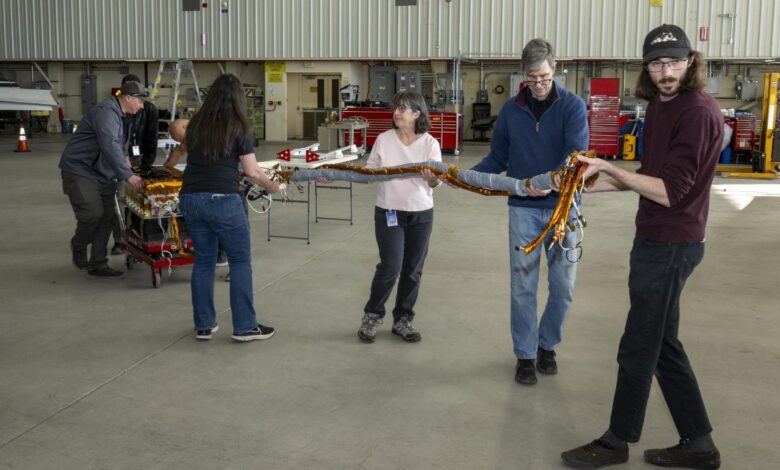
NASA Measures Moonlight to Improve Earth Observations
Flying high above the clouds and moon-gazing may sound like a scene from a timeless romance, but NASA did just that in the name of Earth science research. In March 2025 pilots took the agency’s ER-2 science aircraft on a series of night flights over NASA’s Armstrong Flight Research Center in Edwards, California, as the Moon increased in visible size.…
Read More » -

Have We Been to Uranus? We Asked a NASA Expert: Episode 56
Have we ever been to Uranus? The answer is simple, yes, but only once. The Voyager II spacecraft flew by the planet Uranus back in 1986, during a golden era when the Voyager spacecraft explored all four giant planets of our solar system. It revealed an extreme world, a planet that had been bowled over onto its side by some…
Read More » -
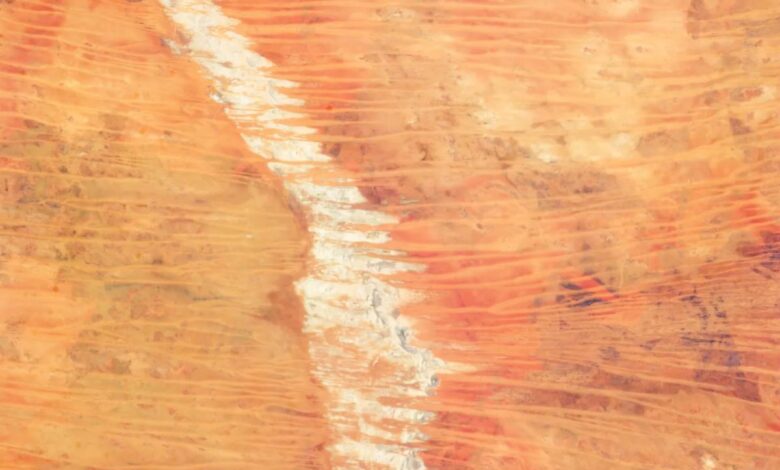
Linear Sand Dunes in the Great Sandy Desert
On March 25, 2013, an astronaut aboard the International Space Station took this photo of the Great Sandy Desert in northwest Australia, showcasing linear dunes separated in a roughly regular fashion. When you fly over such dune fields—either in an airplane or the space station—the fire scars stand out. Where thin vegetation has been burned, the dunes appear red from the…
Read More » -

NASA’s Perseverance Mars Rover Studies Trove of Rocks on Crater Rim
The diversity of rock types along the rim of Jezero Crater offers a wide glimpse of Martian history. Scientists with NASA’s Perseverance rover are exploring what they consider a veritable Martian cornucopia full of intriguing rocky outcrops on the rim of Jezero Crater. Studying rocks, boulders, and outcrops helps scientists understand the planet’s history, evolution, and potential for past or…
Read More »