
NASA
-
NASA’s Dust Shield Successfully Repels Lunar Regolith on Moon
NASA’s Electrodynamic Dust Shield (EDS) successfully demonstrated its ability to remove regolith, or lunar dust and dirt, from its various surfaces on the Moon during Firefly Aerospace’s Blue Ghost Mission 1, which concluded on March 16. Lunar dust is extremely abrasive and electrostatic, which means it clings to anything that carries a charge. It can damage everything from spacesuits and…
Read More » -
NASA, NSIDC Scientists Say Arctic Winter Sea Ice at Record Low
Ice cover ebbs and flows through the seasons in the Arctic (left) and the Antarctic (right). Overall, ice cover has declined since scientists started tracking it half a century ago. Download this visualization from NASA’s Scientific Visualization Studio: https://svs.gsfc.nasa.gov/5099 Trent Schindler/NASA’s Scientific Visualization Studio Winter sea ice cover in the Arctic was the lowest it’s ever been at its annual…
Read More » -

Finding Clues in Ruins of Ancient Dead Star With NASA’s Chandra
People often think about archaeology happening deep in jungles or inside ancient pyramids. However, a team of astronomers has shown that they can use stars and the remains they leave behind to conduct a special kind of archaeology in space. Mining data from NASA’s Chandra X-ray Observatory, the team of astronomers studied the relics that one star left behind after…
Read More » -
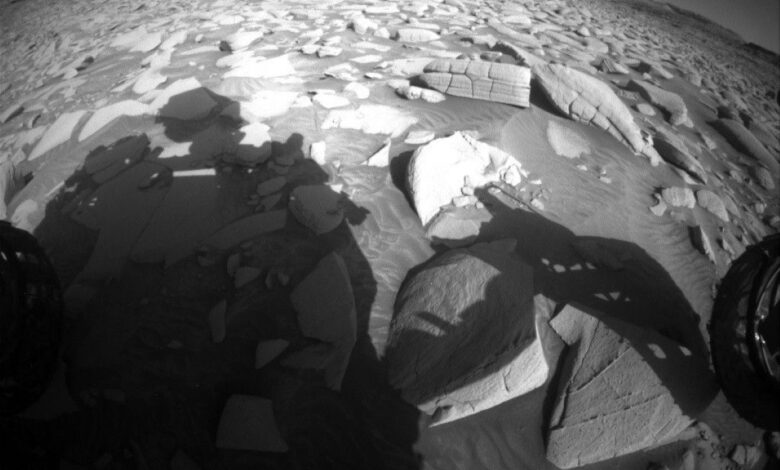
Sols 4491-4492: Classic Field Geology Pose
Written by Lauren Edgar, Planetary Geologist at USGS Astrogeology Science Center Earth planning date: Monday, March 24, 2025 If you’ve ever seen a geologist in the field, you may have seen a classic stance: one leg propped up on a rock, knee bent, head down looking at the rocks at their feet, and arm pointing to the distant stratigraphy. Today…
Read More » -

NASA’s X-59 Completes ‘Cruise Control’ Engine Speed Hold Test
The team behind NASA’s X-59 completed another critical ground test in March, ensuring the quiet supersonic aircraft will be able to maintain a specific speed during operation. The test, known as engine speed hold, is the latest marker of progress as the X-59 nears first flight this year. “Engine speed hold is essentially the aircraft’s version of cruise control,” said…
Read More » -

Norman Rockwell Commemorates Gemini Program with Grissom and Young
In his painting called Grissom and Young, American painter and illustrator Norman Rockwell captures technicians helping NASA astronauts John Young and Gus Grissom suit up for the first flight of the Gemini program in March 1965. NASA loaned Norman Rockwell a Gemini spacesuit to make this painting as accurate as possible. Since its beginning, NASA has used the power of art to communicate the extraordinary…
Read More » -
How Can I See the Northern Lights? We Asked a NASA Expert: Episode 54
How can I see the northern lights? To see the northern lights, you need to be in the right place at the right time. Auroras are the result of charged particles and magnetism from the Sun called space weather dancing with the Earth’s magnetic field. And they happen far above the clouds. So you need clear skies, good space weather…
Read More » -

NASA Starling and SpaceX Starlink Improve Space Traffic Coordination
As missions to low Earth orbit become more frequent, space traffic coordination remains a key element to efficiently operating in space. Different satellite operators using autonomous systems need to operate together and manage increasing workloads. NASA’s Starling spacecraft swarm recently tested a coordination with SpaceX’s Starlink constellation, demonstrating a potential solution to enhance space traffic coordination. Led by the Small Spacecraft Technology program at…
Read More » -

The Sky’s Not the Limit: Testing Precision Landing Tech for Future Space Missions
Nestled in a pod under an F/A-18 Hornet aircraft wing, flying above California, and traveling up to the speed of sound, NASA put a commercial sensor technology to the test. The flight tests demonstrated the sensor accuracy and navigation precision in challenging conditions, helping prepare the technology to land robots and astronauts on the Moon and Mars. The Psionic Space…
Read More » -

NASA’s Webb Sees Galaxy Mysteriously Clearing Fog of Early Universe
Using the unique infrared sensitivity of NASA’s James Webb Space Telescope, researchers can examine ancient galaxies to probe secrets of the early universe. Now, an international team of astronomers has identified bright hydrogen emission from a galaxy in an unexpectedly early time in the universe’s history. The surprise finding is challenging researchers to explain how this light could have pierced…
Read More »