
NASA
-

NASA’s Lunar Reconnaissance Orbiter Views IM-2 on Moon’s Surface
NASA’s LRO (Lunar Reconnaissance Orbiter) imaged Intuitive Machines’ IM-2 on the Moon’s surface on March 7, just under 24 hours after the spacecraft landed. Later that day Intuitive Machines called an early end of mission for IM-2, which carried NASA technology demonstrations as part of the agency’s CLPS (Commercial Lunar Payload Services) initiative and Artemis campaign. The Intuitive Machines IM-2 Athena…
Read More » -

NASA’s Lunar Reconnaissance Orbiter Views Blue Ghost on Moon’s Surface
NASA’s LRO (Lunar Reconnaissance Orbiter) imaged Firefly Aerospace’s Blue Ghost Mission 1 lunar lander on the Moon’s surface the afternoon of March 2, not quite 10 hours after the spacecraft landed. Firefly Aerospace’s Blue Ghost Mission 1 lunar lander, which appears in this image from NASA’s Lunar Reconnaissance Orbiter as a bright pixel casting a shadow in the middle of…
Read More » -

Sols 4488-4490: Progress Through the Ankle-Breaking Terrain (West of Texoli Butte, Climbing Southward)
Written by Lucy Lim, Planetary Scientist at NASA’s Goddard Space Flight Center Earth planning date: Friday, March 21, 2025 It’s the start of spring here in the Northern Hemisphere on Earth, but in Gale Crater on Mars our rover is still heading into the depths of Martian winter. We’re just a few weeks away from Mars’ aphelion — the time…
Read More » -
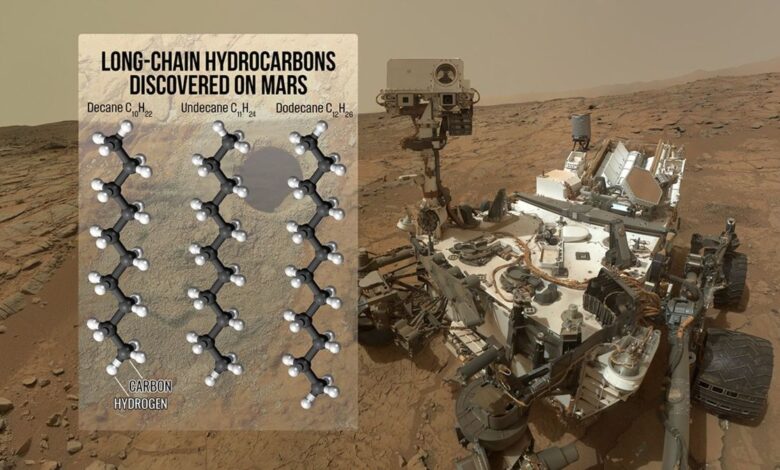
NASA’s Curiosity Rover Detects Largest Organic Molecules Found on Mars
Researchers analyzing pulverized rock onboard NASA’s Curiosity rover have found the largest organic compounds on the Red Planet to date. The finding, published Monday in the Proceedings of the National Academy of Sciences, suggests prebiotic chemistry may have advanced further on Mars than previously observed. Scientists probed an existing rock sample inside Curiosity’s Sample Analysis at Mars (SAM) mini-lab and…
Read More » -

Engineering Reality: Lee Bingham Leads Lunar Surface Simulation Support for Artemis Campaign
If you design a new tool for use on Earth, it is easy to test and practice using that tool in its intended environment. But what if that tool is destined for lunar orbit or will be used by astronauts on the surface of the Moon? NASA’s Simulation and Graphics Branch can help with that. Based at Johnson Space Center…
Read More » -
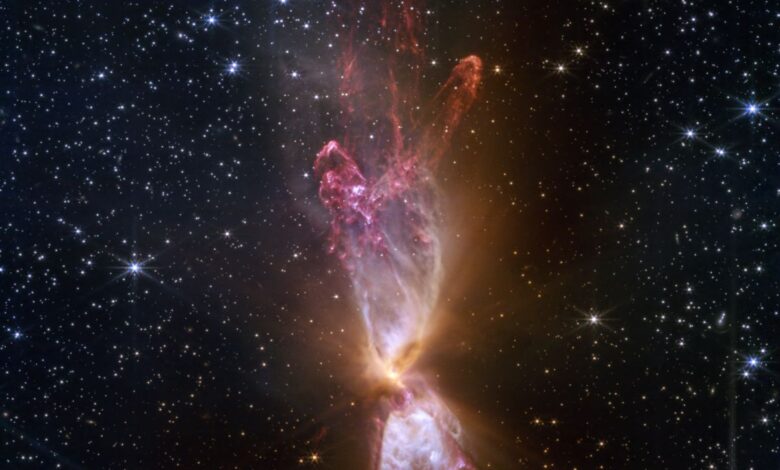
Like Sands Through the Hourglass…
Two actively forming stars are responsible for the shimmering hourglass-shaped ejections of gas and dust that gleam in orange, blue, and purple in this representative color image captured by NASA’s James Webb Space Telescope. This star system, called Lynds 483, is named for American astronomer Beverly T. Lynds, who published extensive catalogs of “dark” and “bright” nebulae in the early 1960s. The…
Read More » -
Career Transition Assistance Plan (CTAP) Services
Overview Welcome to the Career Transition Assistance Plan (CTAP) services page. Provided here are different resources to support informed steps toward a new career opportunity in the public or private sector. Transition Resources Below are links to guidance, resources, and tools that are helpful during a career move, including resume preparation, interview preparation, networking strategies, job search assistance, and more.…
Read More » -

NASA Invites Media to SpaceX’s 32nd Resupply Launch to Space Station
Media accreditation is open for the next launch to deliver NASA science investigations, supplies, and equipment to the International Space Station. NASA and SpaceX are targeting no earlier than Monday, April 21, to launch the SpaceX Dragon spacecraft on the company’s Falcon 9 rocket from Launch Complex 39A at the agency’s Kennedy Space Center in Florida. This launch is the…
Read More » -
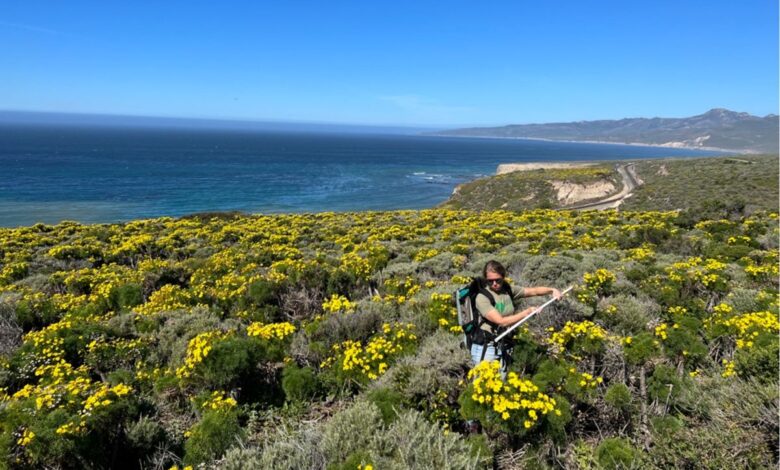
NASA Takes to the Air to Study Wildflowers
For many plant species, flowering is biologically synced with the seasons. Scientists are clocking blooms to understand our ever-changing planet. NASA research is revealing there’s more to flowers than meets the human eye. A recent analysis of wildflowers in California shows how aircraft- and space-based instruments can use color to track seasonal flower cycles. The results suggest a potential new…
Read More » -

50 Years Ago: Final Saturn Rocket Rolls Out to Launch Pad 39
On March 24, 1975, the last in a long line of super successful Saturn rockets rolled out from the vehicle assembly building to Launch Pad 39B at NASA’s Kennedy Space Center in Florida. The Saturn IB rocket for the Apollo-Soyuz Test Project was the 19th in the Saturn class stacked in the assembly building, beginning in 1966 with the Saturn V 500F facilities…
Read More »