
NASA
-
An Ocean in Motion: NASA’s Mesmerizing View of Earth’s Underwater Highways
This data visualization showing ocean currents around the world uses data from NASA’s Estimating the Circulation and Climate of the Ocean model. This data visualization showing ocean currents around the world uses data from NASA’s ECCO model, or Estimating the Circulation and Climate of the Ocean. The model pulls data from spacecraft, buoys, and other measurements. Original Video and Assets
Read More » -
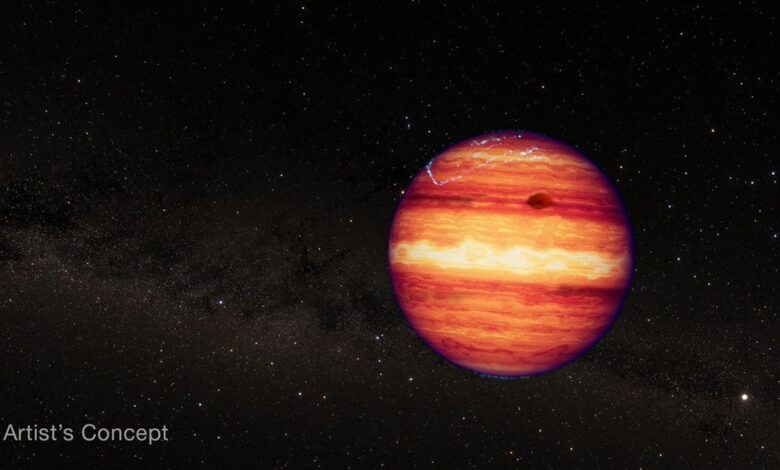
NASA’s Webb Exposes Complex Atmosphere of Starless Super-Jupiter
An international team of researchers has discovered that previously observed variations in brightness of a free-floating planetary-mass object known as SIMP 0136 must be the result of a complex combination of atmospheric factors, and cannot be explained by clouds alone. Using NASA’s James Webb Space Telescope to monitor a broad spectrum of infrared light emitted over two full rotation periods by SIMP…
Read More » -

Touchdown! Carrying NASA Science, Firefly’s Blue Ghost Lands on Moon
Carrying a suite of NASA science and technology, Firefly Aerospace’s Blue Ghost Mission 1 successfully landed at 3:34 a.m. EST on Sunday near a volcanic feature called Mons Latreille within Mare Crisium, a more than 300-mile-wide basin located in the northeast quadrant of the Moon’s near side. The Blue Ghost lander is in an upright and stable configuration, and the…
Read More » -
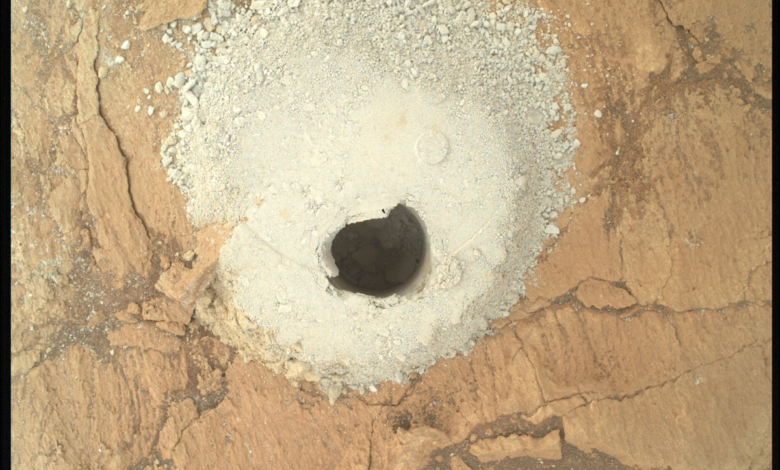
Smooshing for Science: A Flat-Out Success
Written by Henry Manelski, Ph.D. student at Purdue University The Perseverance team is always looking for creative ways to use the tools we have on Mars to maximize the science we do. On the arm of the rover sits the SHERLOC instrument, which specializes in detecting organic compounds and is crucial in our search for signs of past microbial life. But…
Read More » -
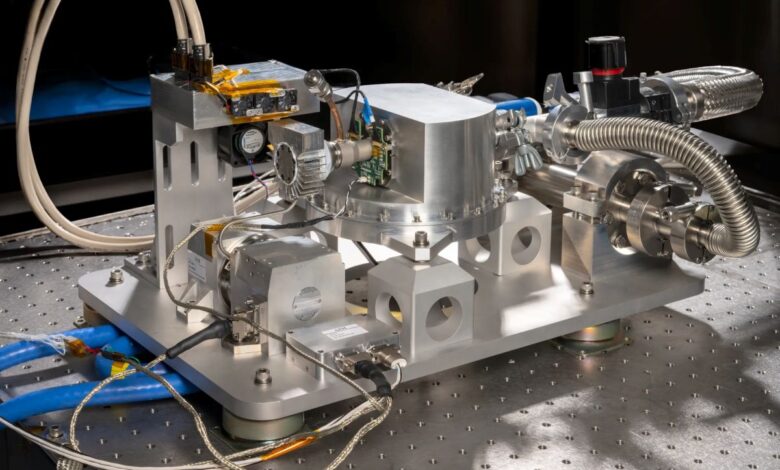
NASA Uses New Technology to Understand California Wildfires
The January wildfires in California devastated local habitats and communities. In an effort to better understand wildfire behavior, NASA scientists and engineers tried to learn from the events by testing new technology. The new instrument, the Compact Fire Infrared Radiance Spectral Tracker (c-FIRST), was tested when NASA’s B200 King Air aircraft flew over the wildfires in the Pacific Palisades and…
Read More » -

What’s Up: March 2025 Skywatching Tips from NASA
A Fast-Moving Planet and a Crimson Moon! Catch Mercury if you can, then stay up late for a total lunar eclipse, and learn the truth about the dark side of the Moon. Skywatching Highlights All Month – Planets Visibility: Mercury: Speedy Mercury is visible beneath Venus for the first week and a half of March, for about 30 minutes each evening,…
Read More » -

Langley Laboratory Apprentice at Work
An apprentice at Langley Laboratory (now NASA’s Langley Research Center in Hampton, Virginia) inspects wind tunnel components in this image from May 15, 1943. During World War II, the National Advisory Committee for Aeronautics (NACA), the precursor to NASA, employed apprentices (which NASA has since transitioned into internships) to support meaningful jobs in data computing, testing, and mechanical work. Make…
Read More » -

NASA Installs Heat Shield on First Private Spacecraft Bound for Venus
Engineers at NASA’s Ames Research Center in California’s Silicon Valley, Bohdan Wesely, right, and Eli Hiss, left, complete a fit check of the two halves of a space capsule that will study the clouds of Venus for signs of life. Led by Rocket Lab of Long Beach, California, and their partners at the Massachusetts Institute of Technology in Cambridge, Rocket…
Read More » -
Project Manager – Goddard Space Flight Center
Growing up near Dover Air Force Base in Delaware, Jamie Dunn — now a project manager for NASA’s Nancy Grace Roman Space Telescope — naturally became interested in planes. While he initially wanted to be a pilot, he chose aerospace engineering as a college major. “I originally had no plans to work in the space industry,” Jamie recalls. “I never…
Read More » -

NASA Selects Participating Scientists to Join Lucy Asteroid Mission
NASA has selected eight participating scientists to join its Lucy mission to the Jupiter Trojan asteroids. These asteroids are remnants of our early solar system trapped on stable orbits associated with — but not close to — the planet Jupiter. NASA’s Lucy mission, shown in this artist’s concept, is the first mission to explore the Jupiter Trojan asteroids. NASA’s Lucy in…
Read More »