LEGOLAND® CALIFORNIA RESORT UNVEILS GLOBAL DEBUT OF WORLD’S-FIRST LEGO® FERRARI BUILD AND RACE ATTRACTION!


Start your engines! Yesterday, LEGOLAND® California Resort debuted its newest attraction, LEGO® Ferrari Build and Race. Capitalizing on the increased popularity of Formula 1 racing (with viewership up 56% compared to 2020), the new attraction puts visitors in the driver’s seat with cutting-edge digital technology that guests have never experienced at any other LEGOLAND theme park in the world.
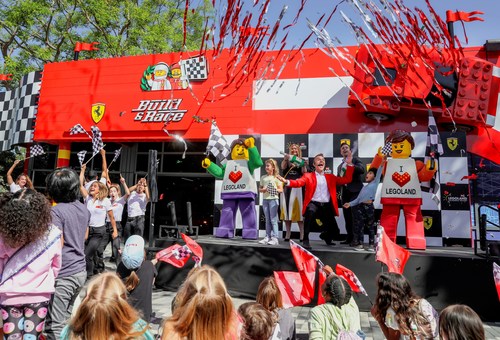
“Kicking off what is anticipated to be one of the biggest vacation seasons to date, LEGOLAND California is thrilled to bring this first-of-its-kind attraction to Carlsbad, California,” said President of LEGOLAND California Resort Kurt Stocks. “On the heels of Miami’s Grand Prix, we know what a thrill the Formula 1 races can be, and we’re excited to give our guests a taste of that experience here at the Park.”
The centerpiece of the opening was a life-size, bright red Ferrari F40 model developed by the LEGO Group, the only model of its kind in the world. The LEGO model took a team of Master Model builders more than 3,800 hours and more than 350,000 LEGO elements to create. It stands at 14 feet long, 6 ½ feet wide, 4 feet tall, and weighs more than 3,000 lbs. A permanent, visual centerpiece of the attraction’s “garage,” guests can sit in the full-scale Ferrari F40 model and have their photos taken.
LEGO® Ferrari Build and Race lets guests build, test, and race their very own LEGO Ferrari. Drawing inspiration from Ferrari fun facts, race history and awards featured in the “garage”, Young racers get to tap into their creativity as they head into the build and test area to construct their own LEGO Ferrari car to race at one of three test tracks which include the test zone, steering test track and speed test track. Each track offers guests different obstacles, challenges and a chance to clock in the fastest time.
Once guests have fine-tuned their vehicles, they will then head into the race area and use digital technology developed by Dimensional Innovations, a leader in immersive and engaging experiences, to digitally scan their cars and virtually race them in an effort to capture the fastest lap time. A fully customizable experience, guests will be able to digitally modify their LEGO car down to its engine size, tire specs, power, and aerodynamics, plus personalize the license plate and even add stickers.
Once on the “track,” LEGO Ferrari Build and Race is designed to be interactive and challenging as racers adapt to changing racecourse conditions due to weather, wind, temperature, and wind speed. Guests will have three laps to set their fastest time using touchpads to give their car extra acceleration and to pass competitors through straghtaways. Families can join in the fun by viewing overhead monitors with a bird’s eye view of the action and leaderboards displaying the status of current races and highlighting top performers of the day.
The journey continues in the DUPLO® build zone where younger guests have the chance to drive their imagination and design their creations out of bigger bricks. A LEGO pit crewmember will also be on hand to share Ferrari fun facts, race history, and showcase themed LEGO race gear and awards.
LEGO Ferrari Build and Race is included in the price of admission to LEGOLAND California Resort. It joins other new additions to the Park this year, including the brand new SoFi Stadium LEGO model in MINILAND U.S.A. For LEGOLAND California Resort ticket prices, operating schedule, and additional information, visit www.LEGOLAND.com or call 760-918-LEGO (5346).