
Astrophysics
-
NASA
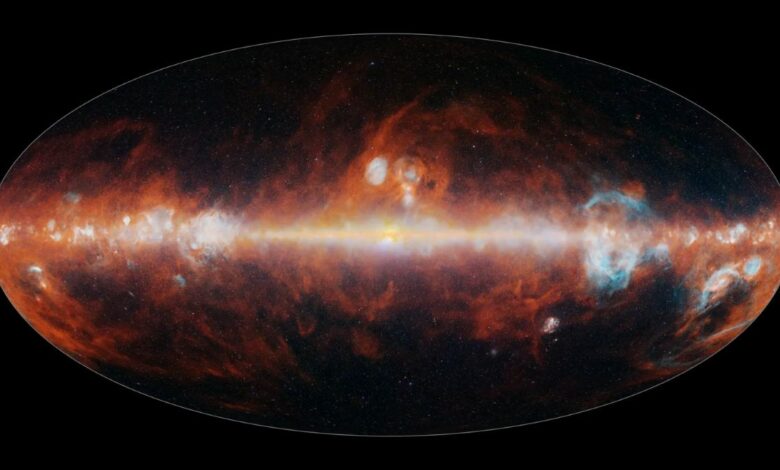
NASA’s SPHEREx Observatory Completes First Cosmic Map Like No Other
Launched in March, NASA’s SPHEREx space telescope has completed its first infrared map of the entire sky in 102 colors. While not visible to the human eye, these 102 infrared wavelengths of light are prevalent in the cosmos, and observing the entire sky this way enables scientists to answer big questions, including how a dramatic event that occurred in the…
Read More » -
NASA
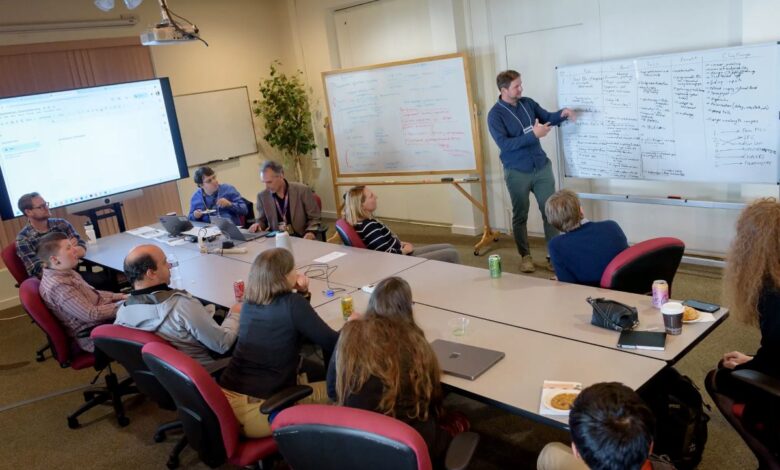
NASA Gathers Experts to Discuss Emerging Technologies in Astrophysics
The future of astrophysics research could unlock the secrets of the universe, and emerging technologies like artificial intelligence, quantum sensing, and advanced materials may hold the key to faster, more efficient discovery. Advancements and implementations of new technologies are imperative for observational astrophysics to achieve the next level of detection. NASA’s Emerging Technologies for Astrophysics workshop brought together subject matter…
Read More » -
NASA
NASA Establishes New Class of Astrophysics Missions, Selects Studies
Two proposals for missions to observe X-ray and far-infrared wavelengths of light from space were selected by NASA for additional review, the agency announced Thursday. Each proposal team will receive $5 million to conduct a 12-month mission concept study. After detailed evaluation of those studies, NASA expects to select one concept in 2026 to proceed with construction, for a launch…
Read More » -
NASA
Regina Caputo Charts the Future of High-Energy Astrophysics
Research astrophysicist Regina Caputo puzzles out how the universe works by studying the most extreme events in the cosmos. Name: Regina CaputoTitle: Research Astrophysicist Organization: Astroparticle Physics Laboratory (Code 661) Regina Caputo is a research astrophysicist at NASA’s Goddard Space Flight Center in Greenbelt, Md. She focuses on technology development and support for gamma-ray telescopes. Photo credit: NASA/David Friedlander What do you do and…
Read More » -
NASA
Astrophysics Instruments
Science in Space – February 2024 Instruments on the exterior of the International Space Station provide data on astrophysical phenomena that are helping scientists better understand our universe and its origins. Crew members install and maintain these instruments robotically and scientific teams operate them remotely. One of the instruments, the Neutron star Interior Composition Explorer (NICER), measures X-rays emitted by…
Read More » -
NASA Highlights Astrophysics Missions at ‘Super Bowl of Astronomy’
Editor’s Note: This advisory was updated on Jan. 11 to correct the time of the Stratospheric Observatory for Infrared Astronomy (SOFIA) Town Hall, which is taking place at 1:40 p.m. on Friday, Jan. 15. Experts from across NASA will discuss topics ranging from black holes to exploding stars to planets beyond our solar system at the 237th meeting of the American Astronomical Society…
Read More »