
ASU
-
NASA
Arizona Students Go on an Exoplanet Watch
Exoplanets, planets outside of our own solar system, hold the keys to finding extraterrestrial life and understanding the origin of our own world. Now online students at Arizona State University (ASU) in a new course called Exoplanet Research Experience have become exoplanet scientists by taking part in NASA’s Exoplanet Watch project. Fifteen students from ASU’s Astronomical and Planetary Sciences online degree program enroll in this course…
Read More » -
Press Releases

Astrobotic Awarded NASA JPL Commercial Service Studies to Enable Future Missions to Mars
Astrobotic has been selected by NASA’s Mars Exploration Program for two concept studies of commercial services to support lower-cost, higher-frequency missions to Mars. The company will examine how potential commercial services, both payload delivery and surface imaging, could enable future science missions to the Red Planet. The two studies — one for large payload delivery and hosting services, and the other…
Read More » -
Press Releases

Sprint and Arizona State University to Combine Innovation with 5G and Curiosity™ IoT in Groundbreaking Collaboration to Reach Millions of Residents, Students
LOS ANGELES, Oct. 22, 2019 /PRNewswire/ — Sprint (NYSE: S) today at MWC Los Angeles 2019 announced it is working with Arizona State University (ASU) in an effort to help drive economic, educational, technological and social growth for an entire region in Arizona, leveraging the power of Sprint’s True Mobile 5G and Curiosity™ IoT’s advanced dedicated network and operating system. Sprint will work alongside ASU: To offer blazing-fast 5G service and…
Read More » -
NASA
Next Mars Rover Will Have 23 ‘Eyes’
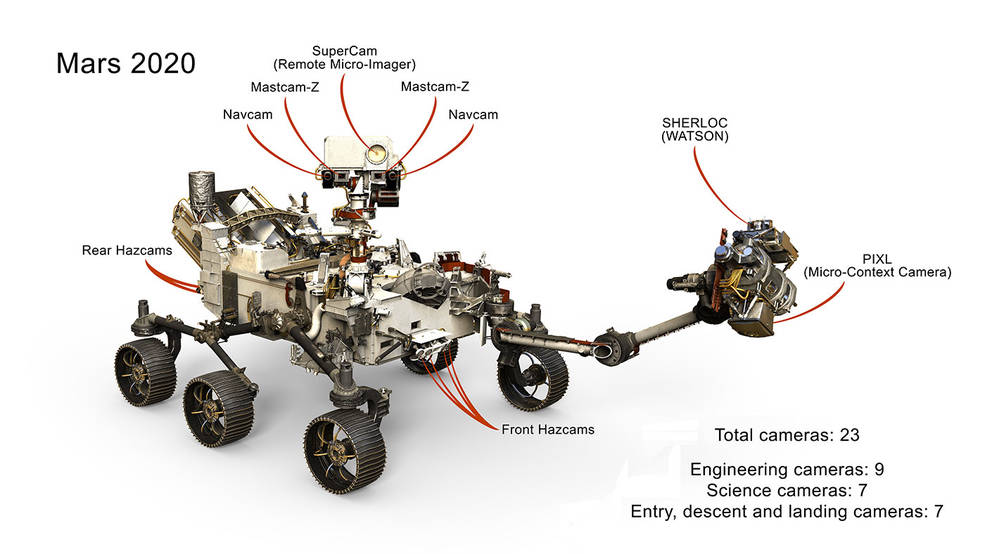
When NASA’s Mars Pathfinder touched down in 1997, it had five cameras: two on a mast that popped up from the lander, and three on NASA’s first rover, Sojourner. Since then, camera technology has taken a quantum leap. Photo sensors that were improved by the space program have become commercially ubiquitous. Cameras have shrunk in size, increased in quality and…
Read More »