Mission engineers were confident NASA’s OSIRIS-APEX (Origins, Spectral Interpretation, Resource Identification – Apophis Explorer) spacecraft could weather its closest ever pass of the Sun on Jan. 2, 2024. Their models had predicted that, despite traveling 25 million miles closer to the heat of the Sun than it was originally designed to, OSIRIS-APEX and its components would remain safe.
The mission team confirmed that the spacecraft indeed had come out of the experience unscathed after downloading stored telemetry data in mid-March. The team also tested OSIRIS-APEX’s instruments in early April, once the spacecraft was far enough from the Sun to return to normal operations. Between December 2023 and March, OSIRIS-APEX was inactive, with only limited telemetry data available to the team on Earth.
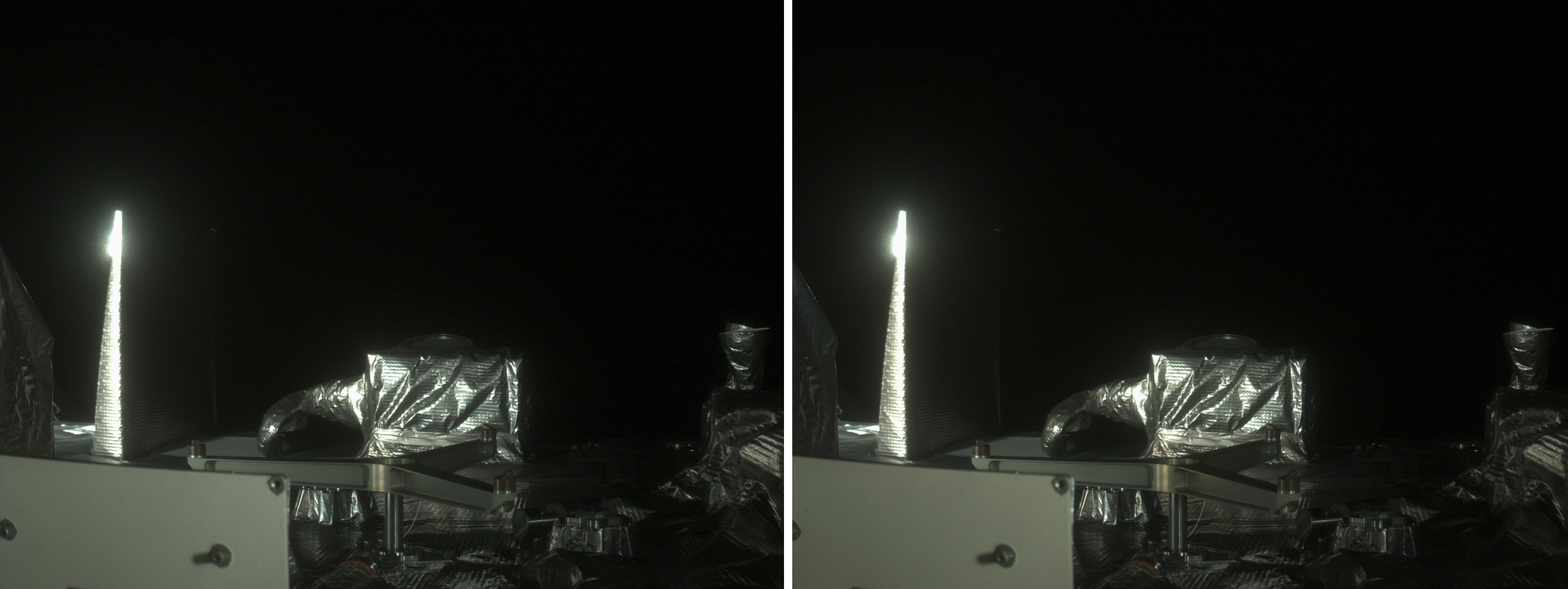
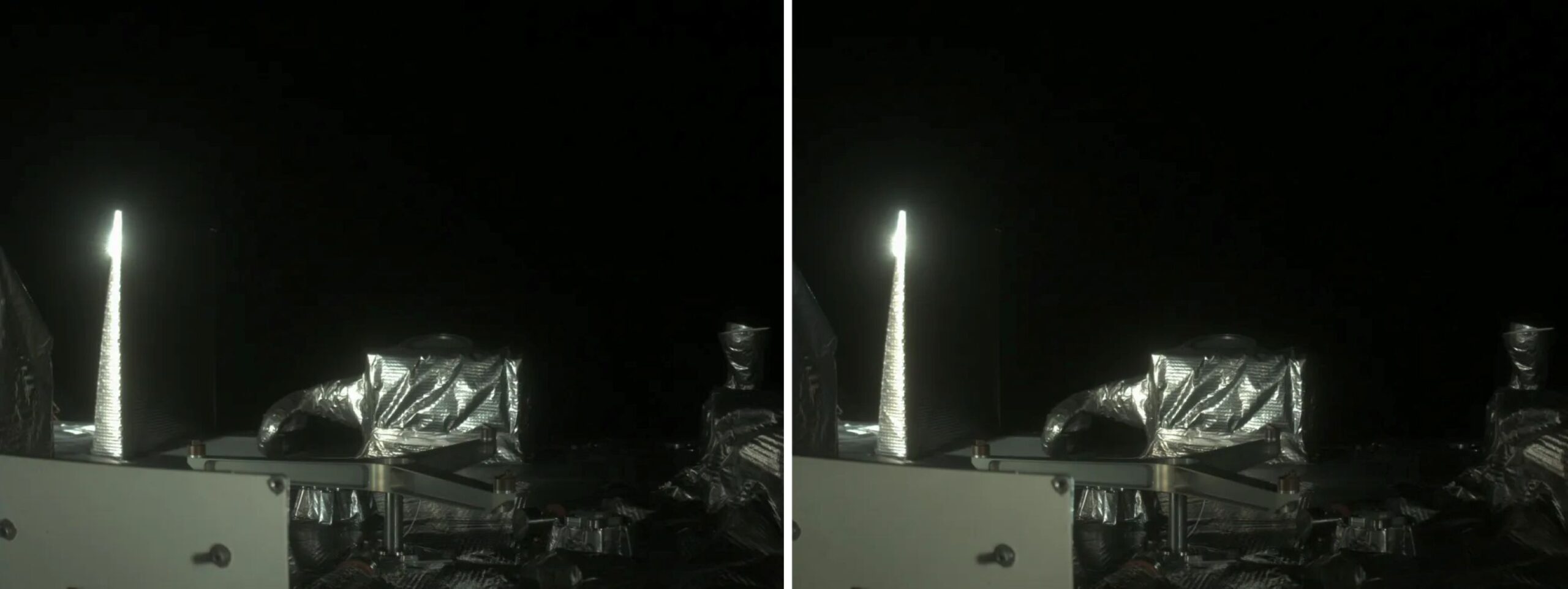
Both these images from a camera called StowCam aboard OSIRIS-APEX show the same view taken six months apart, before (left) and after (right) the Jan. 2, 2024, perihelion. Notably, there is no observable difference on spacecraft surfaces, a good indication that the higher temperatures faced during perihelion didn’t alter the spacecraft. Another insight gleaned from the identical view in the two images is that the camera’s performance was also not affected by perihelion. StowCam, a color imager, is one of three cameras comprising TAGCAMS (the Touch-and-Go Camera System), which is part of OSIRIS-APEX’s guidance, navigation, and control system. TAGCAMS was designed, built and tested by Malin Space Science Systems; Lockheed Martin integrated TAGCAMS to the OSIRIS-APEX spacecraft and operates TAGCAMS.
NASA/University of Arizona/Lockheed Martin
The spacecraft’s clean bill of health was due to creative engineering. Engineers placed OSIRIS-APEX in a fixed orientation with respect to the Sun and repositioned one of its two solar arrays to shade the spacecraft’s most sensitive components during the pass.
The spacecraft is in an elliptical orbit around the Sun that brings it to a point closest to the Sun, called a perihelion, about every nine months. To get on a path that will allow it to meet up with its new target Apophis in 2029, the spacecraft’s trajectory includes several perihelions that are closer to the Sun than the spacecraft’s components were originally designed to withstand.
“It’s phenomenal how well our spacecraft configuration protected OSIRIS-APEX, so I’m really encouraged by this first close perihelion pass,” said Ron Mink, mission systems engineer for OSIRIS-APEX, based at NASA’s Goddard Space Flight Center in Greenbelt, Maryland.
Besides confirming that the January perihelion worked out according to predictions, engineers found surprises while testing spacecraft components. A couple of instruments came out better than expected after exposure to higher temperatures.
A camera that helped map asteroid Bennu and will do the same at Apophis, saw a 70% reduction in “hot pixels” since April 13, 2023, the last time it was tested. Hot pixels, which are common in well-used cameras in space, show up as white spots in images when detectors accumulate exposure to high-energy radiation, mostly from our Sun.
“We think the heat from the Sun reset the pixels through annealing,” said Amy Simon, OSIRIS-APEX project scientist, based at NASA Goddard. Annealing is a heat process that can restore function of instruments and is often done intentionally through built-in heaters on some spacecraft.
Captured on Oct. 20, 2020, as NASA’s OSIRIS-REx spacecraft collected a sample from the surface of asteroid Bennu, this series of 82 images shows the SamCam imager’s field of view as the spacecraft approached and touched Bennu’s surface. OSIRIS-REx’s sampling head touched Bennu’s surface for approximately 6 seconds, after which the spacecraft performed a back-away burn. Credit: NASA/Goddard/University of Arizona
Another welcome surprise, said Simon, came from the spacecraft’s visible and near-infrared spectrometer. Before perihelion, the spectrometer, which mapped the surface composition of Bennu, and will do the same at Apophis, seemed to have a rock from Bennu stuck inside its calibration port. Scientist suspected that some sunlight was blocked from filtering through the instrument after the spacecraft, then called OSIRIS-REx, grabbed a sample from asteroid Bennu on Oct. 20, 2020. By picking up the sample and then firing its engines to back away from Bennu, the spacecraft stirred up dust and pebbles that clung to it.
“But, with enough spacecraft maneuvers and engine burns after sample collection,” Simon said, the rock in the calibration port appears to have been dislodged. Scientists will check the spectrometer again when OSIRIS-APEX swings by Earth on Sept. 25, 2025, for a gravitational boost.
OSIRIS-APEX is now operating normally as it continues its journey toward asteroid Apophis for a 2029 rendezvous. Its better-than-expected performance during the first close perihelion is welcome news. But engineers caution that it doesn’t mean it’s time to relax. OSIRIS-APEX needs to execute five more exceptionally close passes of the Sun — along with three Earth gravity assists — to get to its destination. It’s unclear how the cumulative effect of six perihelions at a closer distance than designed will impact the spacecraft and its components.
The second OSIRIS-APEX perihelion is scheduled for Sept. 1, 2024. The spacecraft will be 46.5 million miles away from the Sun, which is roughly half the distance between Earth and the Sun, and well inside the orbit of Venus.
Learn more about the OSIRIS-APEX mission to Apophis
NASA’s Goddard Space Flight Center, Greenbelt, Md.