
Chandra X-Ray Observatory
-
NASA
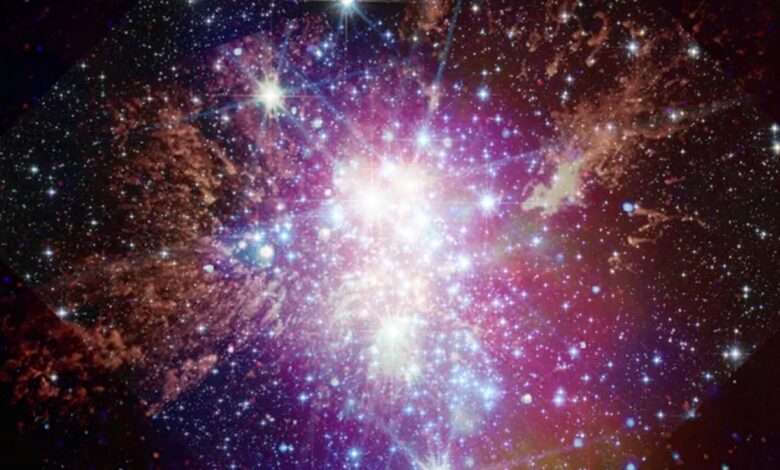
An Eye-catching Star Cluster
Westerlund 1, the biggest and closest “super” star cluster to Earth, dazzles in this image released on July 23, 2025. This view combines x-ray data from NASA’s Chandra X-ray Observatory (in pink, blue, purple, and orange), infrared data from NASA’s James Webb Space Telescope (in yellow, gold, and blue), and optical data from NASA’s Hubble Space Telescope (in cyan, grey, and light…
Read More » -
NASA

NASA’s Chandra Reveals Star’s Inner Conflict Before Explosion
The inside of a star turned on itself before it spectacularly exploded, according to a new study from NASA’s Chandra X-ray Observatory. Today, this shattered star, known as the Cassiopeia A supernova remnant, is one of the best-known, well-studied objects in the sky. Over three hundred years ago, however, it was a giant star on the brink of self-destruction. The…
Read More » -
NASA
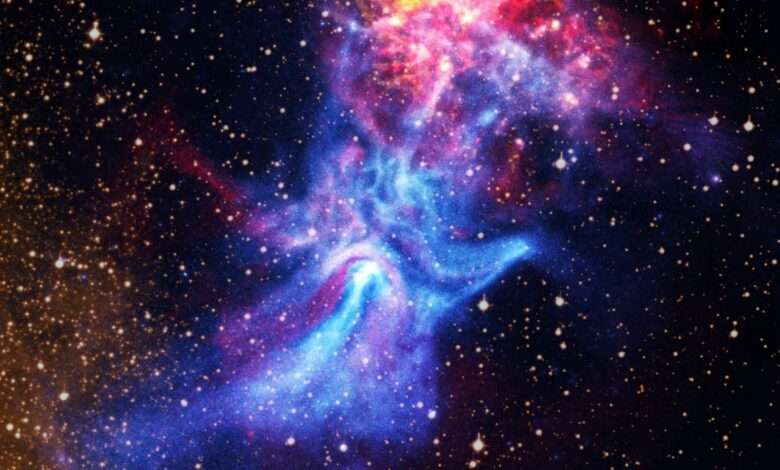
X-ray and Radio go ‘Hand in Hand’ in New Image
In 2009, NASA’s Chandra X-ray Observatory released a captivating image: a pulsar and its surrounding nebula that is shaped like a hand. Since then, astronomers have used Chandra and other telescopes to continue to observe this object. Now, new radio data from the Australia Telescope Compact Array (ATCA), has been combined with Chandra’s X-ray data to provide a fresh view…
Read More » -
NASA
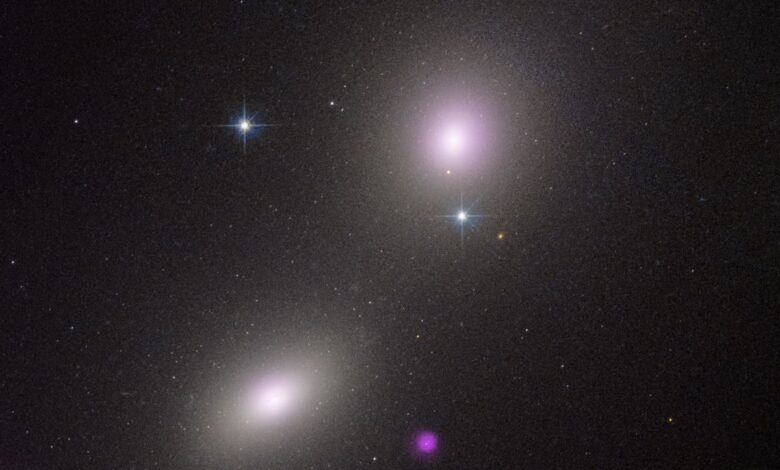
Rare Type of Black Hole Snacks on Star
NASA’s Hubble Space Telescope and NASA’s Chandra X-ray Observatory teamed up to identify a new possible example of a rare class of black holes, identified by X-ray emission (in purple) in this image released on July 24, 2025. Called NGC 6099 HLX-1, this bright X-ray source seems to reside in a compact star cluster in a giant elliptical galaxy. These rare black holes are…
Read More » -
NASA
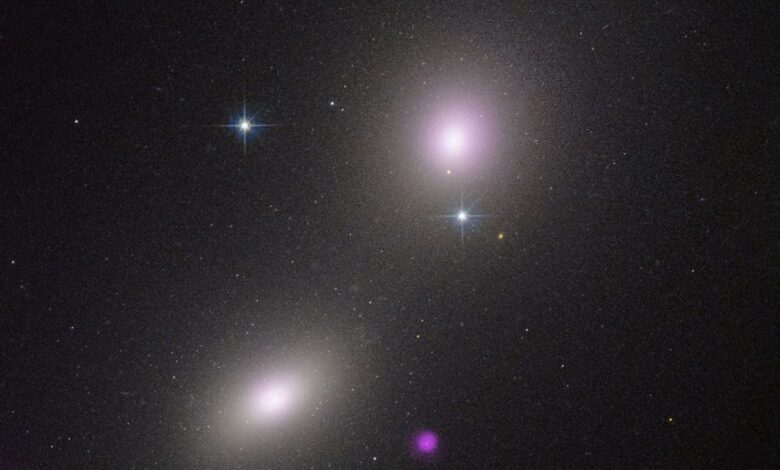
NASA’s Hubble, Chandra Spot Rare Type of Black Hole Eating a Star
NASA’s Hubble Space Telescope and NASA’s Chandra X-ray Observatory have teamed up to identify a new possible example of a rare class of black holes. Called NGC 6099 HLX-1, this bright X-ray source seems to reside in a compact star cluster in a giant elliptical galaxy. Just a few years after its 1990 launch, Hubble discovered that galaxies throughout the universe can contain supermassive…
Read More » -
NASA

NASA’s Chandra Shares a New View of Our Galactic Neighbor
The Andromeda galaxy, also known as Messier 31 (M31), is the closest spiral galaxy to the Milky Way at a distance of about 2.5 million light-years. Astronomers use Andromeda to understand the structure and evolution of our own spiral, which is much harder to do since Earth is embedded inside the Milky Way. The galaxy M31 has played an important role in many aspects of…
Read More » -
NASA

Galaxy Clusters on Course to Crash Again, NASA’s Chandra Finds
New observations from NASA’s Chandra X-ray Observatory and other telescopes have captured a rare cosmic event: two galaxy clusters have collided and are now poised to head back for another swipe at each other. Galaxy clusters are some of the largest structures in the Universe. Held together by gravity, they are monster-sized collections of hundreds or thousands of individual galaxies,…
Read More » -
NASA
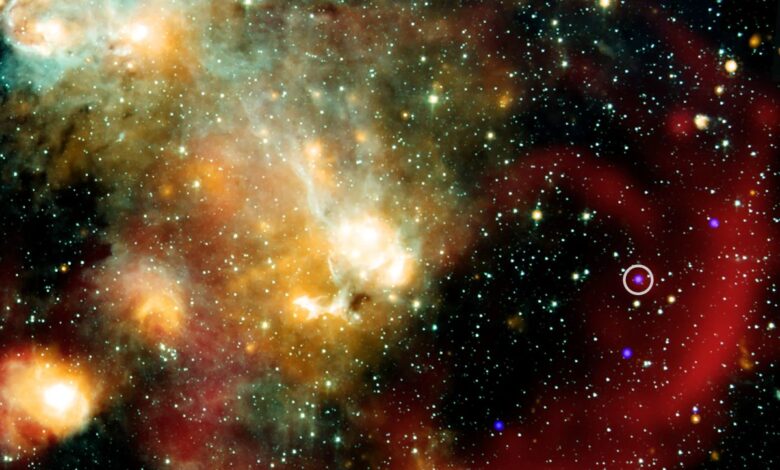
A Star Like No Other
An unusual star (circled in white at right) behaving like no other seen before and its surroundings are featured in this composite image released on May 28, 2025. A team of astronomers combined data from NASA’s Chandra X-ray Observatory and the Square Kilometer Array Pathfinder (ASKAP) radio telescope on Wajarri Country in Australia to study the discovered object, known as ASKAP J1832−0911 (ASKAP J1832 for short).…
Read More » -
NASA
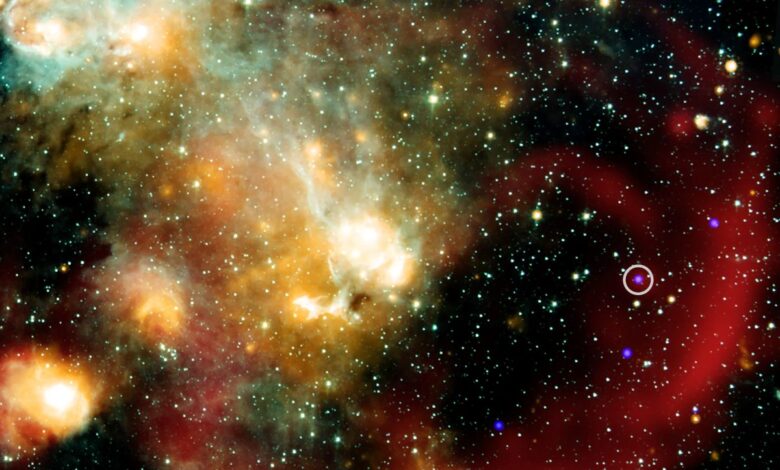
Eccentric ‘Star’ Defies Easy Explanation, NASA’s Chandra Finds
Scientists have discovered a star behaving like no other seen before, giving fresh clues about the origin of a new class of mysterious objects. As described in our press release, a team of astronomers combined data from NASA’s Chandra X-ray Observatory and the SKA [Square Kilometer Array] Pathfinder (ASKAP) radio telescope on Wajarri Country in Australia to study the antics of the discovered object, known as ASKAP…
Read More » -
NASA

NASA Telescopes Tune Into a Black Hole Prelude, Fugue
NASA released three new pieces of cosmic sound Thursday that are associated with the densest and darkest members of our universe: black holes. These scientific productions are sonifications — or translations into sound — of data collected by NASA telescopes in space including the Chandra X-ray Observatory, James Webb Space Telescope, and Imaging X-ray Polarimetry Explorer (IXPE). This trio of sonifications represents different…
Read More »