
Chandra X-Ray Observatory
-
NASA
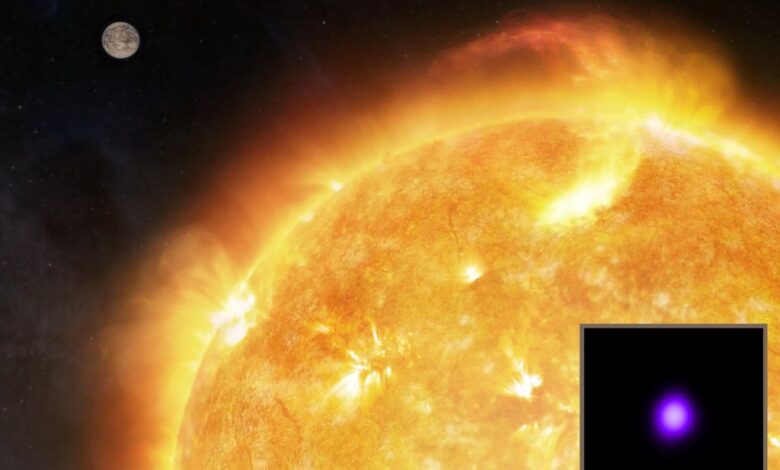
Exoplanets Need to Be Prepared for Extreme Space Weather, Chandra Finds
Planets around other stars need to be prepared for extreme weather conditions, according to a new study from NASA’s Chandra X-ray Observatory and ESA’s (European Space Agency’s) XMM-Newton that examined the effects of X-rays on potential planets around the most common type of stars. Astronomers found that only a planet with greenhouse gases in its atmosphere like Earth and at…
Read More » -
NASA
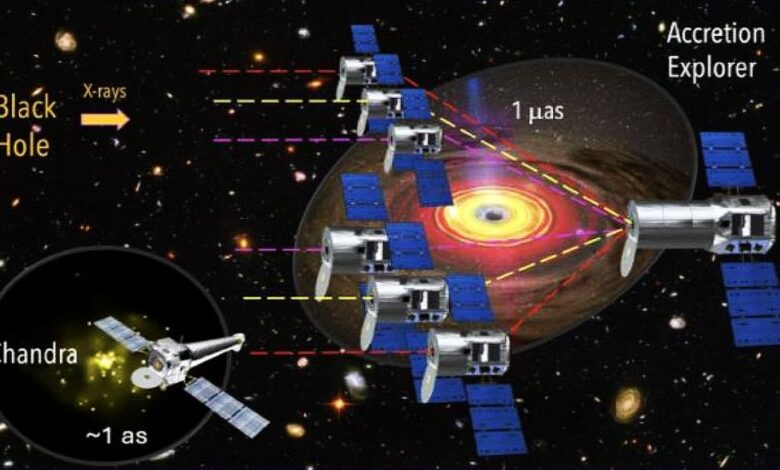
Beholding Black Hole Power with the Accretion Explorer Interferometer
Kimberly WeaverNASA Goddard Space Flight Center Some of the most enigmatic objects in the Universe are giant supermassive black holes (SMBH). Yet after 30 years of study, we don’t know precisely how these objects produce their power. This requires observations at X-ray wavelengths. The state-of-the-art for X-ray images is Chandra (~0.5-1 arcsecond resolution) but this is insufficient to image regions…
Read More » -
NASA
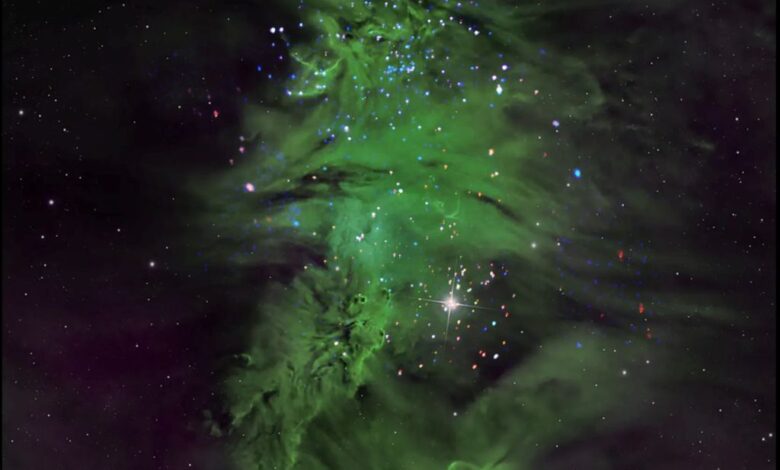
Hang a Shining Star Upon the Highest Bough
This new view of the “Christmas tree cluster” NGC 2264, released on Dec. 17, 2024, combines data from NASA’s Chandra X-ray Observatory and optical data from astrophotographer Michael Clow’s telescope in Arizona. Chandra data is represented in red, purple, blue, and white, while optical data is in green and violet. Located about 2,500 light-years from Earth, NGC 2264 is a cluster of…
Read More » -
NASA
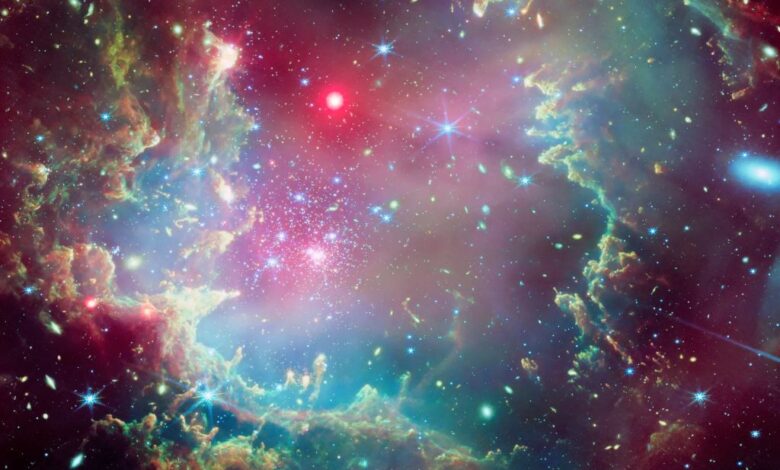
Chandra and Webb Spy a Cosmic Wreath
This new image of star cluster NGC 602, released on Dec. 17, 2024, combines data from NASA’s Chandra X-ray Observatory with a previously released image from the agency’s James Webb Space Telescope. Webb data provide the ring-like outline of the “wreath,” while X-rays from Chandra (red) show young, massive stars that are illuminating the wreath, sending high-energy light into interstellar space. NGC 602 lies on…
Read More » -
NASA
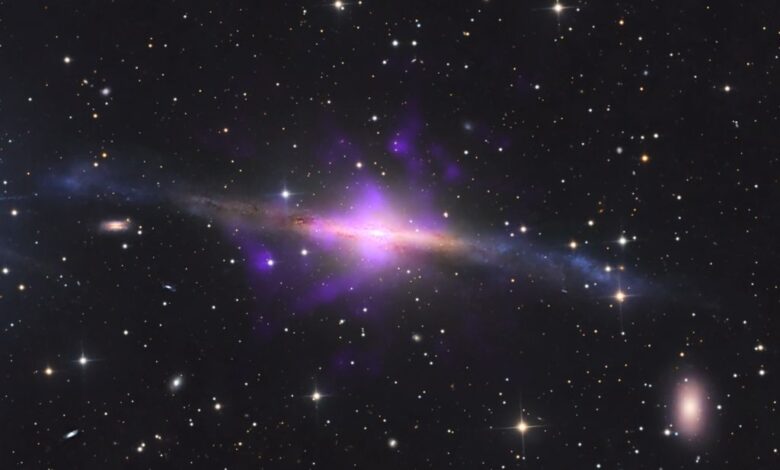
NASA Finds ‘Sideways’ Black Hole Using Legacy Data, New Techniques
Lee esta historia en español aquí. NASA researchers have discovered a perplexing case of a black hole that appears to be “tipped over,” rotating in an unexpected direction relative to the galaxy surrounding it. That galaxy, called NGC 5084, has been known for years, but the sideways secret of its central black hole lay hidden in old data archives. The discovery…
Read More » -
NASA
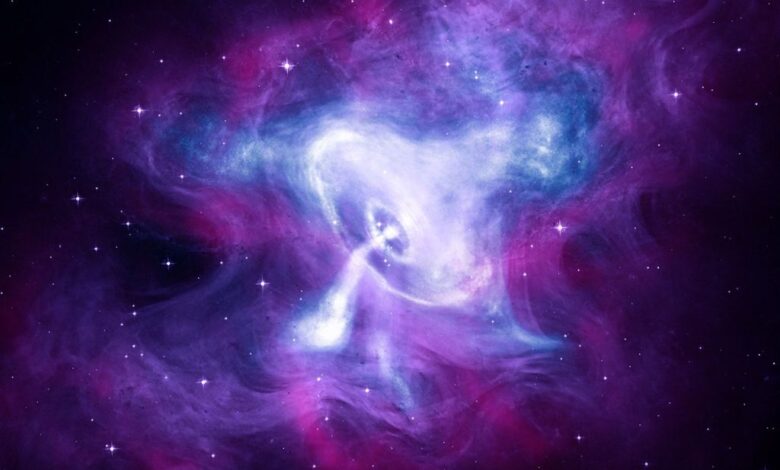
NASA Open Science Reveals Sounds of Space
NASA has a long history of translating astronomy data into beautiful images that are beloved by the public. Through its Chandra X-ray Observatory and Universe of Learning programs, NASA brings that principle into the world of audio in a project known as “A Universe of Sound.” The team has converted openly available data from Chandra, supplemented by open data from other observatories, into dozens…
Read More » -
NASA
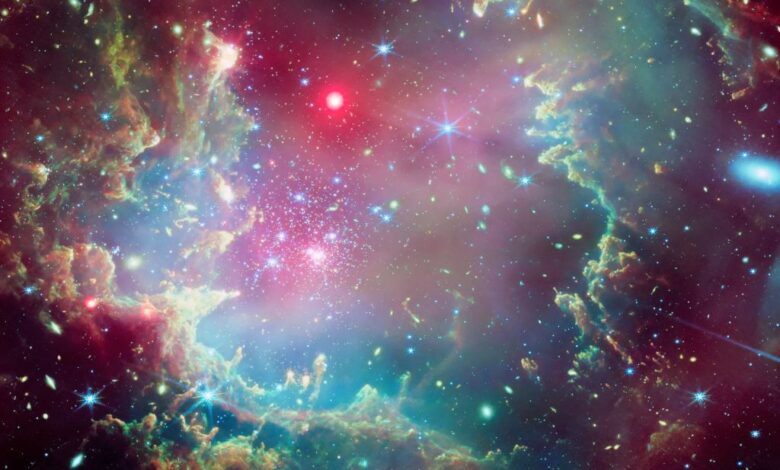
NASA Missions Spot Cosmic ‘Wreath’ Displaying Stellar Circle of Life
Since antiquity, wreaths have symbolized the cycle of life, death, and rebirth. It is fitting then that one of the best places for astronomers to learn more about the stellar lifecycle resembles a giant holiday wreath itself. The star cluster NGC 602 lies on the outskirts of the Small Magellanic Cloud, which is one of the closest galaxies to the Milky Way, about…
Read More » -
NASA
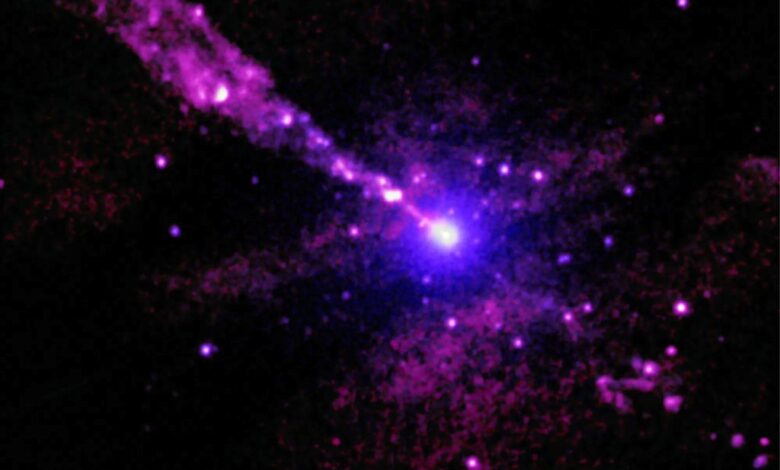
Black Hole Jet Stumbles Into Something in the Dark
Even matter ejected by black holes can run into objects in the dark. Using NASA’s Chandra X-ray Observatory, astronomers have found an unusual mark from a giant black hole’s powerful jet striking an unidentified object in its path. The discovery was made in a galaxy called Centaurus A (Cen A), located about 12 million light-years from Earth. Astronomers have long studied Cen A because it has a supermassive…
Read More » -
NASA
NASA’s Chandra, Hubble Tune Into ‘Flame-Throwing’ Guitar Nebula
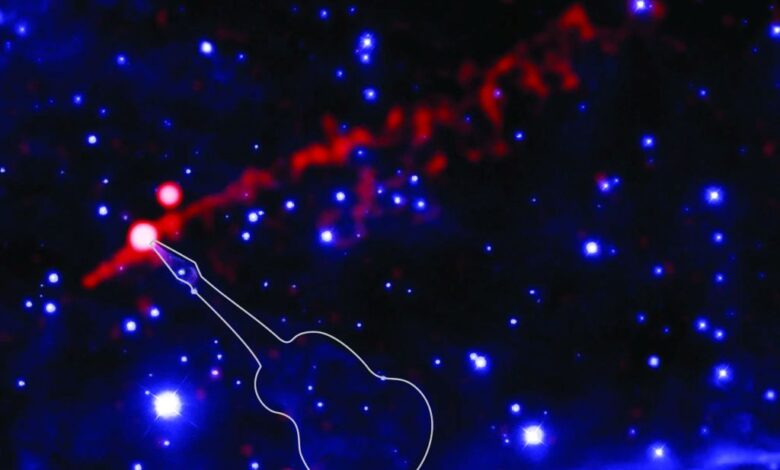
Normally found only in heavy metal bands or certain post-apocalyptic films, a “flame-throwing guitar” has now been spotted moving through space. Astronomers have captured movies of this extreme cosmic object using NASA’s Chandra X-ray Observatory and Hubble Space Telescope. The new movie of Chandra (red) and Palomar (blue) data helps break down what is playing out in the Guitar Nebula.…
Read More » -
NASA
Planets Beware: NASA Unburies Danger Zones of Star Cluster
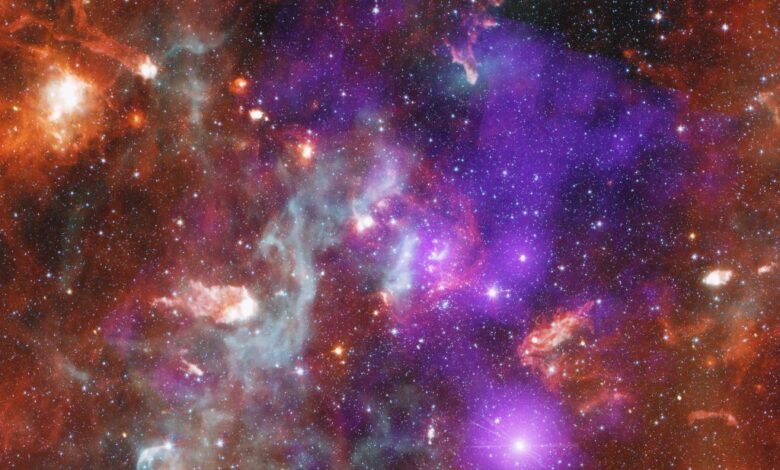
Most stars form in collections, called clusters or associations, that include very massive stars. These giant stars send out large amounts of high-energy radiation, which can disrupt relatively fragile disks of dust and gas that are in the process of coalescing to form new planets. A team of astronomers used NASA’s Chandra X-ray Observatory, in combination with ultraviolet, optical, and infrared data, to show where some…
Read More »