The JSAUX FlipGo Dual Stacked Portable Monitor nears the end of its Kickstarter campaign at more than 14,000% of its goal

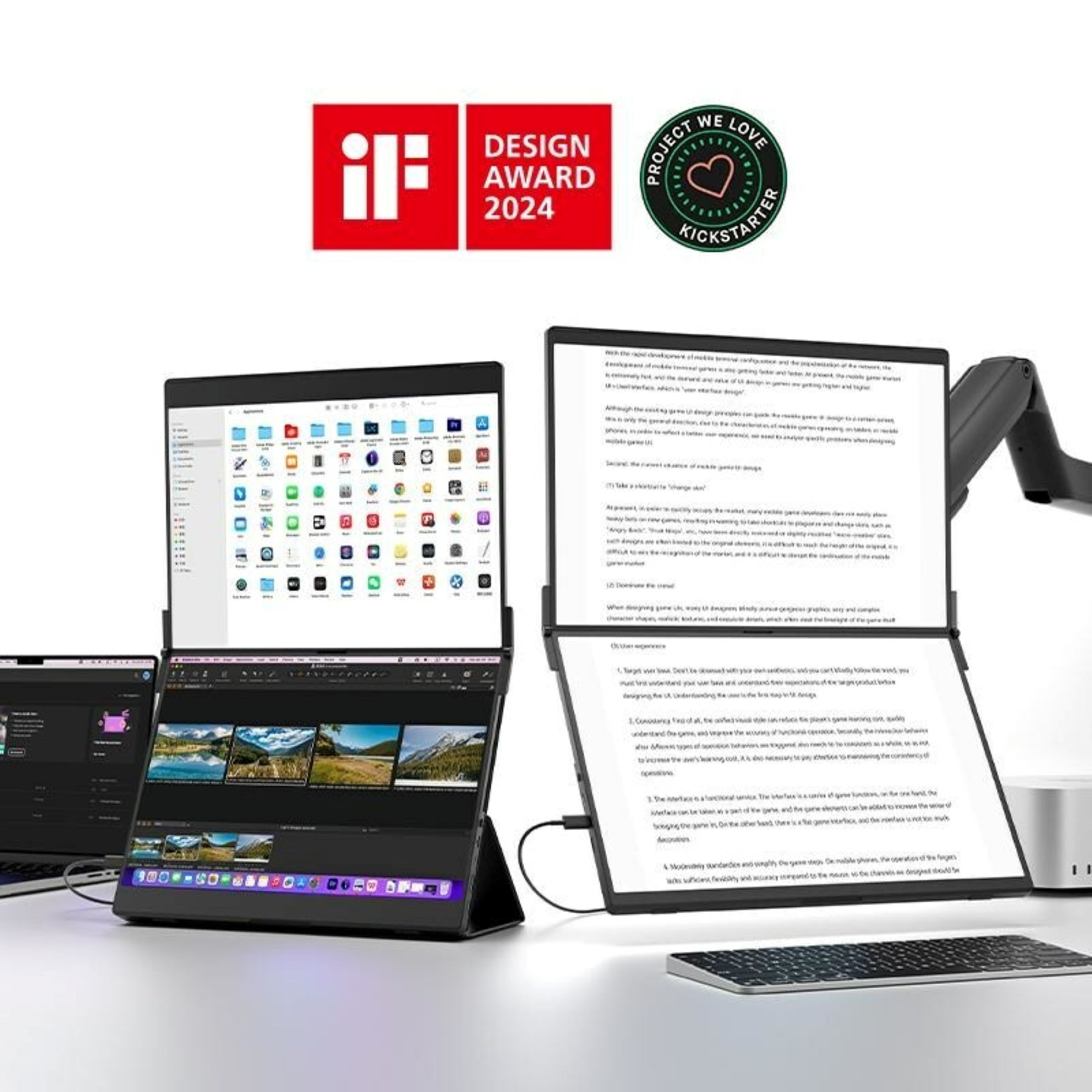
Technology manufacturer JSAUX announces that the iF Design Award FlipGo Dual Stacked Portable Monitor nears the end of its Kickstarter campaign with more than $900,000 of funding, surpassing 14,000% of the initial funding goal. JSAUX’s FlipGo Dual Stacked Portable Monitor has already been featured in several technology and computer media. Below you can find some accolades:
- Windows Central: “This setup lets you use apps in full screen mode on a single display and lets you split your workload into separate screens that you can take with you on the go or set up at a desk”.
- Dexerto: “The dual-screened nature of it makes it easy to pick up and take away with you at an instant”.
- Geeky Gadgets: “[The FlipGo] versatility means that no matter what platform you’re using, you can interact with your work in a way that feels natural and boosts your productivity”.
ABOUT THE JSAUX FLIPGO DUAL STACKED PORTABLE MONITOR
The JSAUX FlipGo Dual Stacked Portable Monitor has been designed for digital nomads, remote workers and creatives featuring portability (it weighs between 1.1kg and 1.6kg), convenience (only needs one USB-C cable to power up) and efficiency. There are three models of the dual-screen portable monitor: the Standard, the Pro and the Touch Screen version.
The Touch Screen version features touch and gesture support for macOS and Windows in its dual-screen. Users not only can use their FlipGo as a regular touchscreen, but as a second touchpad for their laptops.
Each screen features up to 2.5K resolution and a pixel density of 200ppi with up to 500 nits brightness. The monitor is compatible with the latest Mac computers (M1, M2, and M3 chips) and can be powered only with one USB-C cable.
JSAUX has also designed the FlipGo dual screen portable monitor with a magnetic surface that can be attached to a wide range of stands, catered to all kinds of users. The Flex Folio is a leather case that protects your monitor from scratches and can be unfolded to use it as a stand to place the FlipGo close to your laptop or existing monitor. The Snap Stand uses a magnet to help you place the FlipGo at a more convenient height and is a solution aimed at digital nomads and people who work from home and in an office. The Snap VESA adapter lets you connect the monitor to a VESA stand easily.
ABOUT JSAUX
JSAUX, a pioneer brand in innovation and quality, boasts products that are best-sellers across over 100 countries and regions worldwide, serving more than 20 million consumers. Since 2016, multiple JSAUX product lines sold on Amazon have been designated as “#1 Best Sellers”, ranking first in several categories. This success has solidified JSAUX’s foothold in the electronics accessories market and has further established the brand as one of the top 100 Chinese brands on Amazon.
In 2022, JSAUX swiftly rose to become one of the most popular brands in gaming accessories, firmly establishing itself as the premier brand for Steam Deck accessories. The brand’s strong product innovation, superior quality, robust supply chain, and consumer-centric brand strategy have enabled it to continuously design and produce outstanding products over the past seven years. This accomplishment is the result of seamless coordination within our internal teams, spanning from research and development to product manufacturing and global marketing.