
Hubble Space Telescope
-
NASA

Hubble Helps Determine Uranus’ Rotation Rate with Unprecedented Precision
An international team of astronomers using the NASA/ESA Hubble Space Telescope has made new measurements of Uranus’ interior rotation rate with a novel technique, achieving a level of accuracy 1,000 times greater than previous estimates. By analyzing more than a decade of Hubble observations of Uranus’ aurorae, researchers have refined the planet’s rotation period and established a crucial new reference point for…
Read More » -
NASA

Hubble Studies a Nearby Galaxy’s Star Formation
This NASA/ESA Hubble Space Telescope image features the picturesque spiral galaxy NGC 4941, which lies about 67 million light-years from Earth in the constellation Virgo (The Maiden). Because this galaxy is nearby, cosmically speaking, Hubble’s keen instruments are able to pick out exquisite details such as individual star clusters and filamentary clouds of gas and dust. The data used to construct this…
Read More » -
NASA

Hubble Spots Stellar Sculptors in Nearby Galaxy
As part of ESA/Hubble’s 35th anniversary celebrations, the European Space Agency (ESA) is sharing a new image series revisiting stunning, previously released Hubble targets with the addition of the latest Hubble data and new processing techniques. This new image showcases the dazzling young star cluster NGC 346. Although both the James Webb Space Telescope and Hubble have released images of NGC 346 previously, this image…
Read More » -
NASA

20-Year Hubble Study of Uranus Yields New Atmospheric Insights
The ice-giant planet Uranus, which travels around the Sun tipped on its side, is a weird and mysterious world. Now, in an unprecedented study spanning two decades, researchers using NASA’s Hubble Space Telescope have uncovered new insights into the planet’s atmospheric composition and dynamics. This was possible only because of Hubble’s sharp resolution, spectral capabilities, and longevity. The team’s results will help…
Read More » -
NASA
Hubble Spots a Chance Alignment
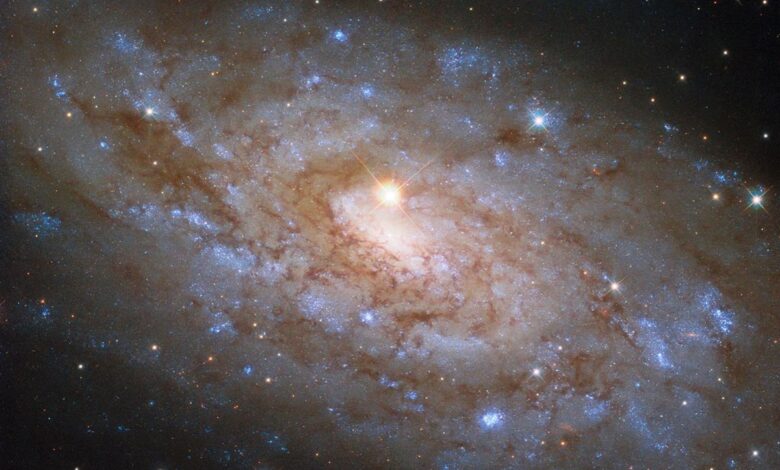
The subject of today’s NASA/ESA Hubble Space Telescope image is the stunning spiral galaxy NGC 5530. This galaxy is situated 40 million light-years away in the constellation Lupus, the Wolf, and classified as a ‘flocculent’ spiral, meaning its spiral arms are patchy and indistinct. While some galaxies have extraordinarily bright centers that host a feasting supermassive black hole, the bright source near…
Read More » -
NASA
NASA’s Webb Captures Neptune’s Auroras For First Time
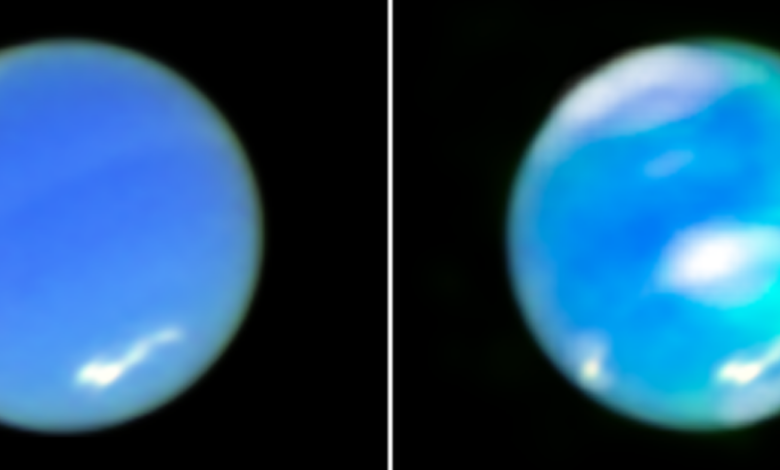
Long-sought auroral glow finally emerges under Webb’s powerful gaze For the first time, NASA’s James Webb Space Telescope has captured bright auroral activity on Neptune. Auroras occur when energetic particles, often originating from the Sun, become trapped in a planet’s magnetic field and eventually strike the upper atmosphere. The energy released during these collisions creates the signature glow. In the…
Read More » -
NASA

Hubble Captures a Neighbor’s Colorful Clouds
Download this image Say hello to one of the Milky Way’s neighbors! This NASA/ESA Hubble Space Telescope image features a scene from one of the closest galaxies to the Milky Way, the Small Magellanic Cloud (SMC). The SMC is a dwarf galaxy located about 200,000 light-years away. Most of the galaxy resides in the constellation Tucana, but a small section crosses over…
Read More » -
NASA
Hubble Sees a Spiral and a Star
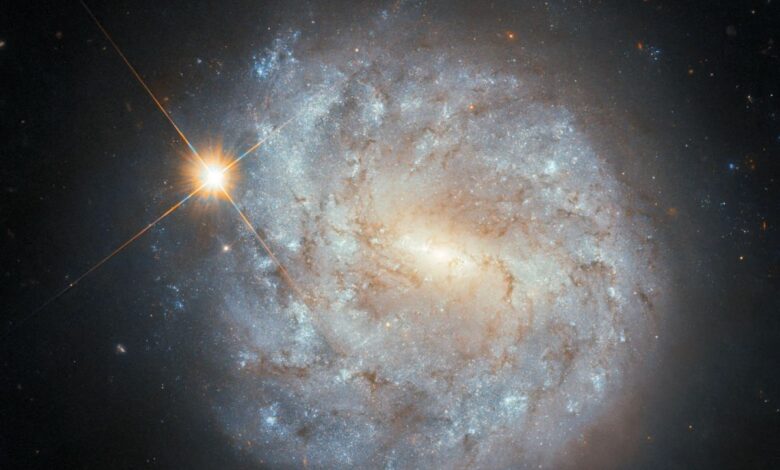
This NASA/ESA Hubble Space Telescope image features a sparkling spiral galaxy paired with a prominent star, both in the constellation Virgo. While the galaxy and the star appear to be close to one another, even overlapping, they’re actually a great distance apart. The star, marked with four long diffraction spikes, is in our own galaxy. It’s just 7,109 light-years away from Earth.…
Read More » -
NASA
Hubble Sees a Spiral and a Star
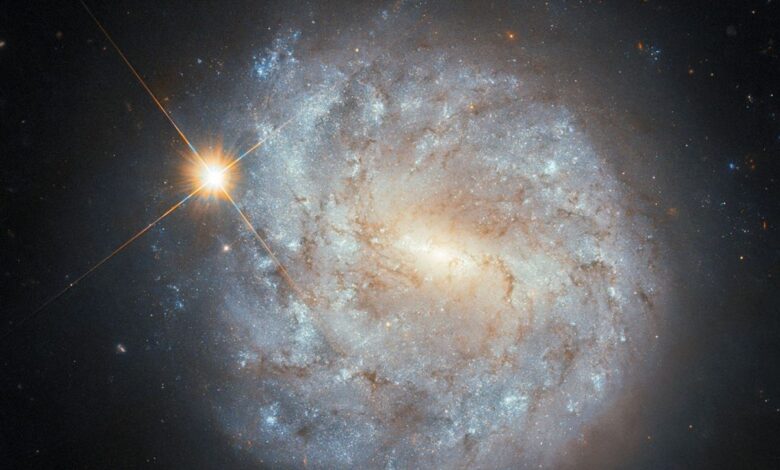
Download this image This NASA/ESA Hubble Space Telescope image features a sparkling spiral galaxy paired with a prominent star, both in the constellation Virgo. While the galaxy and the star appear to be close to one another, even overlapping, they’re actually a great distance apart. The star, marked with four long diffraction spikes, is in our own galaxy. It’s just 7,109 light-years…
Read More » -
NASA
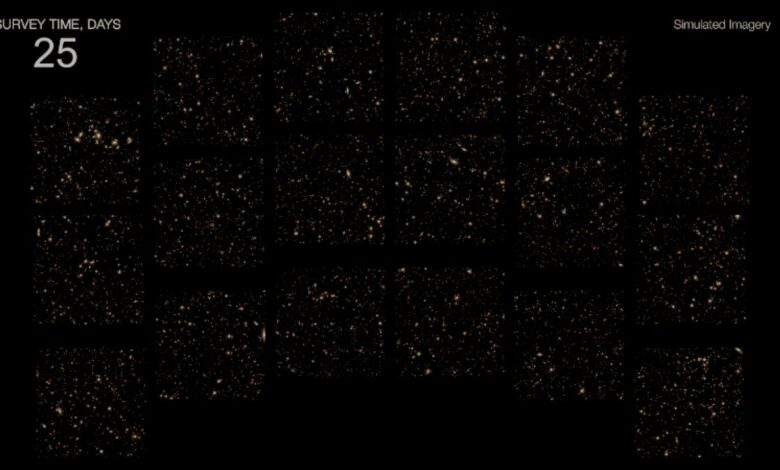
Team Preps to Study Dark Energy via Exploding Stars With NASA’s Roman
The universe is ballooning outward at an ever-faster clip under the power of an unknown force dubbed dark energy. One of the major goals for NASA’s upcoming Nancy Grace Roman Space Telescope is to help astronomers gather clues to the mystery. One team is setting the stage now to help astronomers prepare for this exciting science. “Roman will scan the…
Read More »