
James Webb Space Telescope
-
NASA
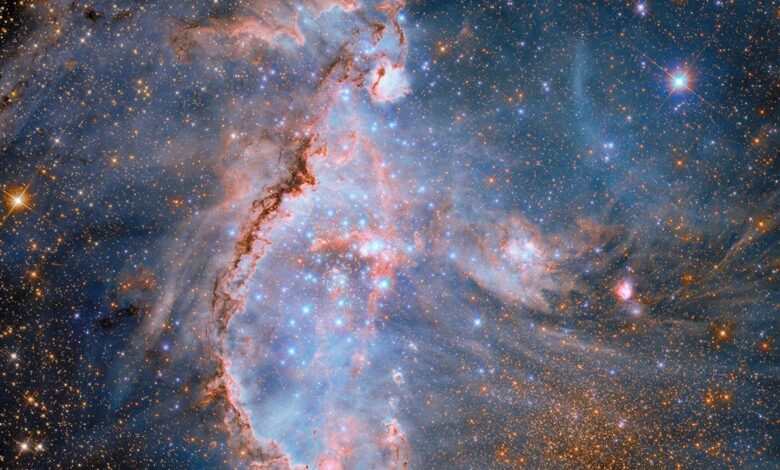
Sculpted by Luminous Stars
This new image, released on April 4, 2025, showcases the dazzling young star cluster NGC 346. Although both the James Webb Space Telescope and the Hubble Space Telescope have released images of NGC 346 previously, this image includes new data and is the first to combine Hubble observations made at infrared, optical, and ultraviolet wavelengths into an intricately detailed view of this vibrant star-forming factory.…
Read More » -
NASA
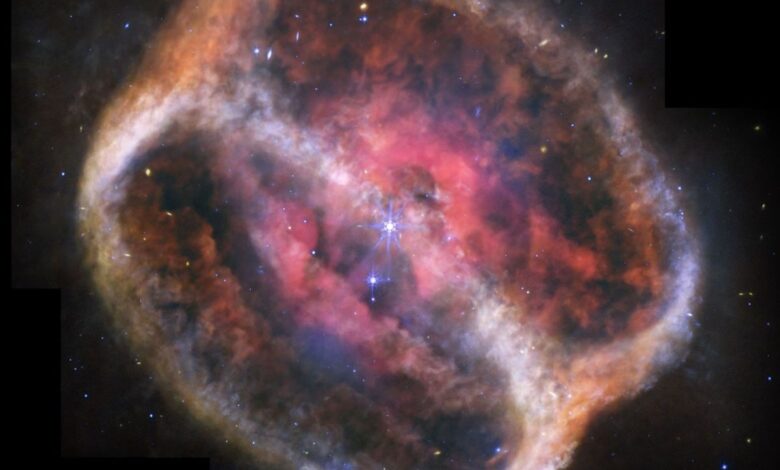
With NASA’s Webb, Dying Star’s Energetic Display Comes Into Full Focus
Gas and dust ejected by a dying star at the heart of NGC 1514 came into complete focus thanks to mid-infrared data from NASA’s James Webb Space Telescope. Its rings, which are only detected in infrared light, now look like “fuzzy” clumps arranged in tangled patterns, and a network of clearer holes close to the central stars shows where faster…
Read More » -
NASA
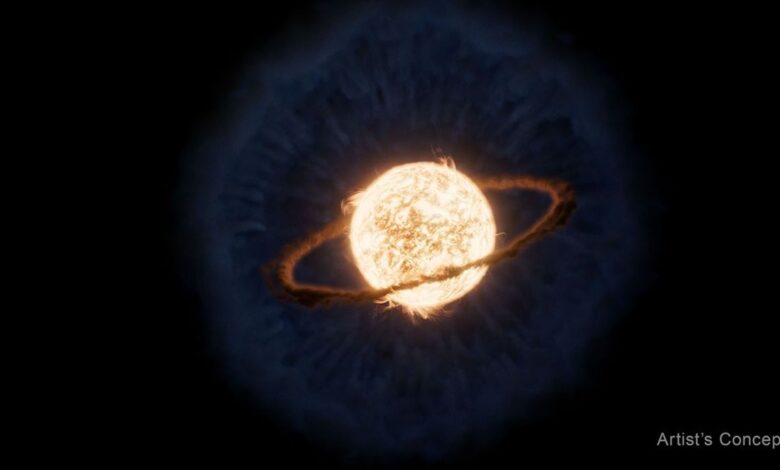
NASA Webb’s Autopsy of Planet Swallowed by Star Yields Surprise
Observations from NASA’s James Webb Space Telescope have provided a surprising twist in the narrative surrounding what is believed to be the first star observed in the act of swallowing a planet. The new findings suggest that the star actually did not swell to envelop a planet as previously hypothesized. Instead, Webb’s observations show the planet’s orbit shrank over time,…
Read More » -
NASA

Hubble Spots Stellar Sculptors in Nearby Galaxy
As part of ESA/Hubble’s 35th anniversary celebrations, the European Space Agency (ESA) is sharing a new image series revisiting stunning, previously released Hubble targets with the addition of the latest Hubble data and new processing techniques. This new image showcases the dazzling young star cluster NGC 346. Although both the James Webb Space Telescope and Hubble have released images of NGC 346 previously, this image…
Read More » -
NASA

NASA Webb Explores Effect of Strong Magnetic Fields on Star Formation
Follow-up research on a 2023 image of the Sagittarius C stellar nursery in the heart of our Milky Way galaxy, captured by NASA’s James Webb Space Telescope, has revealed ejections from still-forming protostars and insights into the impact of strong magnetic fields on interstellar gas and the life cycle of stars. “A big question in the Central Molecular Zone of our…
Read More » -
NASA

NASA’s Webb Sees Galaxy Mysteriously Clearing Fog of Early Universe
Using the unique infrared sensitivity of NASA’s James Webb Space Telescope, researchers can examine ancient galaxies to probe secrets of the early universe. Now, an international team of astronomers has identified bright hydrogen emission from a galaxy in an unexpectedly early time in the universe’s history. The surprise finding is challenging researchers to explain how this light could have pierced…
Read More » -
NASA
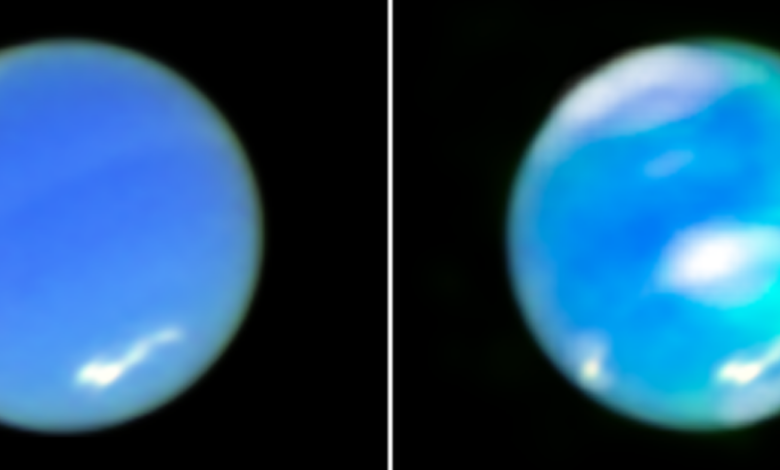
NASA’s Webb Captures Neptune’s Auroras For First Time
Long-sought auroral glow finally emerges under Webb’s powerful gaze For the first time, NASA’s James Webb Space Telescope has captured bright auroral activity on Neptune. Auroras occur when energetic particles, often originating from the Sun, become trapped in a planet’s magnetic field and eventually strike the upper atmosphere. The energy released during these collisions creates the signature glow. In the…
Read More » -
NASA
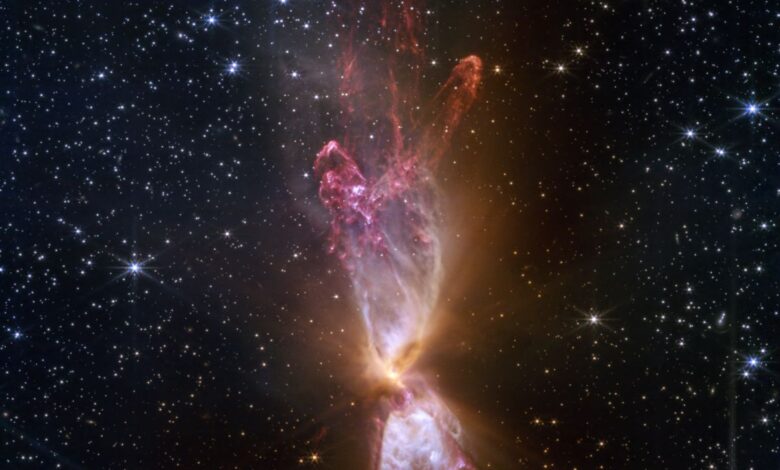
Like Sands Through the Hourglass…
Two actively forming stars are responsible for the shimmering hourglass-shaped ejections of gas and dust that gleam in orange, blue, and purple in this representative color image captured by NASA’s James Webb Space Telescope. This star system, called Lynds 483, is named for American astronomer Beverly T. Lynds, who published extensive catalogs of “dark” and “bright” nebulae in the early 1960s. The…
Read More » -
NASA
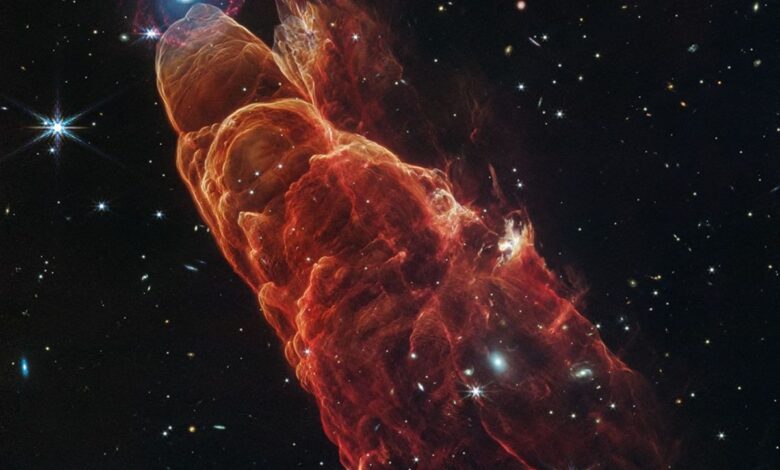
NASA’s Webb Telescope Unmasks True Nature of the Cosmic Tornado
Craving an ice cream sundae with a cherry on top? This random alignment of Herbig-Haro 49/50 — a frothy-looking outflow from a nearby protostar — with a multi-hued spiral galaxy may do the trick. This new composite image combining observations from NASA’s James Webb Space Telescope’s NIRCam (Near-Infrared Camera) and MIRI (Mid-Infrared Instrument) provides a high-resolution view to explore the…
Read More » -
NASA
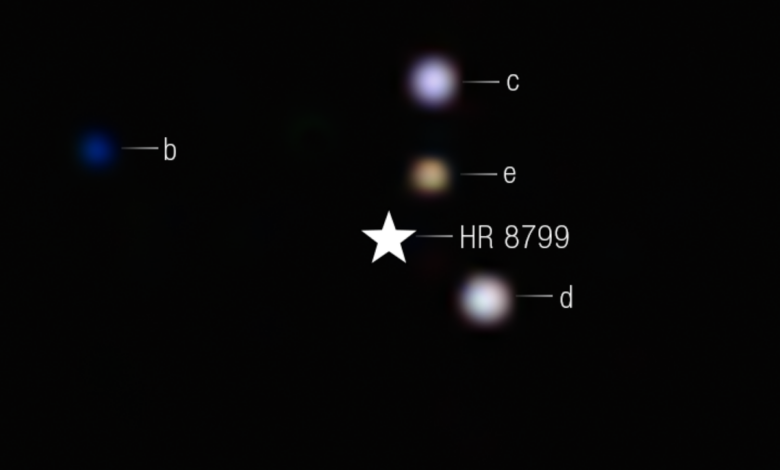
NASA’s Webb Images Young, Giant Exoplanets, Detects Carbon Dioxide
NASA’s James Webb Space Telescope has captured direct images of multiple gas giant planets within an iconic planetary system. HR 8799, a young system 130 light-years away, has long been a key target for planet formation studies. The observations indicate that the well-studied planets of HR 8799 are rich in carbon dioxide gas. This provides strong evidence that the system’s…
Read More »