
James Webb Space Telescope
-
NASA
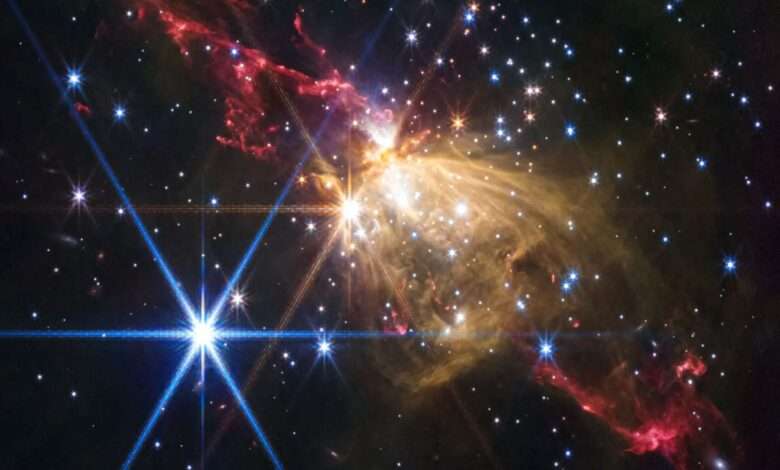
Stellar Jet
NASA’s James Webb Space Telescope captured a blowtorch of seething gasses erupting from a volcanically growing monster star in this image released on Sept. 10, 2025. Stellar jets, which are powered by the gravitational energy released as a star grows in mass, encode the formation history of the protostar. This image provides evidence that protostellar jets scale with the mass of their parent…
Read More » -
NASA
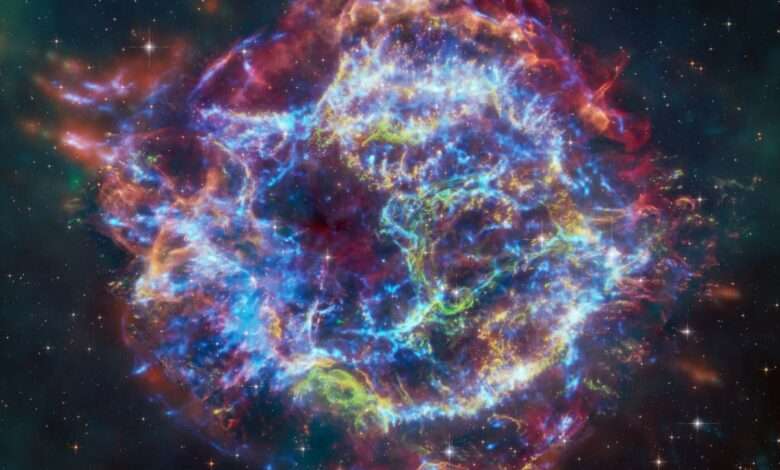
XRISM Finds Chlorine, Potassium in Cas A
The Cassiopeia A supernova remnant glows in X-ray, visible, and infrared light in this Jan. 8, 2024, image that combines data from NASA’s Chandra X-ray Observatory and Hubble, Webb, and Spitzer space telescopes. A study by the XRISM (X-ray Imaging and Spectroscopy Mission) spacecraft has made the first-ever X-ray detections of chlorine and potassium from the wreckage; a paper about…
Read More » -
NASA
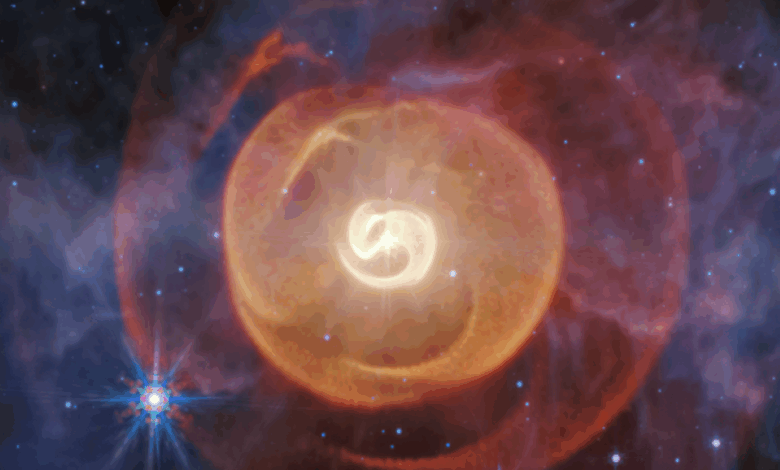
Webb First to Show 4 Dust Shells ‘Spiraling’ Apep, Limits Long Orbit
NASA’s James Webb Space Telescope has delivered a first of its kind: a crisp mid-infrared image of a system of four serpentine spirals of dust, one expanding beyond the next in precisely the same pattern. (The fourth is almost transparent, at the edges of Webb’s image.) Observations taken prior to Webb only detected one shell, and while the existence of…
Read More » -
NASA
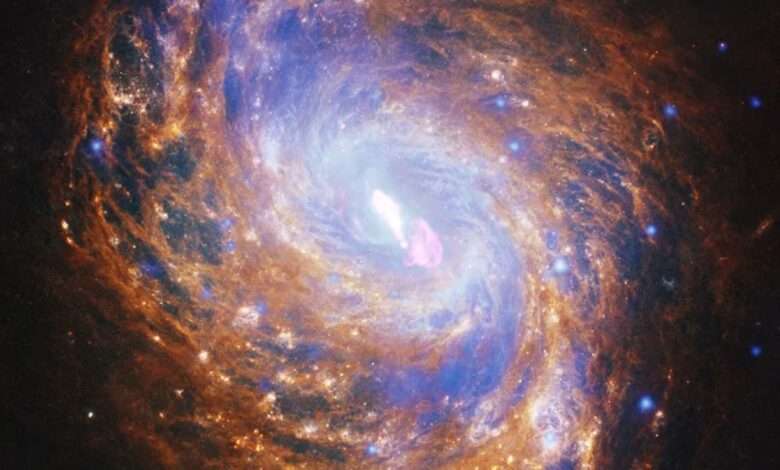
NASA Telescopes View Spiral Galaxy
NGC 1068, a relatively nearby spiral galaxy, appears in this image released on July 23, 2025. The galaxy contains a black hole at its center that is twice as massive as the Milky Way’s. NASA’s Chandra X-ray Observatory data shows a million-mile-per-hour wind is being driven from NGC 1068’s black hole and lighting up the center of the galaxy in X-rays. The image contains…
Read More » -
NASA
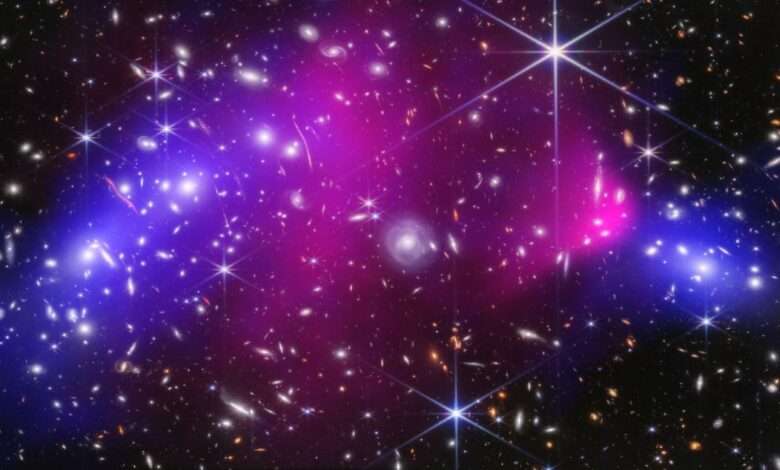
Mapping Dark Matter
This image released on June 30, 2025, combines data from NASA’s James Webb Space Telescope and NASA’s Chandra X-ray Observatory to visualize dark matter. Researchers used Webb’s observations to carefully measure the mass of the galaxy clusters shown here as well as the collective light emitted by stars that are no longer bound to individual galaxies. Learn more. Image credit:…
Read More » -
NASA
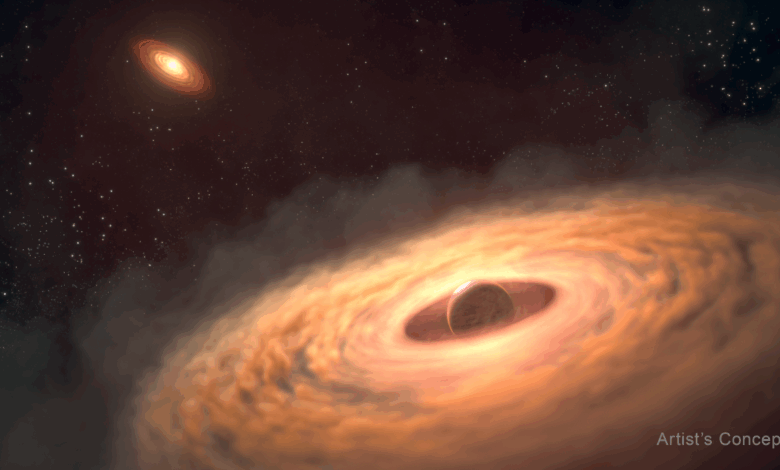
NASA’s Webb Telescope Studies Moon-Forming Disk Around Massive Planet
NASA’s James Webb Space Telescope has provided the first direct measurements of the chemical and physical properties of a potential moon-forming disk encircling a large exoplanet. The carbon-rich disk surrounding the world called CT Cha b, which is located 625 light-years away from Earth, is a possible construction yard for moons, although no moons are detected in the Webb data.…
Read More » -
NASA

NASA’s Webb Explores Largest Star-Forming Cloud in Milky Way
NASA’s James Webb Space Telescope has revealed a colorful array of massive stars and glowing cosmic dust in the Sagittarius B2 molecular cloud, the most massive and active star-forming region in our Milky Way galaxy. “Webb’s powerful infrared instruments provide detail we’ve never been able to see before, which will help us to understand some of the still-elusive mysteries of…
Read More » -
NASA
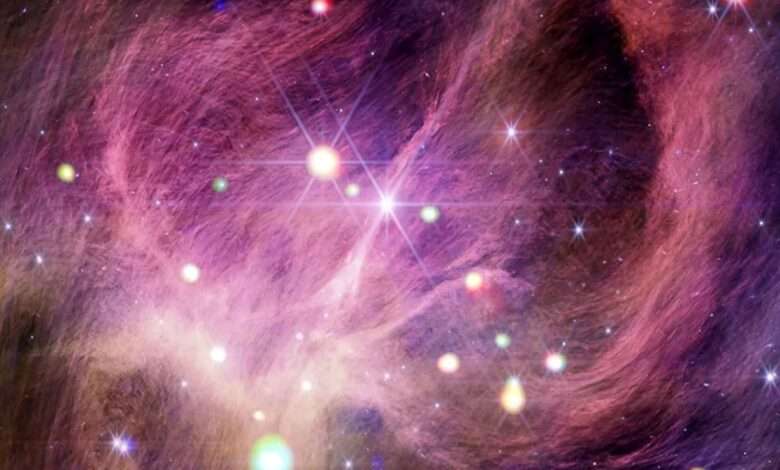
IC Stars
Data from NASA’s Chandra X-ray Observatory and NASA’s James Webb Space Telescope combine to reveal an otherworldly view of the star-forming region IC 348. In this image released on July 23, 2025, X-rays from Chandra are red, green, and blue, while infrared data from Webb are pink, orange, and purple. The wispy structures that dominate the image are interstellar material that reflect…
Read More » -
NASA
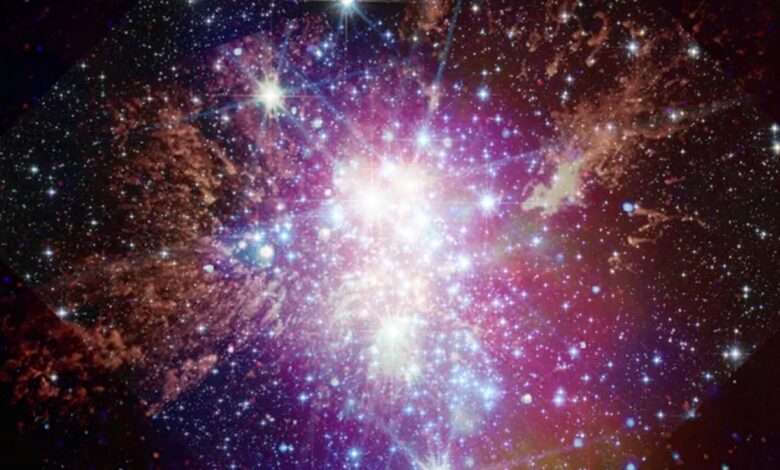
An Eye-catching Star Cluster
Westerlund 1, the biggest and closest “super” star cluster to Earth, dazzles in this image released on July 23, 2025. This view combines x-ray data from NASA’s Chandra X-ray Observatory (in pink, blue, purple, and orange), infrared data from NASA’s James Webb Space Telescope (in yellow, gold, and blue), and optical data from NASA’s Hubble Space Telescope (in cyan, grey, and light…
Read More » -
NASA
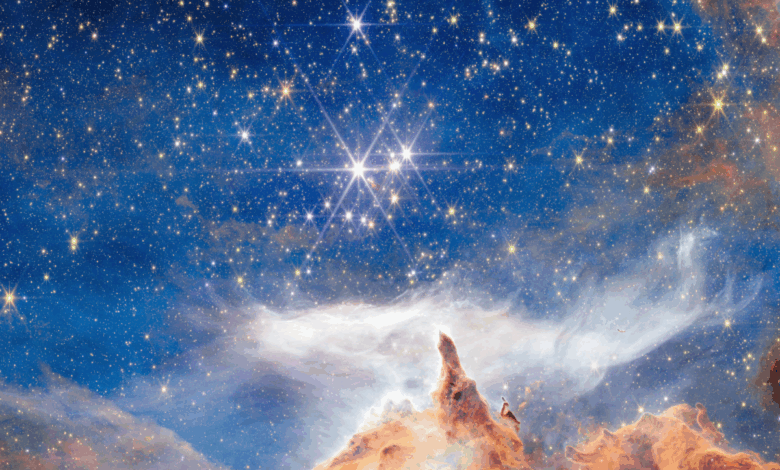
Shining Pismis 24
NASA’s James Webb Space Telescope captured this sparkling scene of star birth in an image released on Sept. 4, 2025. Called Pismis 24, this young star cluster resides in the core of the nearby Lobster Nebula, approximately 5,500 light-years from Earth in the constellation Scorpius. Home to a vibrant stellar nursery and one of the closest sites of massive star birth,…
Read More »