
Lunar Eclipse
-
Rising Over Louisiana
On Aug. 28, 2026 (the evening of Aug. 27 in some time zones), the Moon passed into Earth’s shadow, creating a deep partial lunar eclipse. At the moment of greatest eclipse, 12:13 a.m. EDT, 96.3% of the Moon’s disk was immersed in Earth’s umbra—the central, darkest part of the shadow where sunlight is completely blocked. This stage of the eclipse was…
Read More » -
NASA
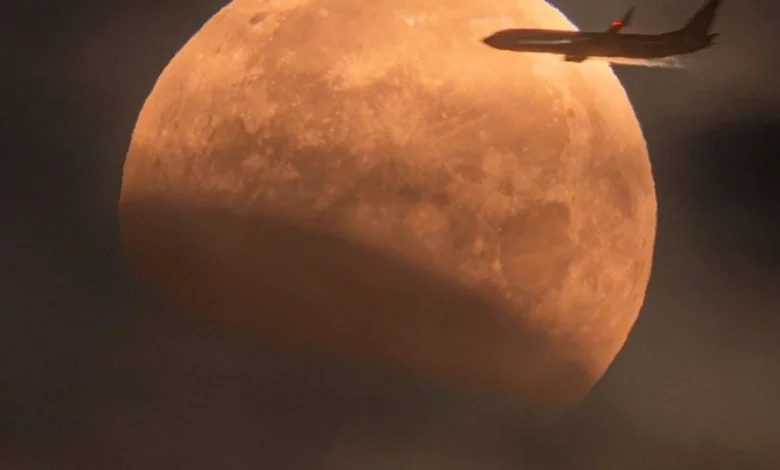
Astronomy Picture of the Day
Discover the cosmos! Each day a different image or photograph of our fascinating universe is featured, along with a brief explanation written by a professional astronomer. A Plane Lunar Eclipse Explanation: Did you need to be on the right side of this airplane to see this eclipse? No. Lunar eclipses are routinely seen from the half of the Earth facing the Moon when the eclipse occurs,…
Read More » -
NASA

NASA Johnson Pilots Chase Moon’s Shadow for Eclipse Science
During the Aug. 12 total solar eclipse over Europe, scientists aimed to study a long-standing mystery: why the Sun’s outer atmosphere, the corona, is far hotter than its visible surface. Capturing the data they needed meant being in exactly the right place at the right time. Pilots from NASA’s Johnson Space Center flew the WB-57F high altitude research aircraft from Ellington Field in Houston to Iceland, their base for flying through the path…
Read More » -
NASA

Shades of a Lunar Eclipse
On March 3, 2026, Earth lined up directly between the Moon and the Sun, casting its shadow on the full Moon. The total lunar eclipse was visible throughout the Americas, East Asia, Australia, and the Pacific. Skygazers in those parts of the world may have witnessed a “Blood Moon,” when the dimmed lunar surface temporarily turned an orange-red color. Meanwhile, satellites observed…
Read More » -
NASA
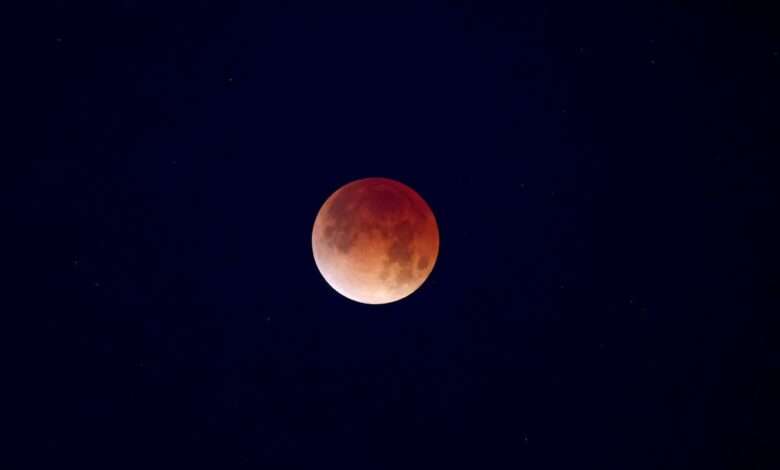
Total Lunar Eclipse
The Moon appears red during a total lunar eclipse over New Orleans, home of NASA’s Michoud Assembly Facility, on March 3, 2026. This “blood moon” occurs during a total lunar eclipse, as Earth lines up between the Moon and the Sun. When this happens, the only light that reaches the Moon’s surface is from the edges of Earth’s atmosphere. The air molecules from Earth’s atmosphere…
Read More » -
NASA
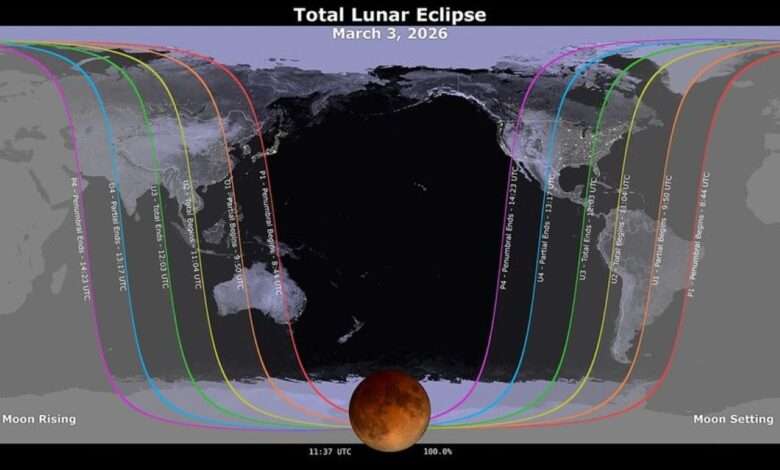
March 2026 Total Lunar Eclipse: Your Questions Answered
A total lunar eclipse will redden the Moon on March 3, 2026. Here’s what you need to know. How does a lunar eclipse work? A lunar eclipse occurs when Earth passes directly between the Sun and Moon, casting a gigantic shadow across the lunar surface and turning the Moon a deep reddish-orange. This alignment can only occur during a full Moon phase. Alignment…
Read More » -
NASA
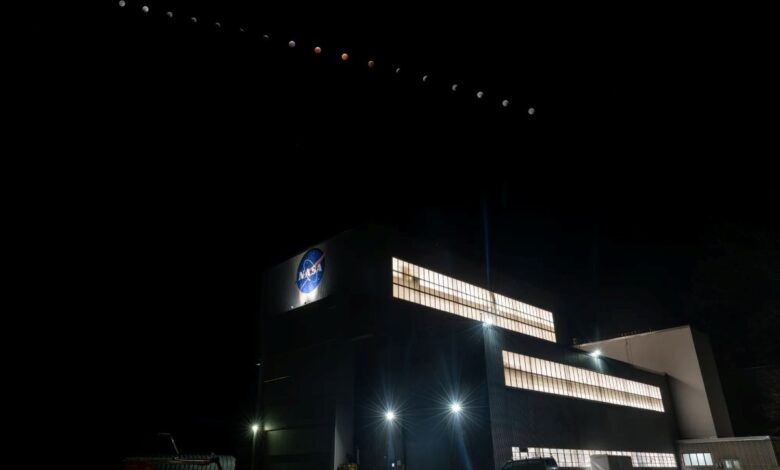
Blood Moon Lunar Eclipse
The phases of the lunar eclipse are visible in this time-lapse image of the Moon above the Space Environments Complex at NASA’s Glenn Research Center at NASA’s Neil Armstrong Test Facility in Sandusky, OH on March 14, 2025. Toward the middle of the Moon’s track through the sky, it appears red – this is the Blood Moon. One meaning of a “Blood…
Read More » -
NASA

The Next Full Moon is the Worm Moon
The next full moon is called the Worm Moon. Also, there will be a total lunar eclipse this full moon. The Moon will be full early Friday morning, March 14, at 2:55 a.m. EDT, but will appear full for about three days around this time, from Wednesday evening into Saturday morning. The phases of the Moon for March 2025. As…
Read More » -
NASA

What You Need To Know About the March 2025 Total Lunar Eclipse
The Moon will pass into Earth’s shadow and appear to turn red on the night of March 13 or early in the morning of March 14, depending on time zone. Here’s what you need to know about the total lunar eclipse. The March 2025 total lunar eclipse will take place between late night on March 13 and early morning on…
Read More »