
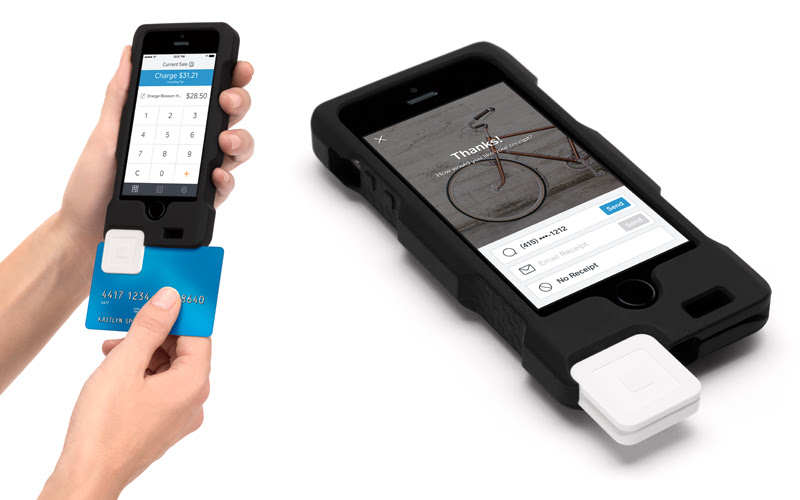
Nashville, Tenn. – January 14, 2014 – After a successful announcement at the 2014 Consumer Electronics Show, Griffin Technology’s Merchant Case + Square Reader is now shipping. The Merchant case is the first protective solution optimized for the new Square Reader.
“We’re extremely excited about the enthusiastic response to the Merchant case. Our case, combined with a Square Reader, is a perfect solution for business on-the-go,” said J. Curtis, Director of B2B Product Development at Griffin.

The Merchant case is custom-molded to secure the Square Reader in place and eliminate excess strain on the iPhone’s headphone jack when connected. A groove along the bottom aligns with the Square Reader and allows credit cards to slide through easily and consistently. Made from a durable silicone, the case protects the phone from bumps and drops and the case’s non-slip material makes it easy to hand over for customers’ signatures. Additionally, an integrated slot located on the back of the case conveniently stores the Square Reader when it’s not in use.

Merchant Case + Square Reader works with Square Register, the free point of sale app that lets anyone, anywhere, accept credit card payments and run their business. With a customizable checkout flow, smart business analytics, and digital receipts, Square Register serves the needs of businesses of all sizes and types, from a locksmith to a retail store.
Griffin’s Merchant case includes the new Square Reader and is now available for $19.99 at store.griffintechnology.com/
To see the Merchant Case + Square Reader in action visit: http://bit.ly/1dqfdTY.
About Griffin Technology
Founded on Paul Griffin’s kitchen table in 1992, Griffin Technology Inc., is today one of the world’s foremost creators of accessories for home, mobile, and personal technology. Unique products such as iTrip®, PowerMate®, iFM®, iMic® and Evolve® Wireless Speaker System have broken new ground in consumer electronics and created loyal fans the world over. Today, Griffin products are conceived, designed and developed in-house and continue to push the envelope of the industry they helped create. Learn more about Griffin’s entire range of ingenious designs atwww.griffintechnology.com, www.facebook.com/griffintech and on Twitter @griffintech.
About Square, Inc.
Square is making commerce easy for everyone. Whether a business needs to accept credit cards, manage a full point of sale system, or sell online, Square offers simple and affordable tools so businesses of all sizes can start, run, and grow. The company began with a free credit card reader for the iPhone, iPad, and Android devices, allowing businesses to accept credit cards anywhere, anytime, for one low, transparent rate. Square now offers a full suite of hardware and software tools including Square Register, Square Stand, Square Market, Square Wallet, and Square Cash. Founded in 2009, and headquartered in San Francisco, Square is currently available in the United States, Canada, and Japan.