
NASA
-
NASA

Terra: The End of An Era
Introduction Launched into the night sky nearly 26 years ago, on Dec. 19, 1999, from Vandenberg Air Force Base (now Space Force Base), Terra was NASA’s first Earth Observing System (EOS) flagship mission to study Earth’s land surface from space via a coordinated series of polar-orbiting and low-inclination satellites that produce long-term global observations useful for understanding the interactions between…
Read More » -
NASA
The Final Earth Observer Editor’s Corner: October–December 2025
It is with a heavy heart that I announce that NASA Earth Science Communications has directed The Earth Observer to conduct an orderly shutdown of the publication. No new content will be published after Dec. 31, 2025. While the sunset of The Earth Observer is bittersweet for our team, the good news is that all of the rich historical and descriptive content preserved on The…
Read More » -
NASA

The State of CERES: Updates and Highlights
Introduction The Clouds and the Earth’s Radiant Energy System (CERES) was initially designed in the late-1980s and early-1990s as a facility instrument for NASA’s Earth Observing System (EOS). Since its inception, NASA’s Langley Research Center (LaRC) has led this effort. CERES has a long history with seven different instruments flying on five different missions since 1997. As of today, six CERES instruments…
Read More » -
NASA
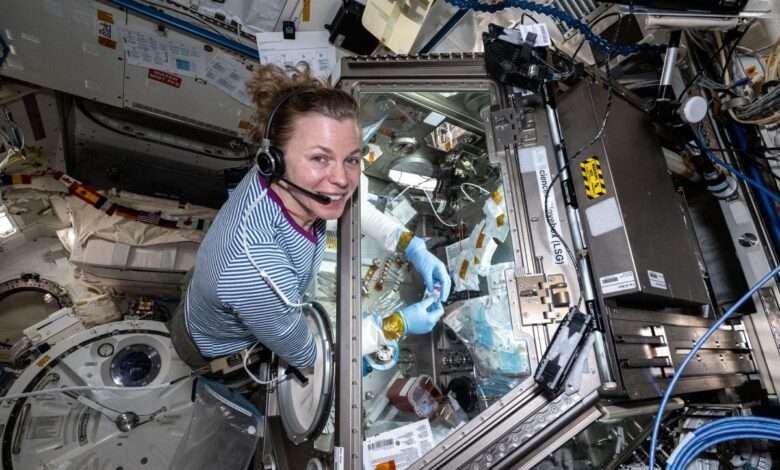
2025 Space Station Science Snapshots
2025 marks another year pushing the boundaries of scientific research aboard the International Space Station. This past year, over 750 investigations were conducted aboard the space station, supported by crewed missions and resupply vehicles delivering essential cargo and experiments to the orbiting laboratory. This year’s research included testing DNA’s ability to store data, producing vital nutrients on demand, demonstrating technology…
Read More » -
NASA
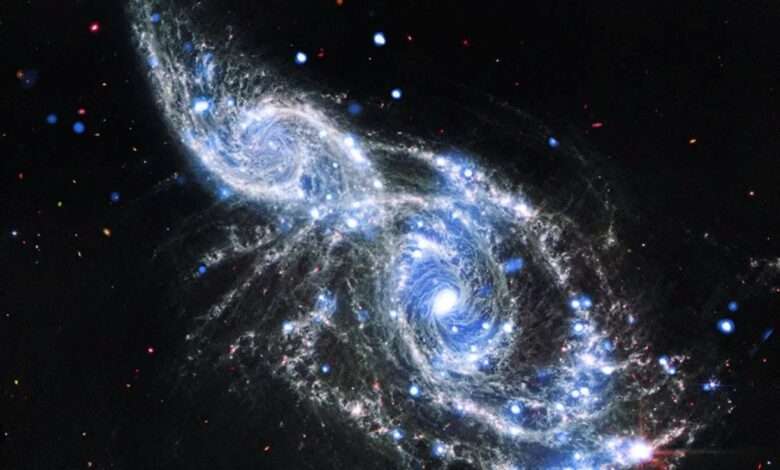
A Galactic Embrace
Mid-infrared data from NASA’s James Webb Space Telescope (in white, gray, and red) and X-ray data from NASA’s Chandra X-ray Observatory (in blue) come together in this photo of colliding spiral galaxies released on Dec. 1, 2025. The pair grazed one another millions of years ago; billions of years in the future, they will merge into a single galaxy. Image…
Read More » -
NASA
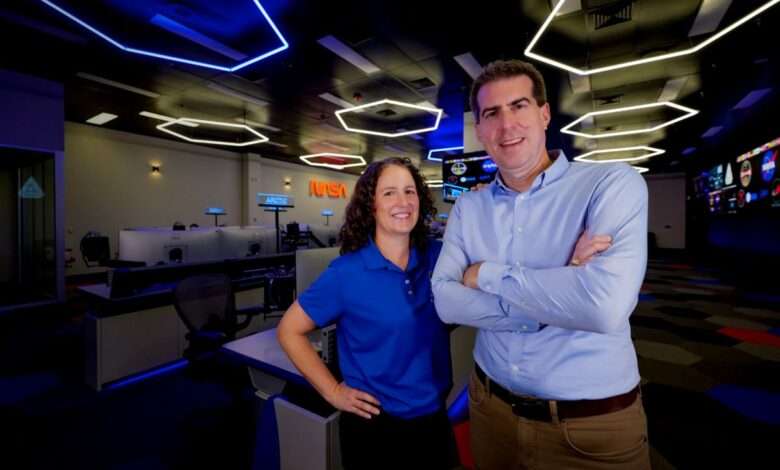
I Am Artemis: Jen Madsen and Trey Perryman
During NASA’s Artemis II mission, Jen Madsen and Trey Perryman will be leading a team monitoring the Orion spacecraft as it carries four astronauts around the Moon. The team works in the Orion Mission Evaluation Room where they will monitor and analyze Orion’s systems and performance in real time to help ensure crew safety and mission success. As the leaders of the…
Read More » -
NASA

Studying Physics in Microgravity
In this Oct. 20, 2025, photo, tiny ball bearings surround a larger central bearing during the Fluid Particles experiment, conducted inside the Microgravity Science Glovebox (MSG) aboard the International Space Station’s Destiny laboratory module. A bulk container installed in the MSG, filled with viscous fluid and embedded particles, is subjected to oscillating frequencies to observe how the particles cluster and form larger structures…
Read More » -
NASA

Santa Visits Artemis II Rocket
Santa Claus (NASA engineer Guy Naylor) poses with NASA’s Artemis II Orion spacecraft and SLS (Space Launch System) rocket in the Vehicle Assembly Building at NASA’s Kennedy Space Center in Florida on Dec. 11, 2025. The Orion spacecraft was stacked atop the SLS in October 2025. Set to launch in early 2026, the Artemis II test flight will be NASA’s first mission with crew…
Read More » -
NASA
OPERA: Addressing Societal Needs with Satellite Data
Introduction The Observational Products for End-Users from Remote Sensing Analysis (OPERA) project represents a strategic initiative designed to address critical satellite data needs identified by federal agencies. Established in 2021 by the NASA/Jet Propulsion Laboratory (JPL), OPERA responds to priorities identified by the Satellite Needs Working Group (SNWG), an interagency body convened by the White House Office of Management and Budget (OMB) and Office of…
Read More » -
NASA
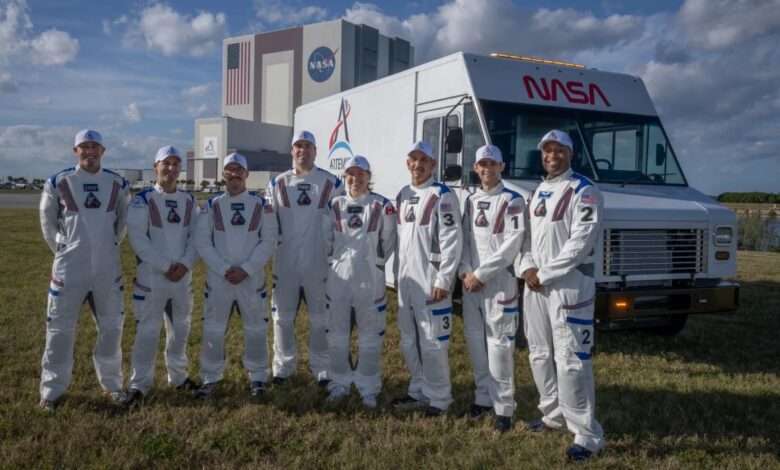
Get In, We’re Going Moonbound: Meet NASA’s Artemis Closeout Crew
For most, getting into a car is a task that can be done without assistance. Yet for those whose destination is the Moon, the process of getting inside and secured – in this case, in NASA’s Orion spacecraft – requires help. That’s the role of the Artemis closeout crew. Trained to support Artemis II and future Moon missions, the five closeout crew…
Read More »