
NASA
-
NASA
NASA Awards Simulation and Advanced Software Services II Contract
NASA has awarded a contract to MacLean Engineering & Applied Technologies, LLC of Houston to provide simulation and advanced software services to the agency. The Simulation and Advanced Software Services II (SASS II) contract includes services from Oct. 1, 2025, through Sept. 30, 2030, with a maximum potential value not to exceed $150 million. The contract is a single award,…
Read More » -
NASA

What’s Up: July 2025 Skywatching Tips from NASA
A.M./P.M. Planet Watching, Plus the Eagle Constellation Mars shines in the evening, and is joined briefly by Mercury. Jupiter joins Venus as the month goes on. And all month, look for Aquila the eagle. Skywatching Highlights All Month – Planet Visibility: Venus: Shines brightly in the east each morning during the couple of hours before sunrise, with the Pleiades and bright…
Read More » -
NASA
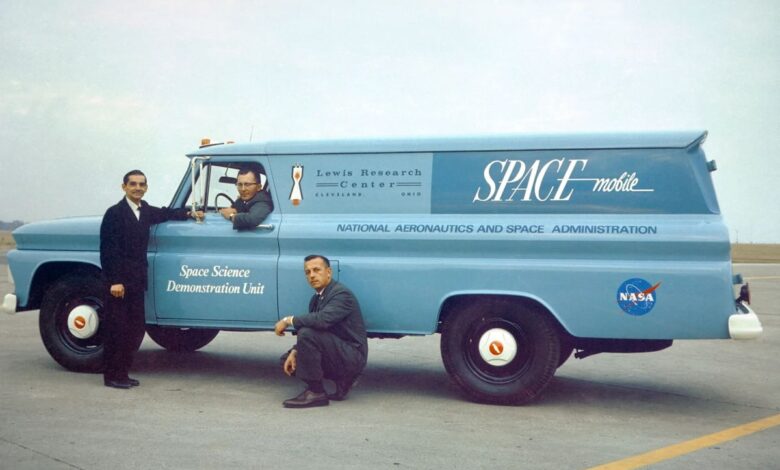
To the Spacemobile!
In this Nov. 1, 1964, image, three members of NASA’s Lewis Research Center’s (now NASA’s Glenn Research Center in Cleveland) Educational Services Office pose with one of the center’s Spacemobile space science demonstration units. Once the NACA (National Advisory Committee for Aeronautics) became NASA, public outreach became one of the agency’s core tenets. Lewis, which had previously been a closed laboratory, began…
Read More » -
NASA

Near-Earth Asteroids as of July 2025
Each month, NASA’s Planetary Defense Coordination Office releases a monthly update featuring the most recent figures on NASA’s planetary defense efforts, near-Earth object close approaches, and other timely facts about comets and asteroids that could pose an impact hazard with Earth. Here is what we’ve found so far. Updated: July 2, 2025
Read More » -
NASA

3 Years of Science: 10 Cosmic Surprises from NASA’s Webb Telescope
Since July 2022, NASA’s James Webb Space Telescope has been unwaveringly focused on our universe. With its unprecedented power to detect and analyze otherwise invisible infrared light, Webb is making observations that were once impossible, changing our view of the cosmos from the most distant galaxies to our own solar system. Webb was built with the promise of revolutionizing astronomy, of…
Read More » -
NASA
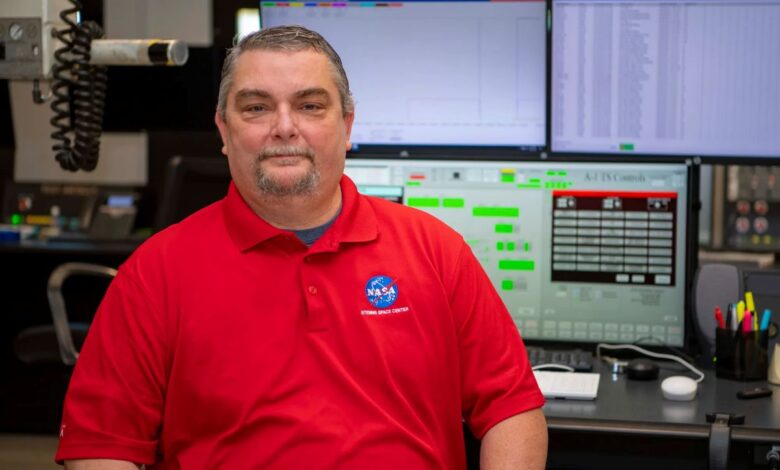
NASA Stennis Engineer Takes Pride in Test Support Work
As a controls engineer at NASA’s Stennis Space Center near Bay St. Louis, Mississippi, Dwayne Lavigne does not just fix problems – he helps put pieces together at America’s largest rocket propulsion test site. “There are a lot of interesting problems to solve, and they are never the same,” Lavigne said. “Sometimes, it is like solving a very cool puzzle…
Read More » -
NASA

Curiosity Blog, Sols 4586-4587: Straight Drive, Strategic Science
Written by Scott VanBommel, Planetary Scientist at Washington University in St. Louis Earth planning date: Monday, June 30, 2025 Our weekend drive placed Curiosity exactly where we had hoped: on lighter-toned, resistant bedrock we have been eyeing for close study. Curiosity’s workspace tosol did not contain any targets suitable for DRT. After a detailed discussion by the team, weighing science not only…
Read More » -
NASA
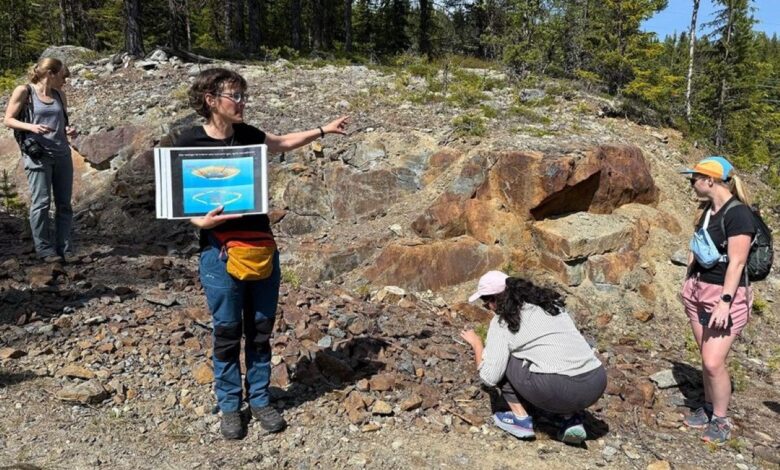
An Update From the 2025 Mars 2020 Science Team Meeting
A behind-the-scenes look at the annual Mars 2020 Science Team Meeting Members of the Mars 2020 Science Team examine post-impact sediments within the Gardnos impact structure, northwest of Oslo, Norway, as part of the June 2025 Science Team Meeting. NASA/Katie Stack Morgan Written by Katie Stack Morgan, Mars 2020 Acting Project Scientist The Mars 2020 Science Team gathered for a…
Read More » -
NASA

Curiosity Blog, Sols 4584–4585: Just a Small Bump
Written by Abigail Fraeman, Deputy Project Scientist at NASA’s Jet Propulsion Laboratory Earth planning date: Friday, June 27, 2025 We weren’t able to unstow Curiosity’s robotic arm on Wednesday because of some potentially unstable rocks under Curiosity’s wheels, but we liked the rocks at Wednesday’s location enough that we decided to spend a sol repositioning the rover so that we’d have…
Read More » -
NASA
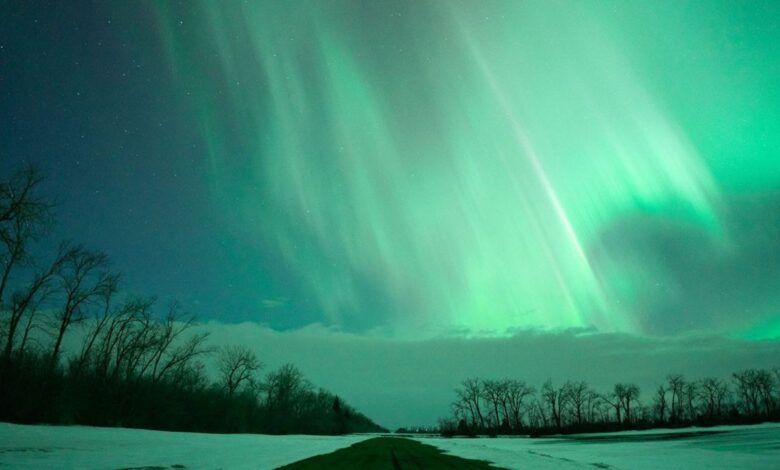
NASA Missions Help Explain, Predict Severity of Solar Storms
An unexpectedly strong solar storm rocked our planet on April 23, 2023, sparking auroras as far south as southern Texas in the U.S. and taking the world by surprise. Two days earlier, the Sun blasted a coronal mass ejection (CME) — a cloud of energetic particles, magnetic fields, and solar material — toward Earth. Space scientists took notice, expecting it could…
Read More »