
NASA
-
NASA

NASA’s Dawn Sees Crescent Ceres
NASA’s Dawn spacecraft took this image of Ceres’ south polar region on May 17, 2017. Launched on Sept. 27, 2007, Dawn was NASA’s first truly interplanetary spaceship. The mission featured extended stays at two extraterrestrial bodies: giant asteroid Vesta and dwarf planet Ceres, both in the debris-strewn main asteroid belt between Mars and Jupiter. The spacecraft’s name was meant to present a…
Read More » -
NASA
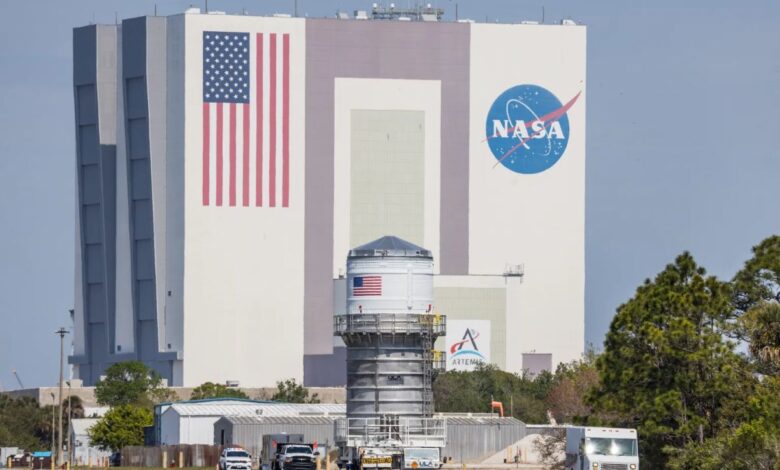
Artemis II Upper Stage Delivered to Kennedy
NASA received the upper stage for the agency’s Artemis II SLS (Space Launch System) rocket on Mar. 9 supplied by Boeing and United Launch Alliance (ULA). Known as the interim cryogenic propulsion stage, it arrived at the Multi Payload Processing Facility (MPPF) at NASA’s Kennedy Space Center in Florida. The upper stage traveled to the spaceport from ULA’s Delta Operations Center…
Read More » -
NASA

NASA Ames Science Directorate: Stars of the Month – March 2025
The NASA Ames Science Directorate recognizes the outstanding contributions of (pictured left to right) Jessica Kong, Josh Alwood, and Sam Kim. Their commitment to the NASA mission represents the entrepreneurial spirit, technical expertise, and collaborative disposition needed to explore this world and beyond. Space Science and Astrobiology Star: Jessica Kong Jessica Kong is serving as the Facility Service Manager (FSM)…
Read More » -
NASA
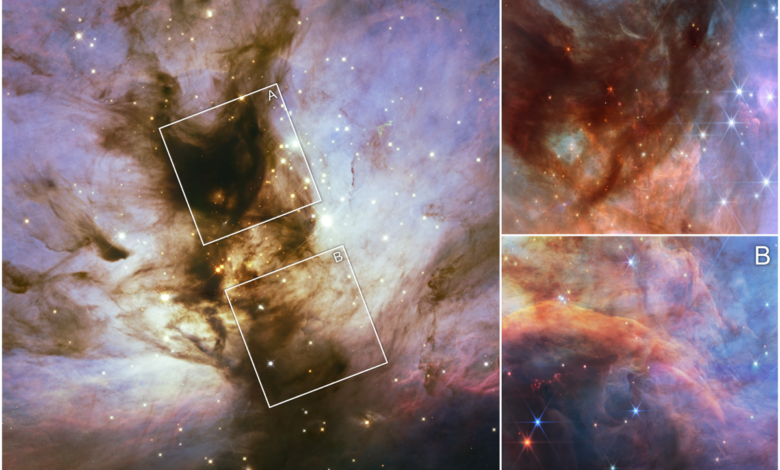
NASA’s Webb Peers Deeper into Mysterious Flame Nebula
The Flame Nebula, located about 1,400 light-years away from Earth, is a hotbed of star formation less than 1 million years old. Within the Flame Nebula, there are objects so small that their cores will never be able to fuse hydrogen like full-fledged stars—brown dwarfs. Brown dwarfs, often called “failed stars,” over time become very dim and much cooler than…
Read More » -
NASA

Moon Mascot: NASA Artemis II ZGI Design Challenge
Will you design the zero gravity indicator (ZGI) that accompanies the Artemis II mission around the Moon? If your design is one of the most compelling and resonates with the global community and the Artemis II astronauts, your design might fly into space aboard the Orion spacecraft and you could win US$1225. Zero gravity indicators are small items carried aboard spacecraft…
Read More » -
NASA
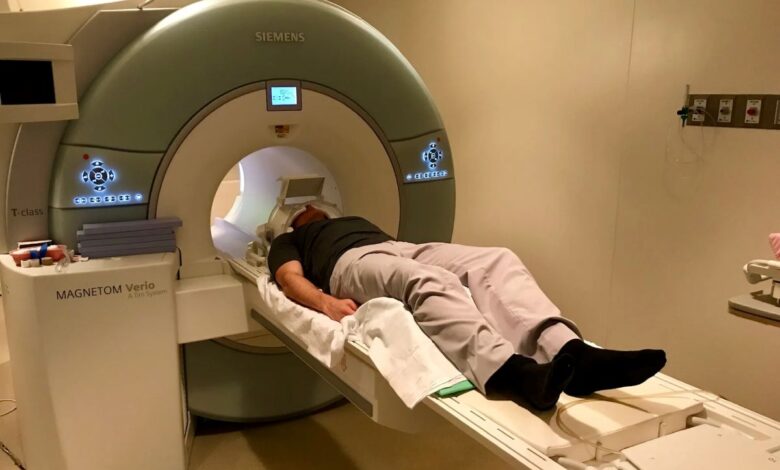
Station Science Top News: March 7, 2025
Researchers found that an upward shift in the brain during spaceflight makes it hard to distinguish different types of tissue, causing errors in determining changes in brain volume. Previous studies have interpreted these changes as evidence of adaptation to space. This finding suggests that unique methods are needed to analyze astronaut brain structure. Wayfinding, a CSA (Canadian Space Agency) investigation,…
Read More » -
NASA
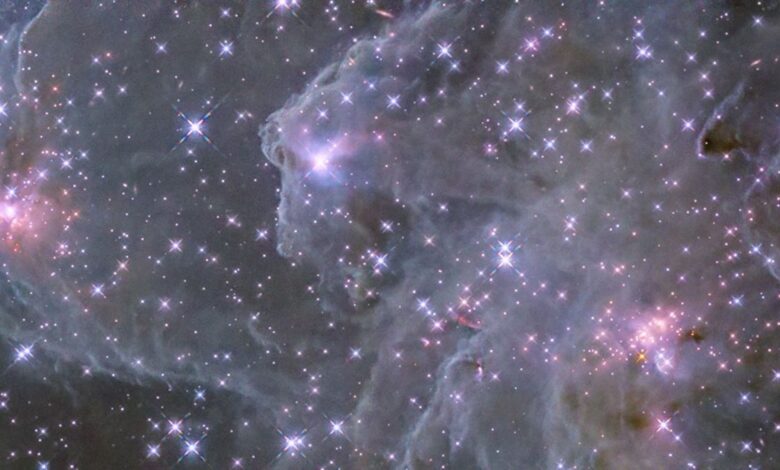
Hubble Unveils a Glittering View of Sh2-284
Download this image A tiny fraction of the stellar nursery known as Sh2-284 is visible in this glittering, star-filled NASA Hubble Space Telescope image. This immense region of gas and dust is the birthing place of stars, which shine among the clouds. Bright clusters of newborn stars glow pink in infrared light, and clouds of gas and dust, resembling puffy cumulus clouds,…
Read More » -
NASA
James Gentile: Shaping the Artemis Generation, One Simulation at a Time
James Gentile always wanted to fly. As he prepared for an appointment to the U.S. Air Force Academy to become a pilot, life threw him an unexpected curve: a diagnosis of Type 1 diabetes. His appointment was rescinded. With his dream grounded, Gentile had two choices—give up or chart a new course. He chose the latter, pivoting to aerospace engineering.…
Read More » -
NASA

Hubble Examines Stars Ensconced in a Cocoon of Gas
Download this image An open cluster of stars shines through misty, cocoon-like gas clouds in this Hubble Space Telescope image of NGC 460. NGC 460 is located in a region of the Small Magellanic Cloud, a dwarf galaxy that orbits the Milky Way. This particular region contains a number of young star clusters and nebulae of different sizes ― all likely related…
Read More » -
NASA

Hubble Spies a Spectacular Starburst Galaxy
Sweeping spiral arms extend from NGC 4536, littered with bright blue clusters of star formation and red clumps of hydrogen gas shining among dark lanes of dust. The galaxy’s shape may seem a little unusual, and that’s because it’s what’s known as an “intermediate galaxy”: not quite a barred spiral, but not exactly an unbarred spiral, either ― a hybrid…
Read More »