
Solar Dynamics Observatory
-
NASA
Volunteers Find Oddly High Solar Flare Rates
Patches of the Sun’s surface often show strong magnetic fields. These fields can emerge within a matter of hours, and can decay slowly or quickly, sometimes over days, weeks, or even months. Thanks to a new study about these long-lived active regions, we now know much more about the patches where these strong magnetic fields take at least a month to…
Read More » -
NASA
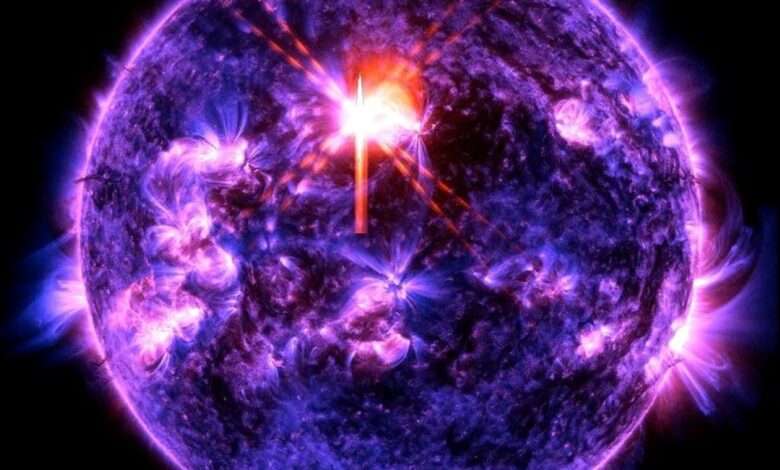
Strong Solar Flare
This Feb. 4, 2026, image from NASA’s Solar Dynamics Observatory (SDO) captures a strong solar flare erupting from the star. Solar flares are powerful bursts of energy that can, along with other types of solar eruptions, can impact radio communications, electric power grids, navigation signals, and pose risks to spacecraft and astronauts. The flare pictured was classified as an X4.2 flare. X-class…
Read More » -
NASA
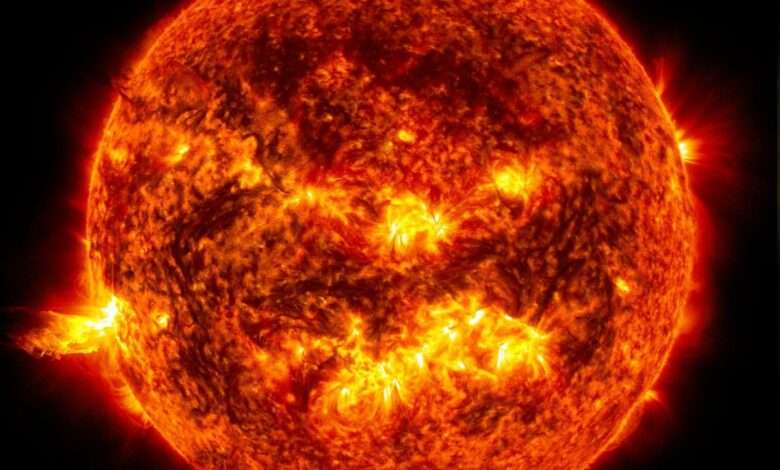
NASA, IBM’s ‘Hot’ New AI Model Unlocks Secrets of Sun
Editor’s Note: This article was updated Aug. 20, 2025, to correct the number of years of training data used and the model accuracy. The original article said the model was trained on 14 years of Solar Dynamics Observatory data and surpassed existing benchmarks by 15%; the model was actually trained on 9 years of data and surpassed existing benchmarks by 16%.…
Read More » -
NASA
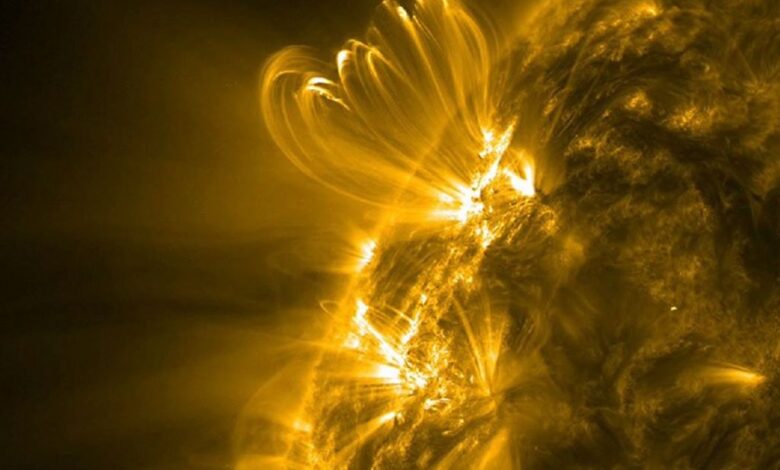
NASA Solar Observatory Sees Coronal Loops Flicker Before Big Flares
For decades, scientists have tried in vain to accurately predict solar flares — intense bursts of light on the Sun that can send a flurry of charged particles into the solar system. Now, using NASA’s Solar Dynamics Observatory, one team has identified flickering loops in the solar atmosphere, or corona, that seem to signal when the Sun is about to…
Read More » -
NASA
NASA Awards Contract Extension for Solar Science Instrument
NASA has awarded a contract extension to Stanford University, California, to continue the mission and services for the Helioseismic and Magnetic Imager (HMI) instrument on the agency’s Solar Dynamics Observatory (SDO). NASA has awarded a contract extension to Stanford University, California, to continue the mission and services for the Helioseismic and Magnetic Imager (HMI) instrument on the agency’s Solar Dynamics…
Read More » -
NASA
Scientists Use NASA Data to Predict Solar Corona Before Eclipse
Our Sun, like many stars, is adorned with a crown. It’s called a corona (Latin for “crown” or “wreath”) and consists of long, thread-like strands of plasma billowing out from the Sun’s surface. The powerful magnetic field of the Sun defines these strands, causing them to ripple and evolve their structures constantly. The strands are faint, however, so the only way to…
Read More » -
NASA

NASA Engineers Push Limits of Physics to Focus Light
Photon sieves focus extreme ultraviolet light and can enable Sun science. A pair of precision-orbiting small satellites will attempt to capture the first views ever of small-scale features near the surface of the Sun that scientists believe drive the heating and acceleration of solar wind. Heliophysicist Dr. Doug Rabin at NASA’s Goddard Space Flight Center in Greenbelt, Maryland, said photon sieves, a…
Read More »