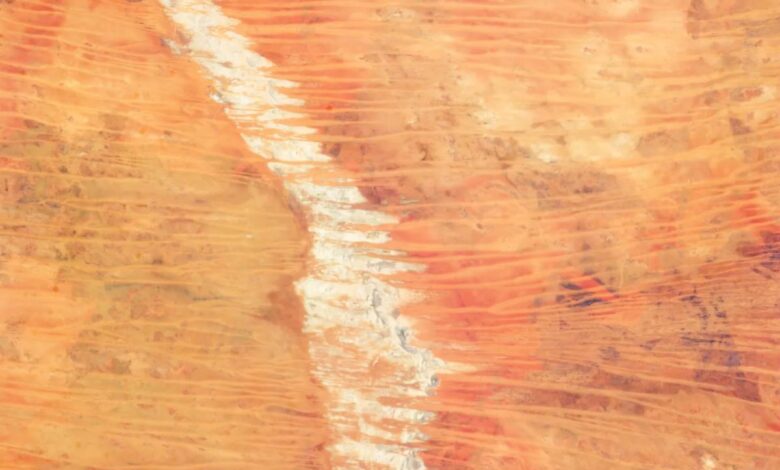
On March 25, 2013, an astronaut aboard the International Space Station took this photo of the Great Sandy Desert in northwest Australia, showcasing linear dunes separated in a roughly regular fashion. When you fly over such dune fields—either in an airplane or the space station—the fire scars stand out. Where thin vegetation has been burned, the dunes appear red from the underlying sand; dunes appear darker where the vegetation remains.
Strings of narrow lakes that represent ancient rivers are also present in the region. The white feature down the center of the image is Lake Auld. The color is the result of a cemented combination of fine, clay-like sediment and salts from the evaporation of flood waters that occasionally fill the lake. Linear dunes can be seen entering Lake Auld on the east side. During flooding events, the sand of the dune noses is dispersed, becoming incorporated into the muds and salts of the lake floor sediments. During the long, intervening dry periods, sand can blow across the lake floor to build thinner, smaller dunes, visible as linear accumulations on the west side of the lake.
See more photos taken by astronauts.
Text credit: NASA/M. Justin Wilkinson
Image credit: NASA
About The Author