
Webb
-
NASA
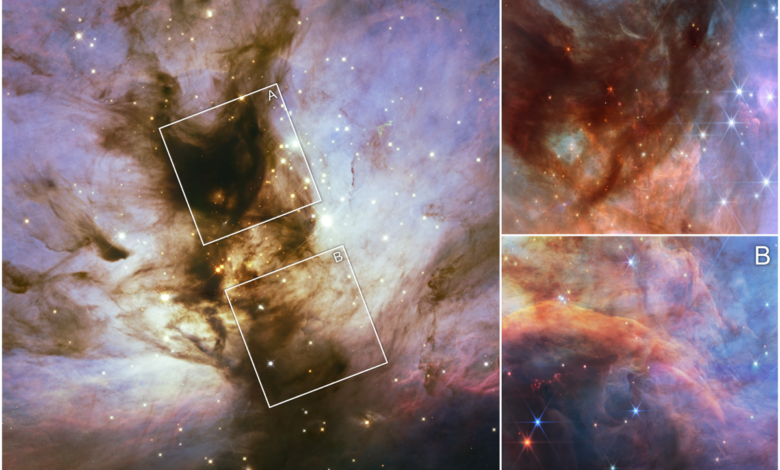
NASA’s Webb Peers Deeper into Mysterious Flame Nebula
The Flame Nebula, located about 1,400 light-years away from Earth, is a hotbed of star formation less than 1 million years old. Within the Flame Nebula, there are objects so small that their cores will never be able to fuse hydrogen like full-fledged stars—brown dwarfs. Brown dwarfs, often called “failed stars,” over time become very dim and much cooler than…
Read More » -
NASA

NASA Webb Wows With Incredible Detail in Actively Forming Star System
High-resolution near-infrared light captured by NASA’s James Webb Space Telescope shows extraordinary new detail and structure in Lynds 483 (L483). Two actively forming stars are responsible for the shimmering ejections of gas and dust that gleam in orange, blue, and purple in this representative color image. Over tens of thousands of years, the central protostars have periodically ejected some of the gas…
Read More » -
NASA
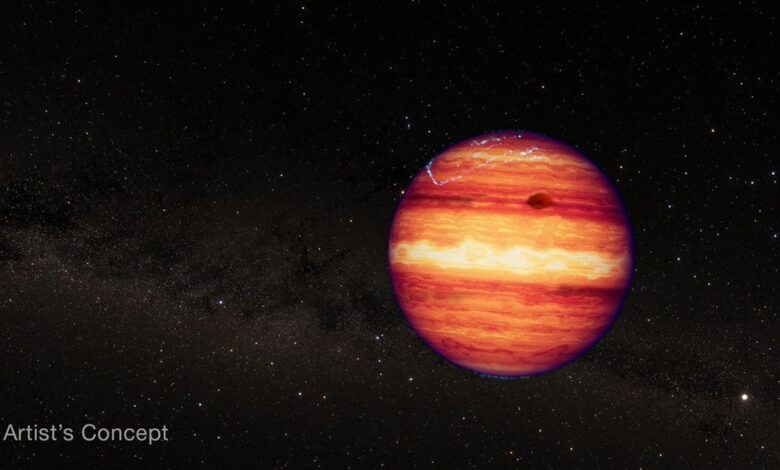
NASA’s Webb Exposes Complex Atmosphere of Starless Super-Jupiter
An international team of researchers has discovered that previously observed variations in brightness of a free-floating planetary-mass object known as SIMP 0136 must be the result of a complex combination of atmospheric factors, and cannot be explained by clouds alone. Using NASA’s James Webb Space Telescope to monitor a broad spectrum of infrared light emitted over two full rotation periods by SIMP…
Read More » -
NASA
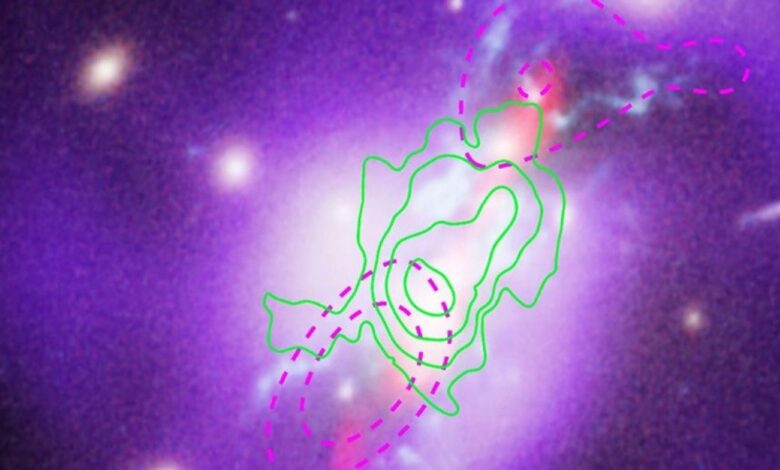
Webb Maps Full Picture of How Phoenix Galaxy Cluster Forms Stars
Discovery proves decades-old theory of galaxy feeding cycle. Researchers using NASA’s James Webb Space Telescope have finally solved the mystery of how a massive galaxy cluster is forming stars at such a high rate. The confirmation from Webb builds on more than a decade of studies using NASA’s Chandra X-ray Observatory and Hubble Space Telescope, as well as several ground-based…
Read More » -
NASA
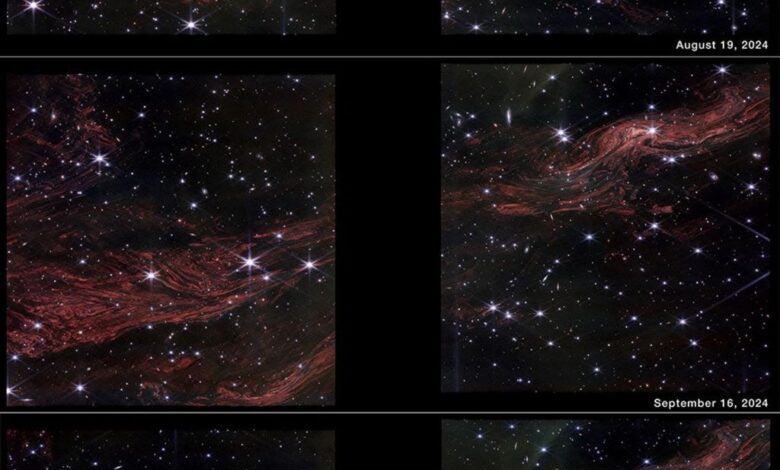
NASA’s Webb Reveals Intricate Layers of Interstellar Dust, Gas
Once upon a time, the core of a massive star collapsed, creating a shockwave that blasted outward, ripping the star apart as it went. When the shockwave reached the star’s surface, it punched through, generating a brief, intense pulse of X-rays and ultraviolet light that traveled outward into the surrounding space. About 350 years later, that pulse of light has…
Read More » -
NASA
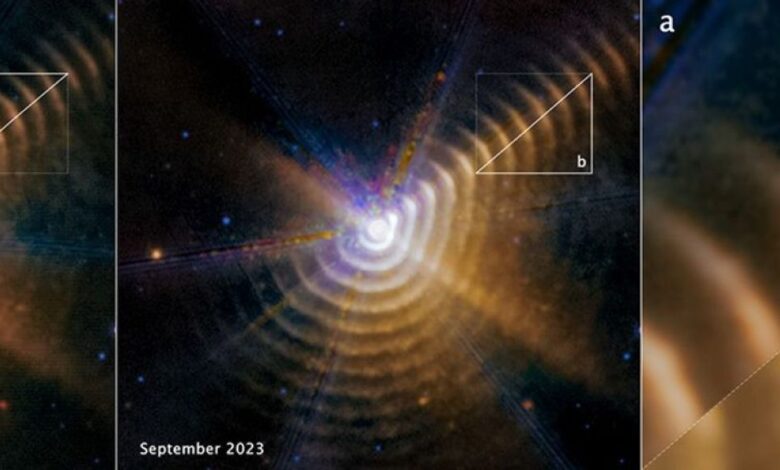
Webb Watches Carbon-Rich Dust Shells Form, Expand in Star System
Astronomers have long tried to track down how elements like carbon, which is essential for life, become widely distributed across the universe. Now, NASA’s James Webb Space Telescope has examined one ongoing source of carbon-rich dust in our own Milky Way galaxy in greater detail: Wolf-Rayet 140, a system of two massive stars that follow a tight, elongated orbit. As…
Read More » -
NASA
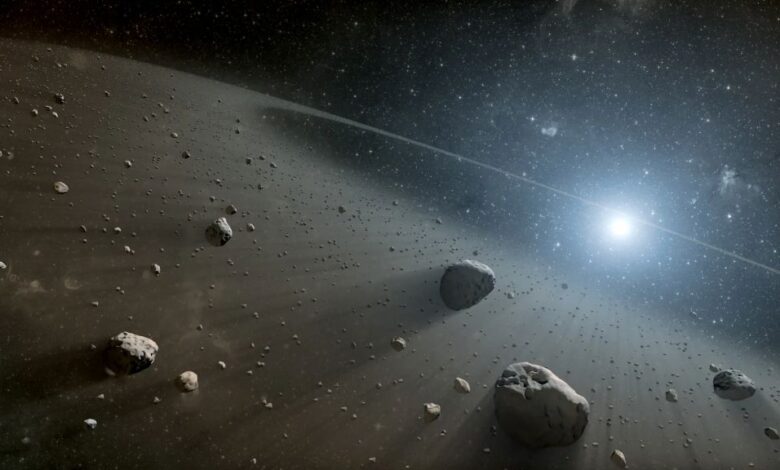
NASA’s Webb Reveals Smallest Asteroids Yet Found in Main Asteroid Belt
NASA’s powerful James Webb Space Telescope includes asteroids on its list of objects studied and secrets revealed. A team led by researchers at the Massachusetts Institute of Technology (MIT) in Cambridge repurposed Webb’s observations of a distant star to reveal a population of small asteroids — smaller than astronomers had ever detected orbiting the Sun in the main asteroid belt between Mars and Jupiter.…
Read More » -
NASA
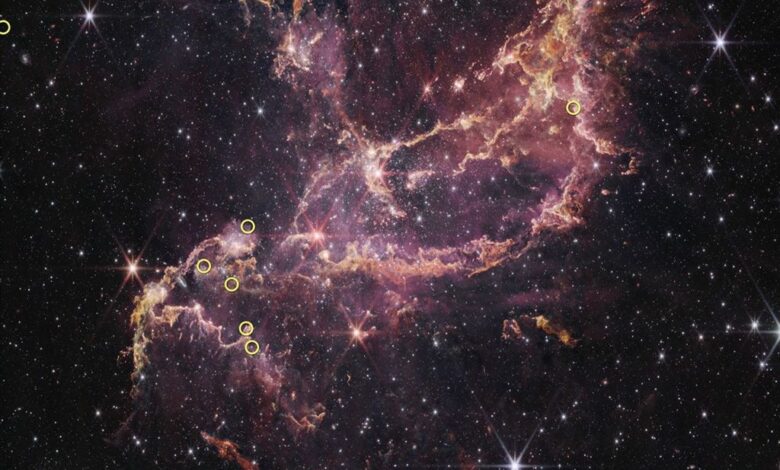
NASA’s Webb Finds Planet-Forming Disks Lived Longer in Early Universe
NASA’s James Webb Space Telescope just solved a conundrum by proving a controversial finding made with the agency’s Hubble Space Telescope more than 20 years ago. In 2003, Hubble provided evidence of a massive planet around a very old star, almost as old as the universe. Such stars possess only small amounts of heavier elements that are the building blocks of planets.…
Read More » -
NASA
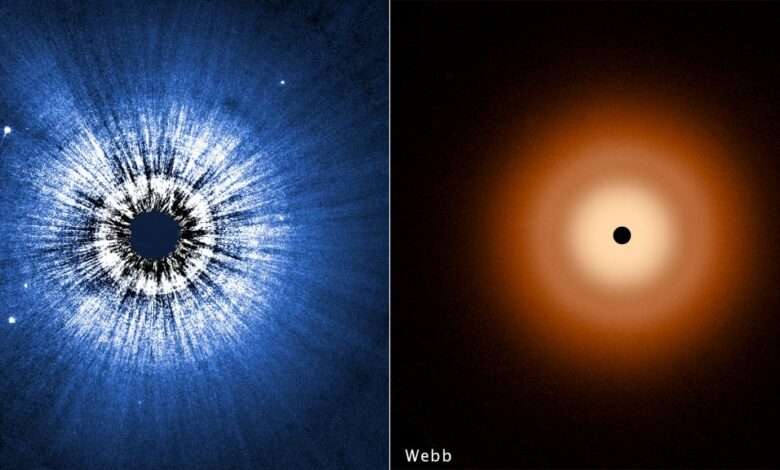
NASA’s Hubble, Webb Probe Surprisingly Smooth Disk Around Vega
In the 1997 movie “Contact,” adapted from Carl Sagan’s 1985 novel, the lead character scientist Ellie Arroway (played by actor Jodi Foster) takes a space-alien-built wormhole ride to the star Vega. She emerges inside a snowstorm of debris encircling the star — but no obvious planets are visible. It looks like the filmmakers got it right. A team of astronomers…
Read More » -
NASA
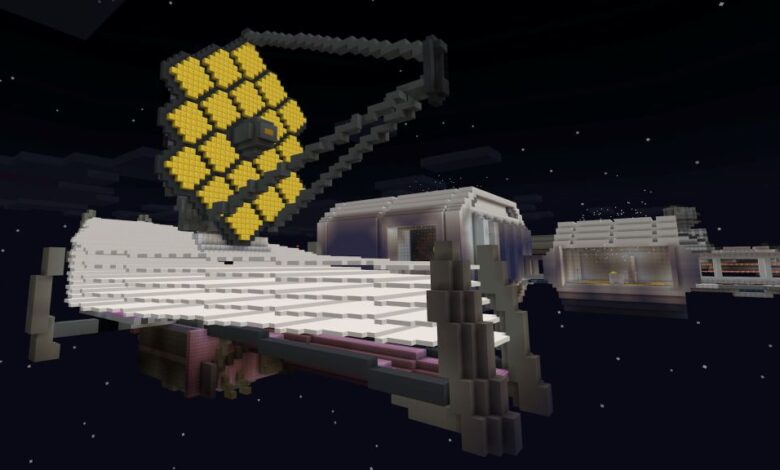
Journey Through Stars with NASA in New Minecraft Game
NASA invites gamers, educators, and students to grab their pickaxe and check out its latest collaboration with Minecraft exploring a new world inspired by the agency’s James Webb Space Telescope. The partnership allows creators to experience NASA’s discoveries with interactive modules on star formation, planets, and galaxy types, modeled using real Webb images. The James Webb Space Telescope Challenges were developed…
Read More »