




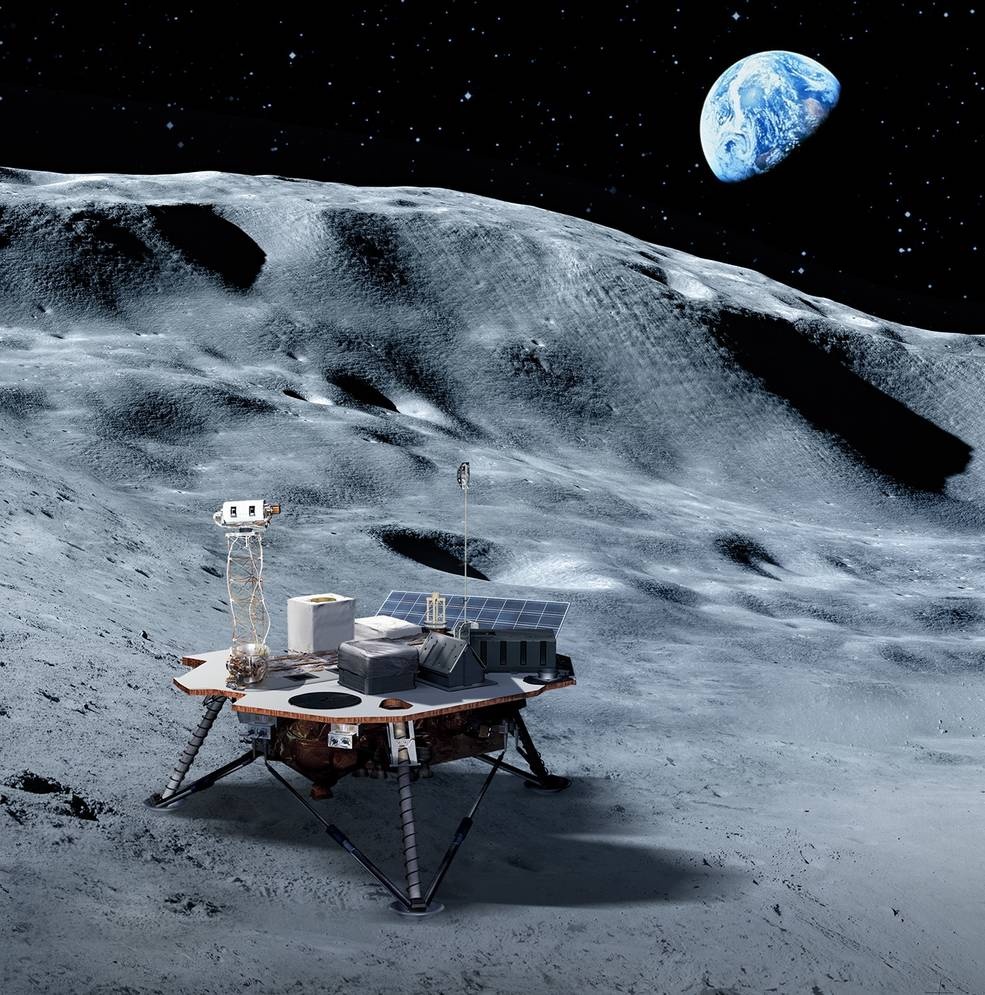
NASA has selected 12 new science and technology payloads that will help us study the Moon and explore more of its surface as part of the agency’s Artemislunar program. These investigations and demonstrations will help the agency send astronauts to the Moon by 2024 as a way to prepare to send humans to Mars for the first time.
The selected investigations will go to the Moon on future flights through NASA’s Commercial Lunar Payload Services (CLPS) project. The CLPS project allows rapid acquisition of lunar delivery services for payloads like these that advance capabilities for science, exploration, or commercial development of the Moon. Many of the new selections incorporate existing hardware, such as parts or models designed for missions that have already flown. Seven of the new selections are focused on answering questions in planetary science or heliophysics, while five will demonstrate new technologies.
“The selected lunar payloads represent cutting-edge innovations, and will take advantage of early flights through our commercial services project,” said Thomas Zurbuchen, associate administrator of the agency’s Science Mission Directorate in Washington. “Each demonstrates either a new science instrument or a technological innovation that supports scientific and human exploration objectives, and many have broader applications for Mars and beyond.”
The 12 selected investigations are:
MoonRanger
- MoonRanger is a small, fast-moving rover that has the capability to drive beyond communications range with a lander and then return to it. This will enable investigations within a 0.6-mile (1 kilometer) range from the lander. MoonRanger will aim to continually map the terrain it traverses, and transmit data for future system improvement.
- The principal investigator is Andrew Horchler of Astrobotic Technology, Inc., Pittsburgh.
Heimdall
- Heimdall is a flexible camera system for conducting lunar science on commercial vehicles. This innovation includes a single digital video recorder and four cameras: a wide-angle descent imager, a narrow-angle regolith imager, and two wide-angle panoramic imagers. This camera system is intended to model the properties of the Moon’s regolith – the soil and other material that makes up the top later of the lunar surface – and characterize and map geologic features, as well characterize potential landing or trafficability hazards, among other goals.
- The principal investigator is R. Aileen Yingst of the Planetary Science Institute, Tucson, Arizona.
Lunar Demonstration of a Reconfigurable, Radiation Tolerant Computer System.
- Lunar Demonstration of a Reconfigurable, Radiation Tolerant Computer System aims to demonstrate a radiation-tolerant computing technology. Due to the Moon’s lack of atmosphere and magnetic field, radiation from the Sun will be a challenge for electronics. This investigation also will characterize the radiation effects on the lunar surface.
- The principal investigator is Brock LaMeres of Montana State University, Bozeman.
Regolith Adherence Characterization (RAC) Payload
- RAC will determine how lunar regolith sticks to a range of materials exposed to the Moon’s environment at different phases of flight. Components of this experiment are derived from a commercial payload facility called MISSE currently on the International Space Station.
- The principal investigator is Johnnie Engelhardt of Alpha Space Test and Research Alliance, LLC, Houston.
The Lunar Magnetotelluric Sounder
- The Lunar Magnetotelluric Sounder is designed to characterize the structure and composition of the Moon’s mantle by studying electric and magnetic fields. The investigation will make use of a flight-spare magnetometer, a device that measures magnetic fields, originally made for the MAVENspacecraft, which is currently orbiting Mars.
- The principal investigator is Robert Grimm of the Southwest Research Institute, San Antonio.
The Lunar Surface Electromagnetics Experiment (LuSEE)
- LuSEE will integrate flight-spare and repurposed hardware from the NASA Parker Solar Probe FIELDS experiment, the STEREO/Waves instrument, and the MAVEN mission to make comprehensive measurements of electromagnetic phenomena on the surface of the Moon.
- The principal investigator is Stuart Bale of University of California, Berkeley.
The Lunar Environment heliospheric X-ray Imager (LEXI)
- LEXI will capture images of the interaction of Earth’s magnetosphere with the flow of charged particles from the Sun, called the solar wind.
- The principal investigator is Brian Walsh of Boston University.
Next Generation Lunar Retroreflectors (NGLR)
- NGLR will serve as a target for lasers on Earth to precisely measure the Earth-Moon distance. They are designed to provide data that could be used to constrain various aspects of the lunar interior and address questions of fundamental physics.
- The principal investigator is Douglas Currie of University of Maryland, College Park.
The Lunar Compact InfraRed Imaging System (L-CIRiS)
- L-CIRiS is targeted to deploy a radiometer, a device that measures infrared wavelengths of light, to explore the Moon’s surface composition, map its surface temperature distribution, and demonstrate the instrument’s feasibility for future lunar resource utilization activities.
- The principal investigator is Paul Hayne at the University of Colorado, Boulder.
The Lunar Instrumentation for Subsurface Thermal Exploration with Rapidity (LISTER)
- LISTER is an instrument designed to measure heat flow from the interior of the Moon. The probe will attempt to drill 7 to 10 feet (2 to 3 meters) into the lunar regolith to investigate the Moon’s thermal properties at different depths.
- The principal investigator is Seiichi Nagihara of Texas Tech University, Lubbock.
PlanetVac
- PlanetVac is a technology for acquiring and transferring lunar regolith from the surface to other instruments that would analyze the material, or put it in a container that another spacecraft could return to Earth.
- The principal investigator is Kris Zacny of Honeybee Robotics, Ltd., Pasadena, California.
SAMPLR: Sample Acquisition, Morphology Filtering, and Probing of Lunar Regolith
- SAMPLR is another sample acquisition technology that will make use of a robotic arm that is a flight spare from the Mars Exploration Rover mission, which included the long-lived rovers Spirit and Opportunity.
- The principal investigator is Sean Dougherty of Maxar Technologies, Westminster, Colorado.
NASA’s lunar exploration plans are based on a two-phase approach: the first is focused on speed – landing astronauts on the Moon by 2024 – while the second will establish a sustained human presence on the Moon by 2028. The agency will use what we learn on the Moon to prepare for the next giant leap – sending astronauts to Mars.
For more information about NASA and agency programs, visit:
https://www.nasa.gov/moontomars
About The Author


Got a Questions?
Find us on Socials or Contact us and we’ll get back to you as soon as possible.