Samsung Galaxy Tab S9 Sets the New Standard to Bring Galaxy’s Premium Experience to a Tablet

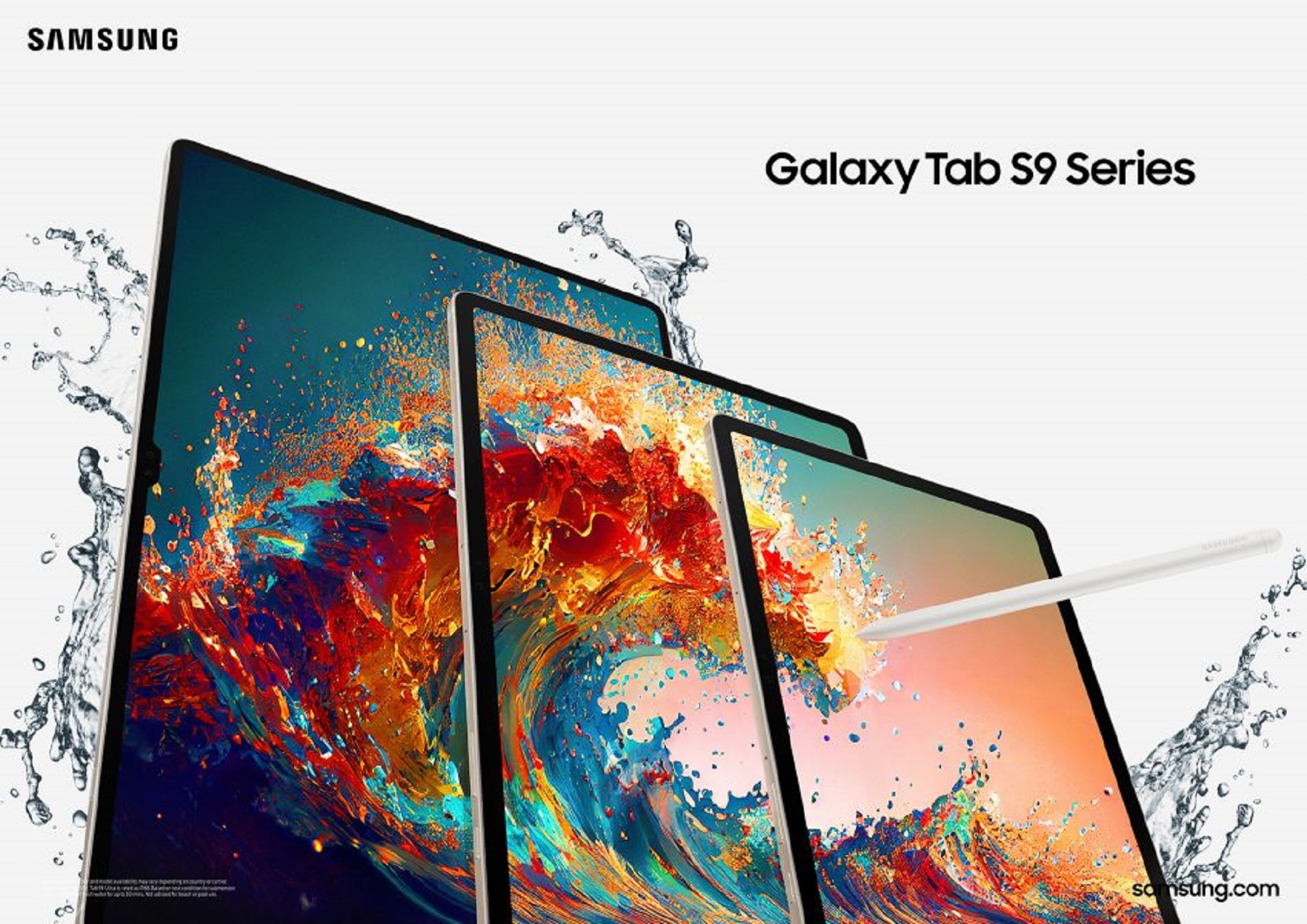
Samsung Electronics Co., Ltd. announces its new Galaxy Tab S9 series, a premium product portfolio that redefines the tablet landscape and sets new standards for immersive viewing and creative freedom. Across all three models, Galaxy Tab S9, S9+ and S9 Ultra, Dynamic AMOLED 2X displays ensure epic viewing and entertainment experiences with the power of Qualcomm Snapdragon® 8 Gen 2 for Galaxy.[1] An in-box, IP68-rated S Pen helps users bring their ideas to life. And as the first Galaxy Tab S series to earn an IP68 rating,[2] Galaxy Tab S9 series enables users to follow their inspiration, both indoors and out.

“There are no devices like the Galaxy Tab S9 series on the market today. A true disrupter in its category, it is the first of its kind to deliver experiences that users love most about tablets in one complete premium design,” said TM Roh, President and Head of Mobile eXperience Business at Samsung Electronics. “The Galaxy Tab S9 series empowers users to take their big ideas and bring them to life, completely effortlessly.”
Discover a World of Entertainment and Inspiration on the Go


Whether playing games or watching videos, Galaxy Tab S9 Ultra’s 14.6-inch[3] Dynamic AMOLED 2X display delivers an entertainment experience that is immersive and portable. Galaxy Tab S9 series’ HDR10+ ensures scene-by-scene, frame-by-frame tone optimization with a wide range of colors and brightness. The dynamic refresh rate of the Galaxy Tab S9 series automatically calibrates from 60 to 120Hz to balance smooth responsiveness with optimized battery efficiency. Eye Comfort also reduces eye strain with low blue light, reduced by more than 70 percent.[4] It brings sharp details to life, making photography, blueprints, animations and more look crisp and clear. Plus, the 16:10 aspect ratio presents TV and movies as they are meant to be viewed.
Entertainment on the Galaxy Tab S9 series’ is enhanced by spacious audio delivered through 20% larger quad speakers[5] with sound by AKG speaker system and Dolby Atmos immersive sound. To ensure a cinematic sound experience, Galaxy Tab S9 users can also choose from customized sound settings for gaming, listening to music, taking video calls and more. For those who want to take their work or entertainment outdoors, innovative Vision Booster technology is now on Galaxy Tab S9 series. It automatically detects bright lighting conditions and adapts to keep the screen vivid. And with the Smart Book Cover[6] that stands all on its own, adjust the device to either portrait or landscape orientation for hands-free viewing.
The Galaxy Tab S9 series is sleeker than ever, but it packs a punch. Every device is equipped with the flagship Snapdragon® 8 Gen 2 Mobile Platform for Galaxy, the same lightning-fast mobile processor in Samsung’s latest smartphones. For the first time on a Galaxy tablet, advanced vapor chamber technology helps power streaming, gaming or video editing marathons. Following close collaboration with industry-leading gaming partners, Galaxy Tab S9 users will benefit from optimized large-screen gaming experiences. Galaxy Tab S9 series is also the most heat-efficient Galaxy Tab lineup ever with an internal vapor chamber custom engineered for the high-intensity demands of a tablet. New two-way heat dissipation helps enable and sustain better performance over a longer usage period.

Embrace the Freedom to Bring Ideas to Life with Ease
Every premium Galaxy Tab S9 device comes with the one tool tablet users love and want most: the Galaxy S Pen. Both the Galaxy Tab S9 Galaxy Tab S9 series and S Pen are now IP68 rated for water and dust resistance, opening up more possibilities for where users can capture and express their ideas or get work done. With its pen-on-paper-like experience, S Pen now lets users intuitively write in search bars, browsers and app stores, and new bidirectional charging ensures it gets power no matter which way it faces when in its cradle. Users can upgrade to the S Pen Creator Edition[7] for an even more premium experience. The S Pen Creator Edition is designed with textured material for a comfortable grip and a wider tilt angle that makes creating more intuitive.
The immersive displays of the Galaxy Tab S9 series are the ideal backdrop for any project. With Multi Window,[8] up to three apps can display as an organized grid of easily adjustable windows. Do research in a browser, reference an image from Samsung Gallery and sketch out ideas in Samsung Notes, all simultaneously in one view. Or with Pop-Up View, apps can be viewed as floating windows while still showing the full home screen.
When traveling or working on the go, the Galaxy Tab S9 series’ Book Cover Keyboard[9] and DeX Mode[10] can simulate a desktop experience with maximum tablet portability. The Book Cover Keyboard’s adjustable angles and backlit keypad feel like a lightweight PC. Meanwhile, DeX Mode offers a PC layout with an easy-to-follow cursor, flexible window resizing and positioning, and Second Screen[11] capabilities to mirror or extend the PC screen to your tablet. In a Google Meet[12] call, collaborate more easily by sharing the screen and co-editing a live Samsung Notes document at the same time.

Designed to inspire spontaneous productivity as well as enhance creativity, the Galaxy Tab S9 series is a powerhouse for creative portfolios with new and enhanced apps for every personal passion. Fan-favorite GoodNotes[13] offers a new note-taking and journaling experience on Android for the first time, launching exclusively for Galaxy tablet users. Plus, notes created in GoodNotes on all platforms can easily be shared and co-edited simultaneously.
The pro-level LumaFusion[14] video editing app makes work easy when creating sharable content. Images and videos — even large files — taken on your Galaxy smartphone camera can be easily shared to Galaxy Tab S9 series with Quick Share.[15] LumaFusion takes full advantage of Galaxy Tab S9 Ultra’s expansive 14.6” screen to ensure editing videos is precise.
RECOMMENDED NEWS
7.18.2023 / MOBILE
Unpacking the Designs and Innovations Inspired by You
Clip Studio Paint[16] has been transformed into a streamlined tablet interface for drawing, painting and more. Meanwhile, ArcSite[17] empowers designers and professionals by transforming their creative vision into meticulously crafted 2D CAD blueprints, comprehensive site plans, and accurate estimates. Through close collaboration with Google to optimize large screen experiences, users can benefit from partner apps to easily complete tasks and turn ideas into reality on the Galaxy Tab S9 series.

Get the Most Out of a Complete Premium Experience, Inside and Out
With its distinctive device experience, The Galaxy Tab S9 series also integrates seamlessly into the Galaxy ecosystem. Using creative tools is simple when Galaxy Tab S9 tablets are connected to other devices. Multi Control[18] makes copying, pasting or dragging text and images directly between tablet and smartphone seamless, allowing users to control their smartphone with a Galaxy Tab S9 touchpad.


To match its premium software experiences, the Galaxy Tab S9 series hardware features iconic Galaxy design characteristics from the flagship Galaxy S series smartphones, such as the same striking camera layout. Measuring as thin as 5.5mm for Tab S9 Ultra, the Galaxy Tab S9 series is lightweight and slim, but also durable with an IP68 rating. They are also built to handle bumps and scrapes thanks to a body reinforced with Armor Aluminum. For those whose best ideas strike in unexpected places, this is the perfect partner, usable in rugged environments and able to withstand a busy day out. And the new Outdoor Cover[19] offers even more peace of mind for tablet users looking for more protection.
The Galaxy Tab S9 series is yet another example of Samsung’s commitment to building technology that enriches people’s lives while minimizing its environmental impact, without compromise. Compared to previous generations, the Tab S9 series features a wider variety of recycled materials[20] in both internal and external components.[21] They also come in a redesigned packaging box[22] and the paper used for the packaging box is 100 percent recycled paper.
Availability and Offers
The Galaxy Tab S9 series is available for pre-order beginning July 26, with general availability starting August 11.
Preorder the Galaxy Tab S9 series and receive a free storage upgrade.[23] Starting today, purchase a 256GB Galaxy Tab S9 Ultra or Tab S9+ and receive a complimentary upgrade to the 512GB version. Or select a 128GB Tab S9 and be upgraded to the 256GB version. Plus, receive up to $650 off any Galaxy Tab S9 series device with an eligible trade-in.[24]
When preordering the Galaxy Tab S9 series, receive 50% off the purchase of a Book Cover Keyboard Slim.[25] You can also receive $40 off a pair of Galaxy Buds2 Pro,[26] when preordering any Galaxy Tab S9 device on Samsung.com or through the Shop Samsung App.
The Tab S9 series comes in two colors, Beige and Graphite,[27] and three sizes: 14.6-inch on Tab S9 Ultra, 12.4-inch on Tab S9+, and 11-inch on Tab S9.[28]
Galaxy Tab S9 Ultra begins at $1,199.99 with 256GB, 512GB and 1TB storage options. S9+ begins at $999.99, with 256 and 512GB options. S9+ connected 5G option is available starting at $1,149.99. It will also feature eSIM and space for a physical SIM card, so you can easily switch between two different plans. S9 begins at $799.99 with 128 and 256GB storage options.
The premium experience on any Galaxy Tab S9 is protected and supported by four generations of One UI and Android OS upgrades and by five years of security updates.
To learn more about Galaxy Tab S9 series, please visit:
https://www.samsung.com/us/tablets/galaxy-tab-s9/
https://www.samsungmobilepress.com
https://www.samsung.com/us/promotions/
Specifications
| Galaxy Tab S9 | Galaxy Tab S9+ | Galaxy Tab S9 Ultra | |
|---|---|---|---|
| Display* | 11-inch, Dynamic AMOLED 2X (60~120Hz) | 12.4-inch, Dynamic AMOLED 2X (60~120Hz) | 14.6-inch, Dynamic AMOLED 2X (60~120Hz) |
| * Measured diagonally as a full rectangle without accounting for the rounded corners. Actual viewable area is less due to the rounded corners and camera hole. | |||
| OS | Android 13.0 | ||
| Dimensions | 165.8 x 254.3 x 5.9mm | 185.4 x 285.4 x 5.7mm | 208.6 x 326.4 x 5.5mm |
| Weight | 498g (Wi-Fi) | 581g (Wi-Fi) / 586g (5 | 732g (Wi-Fi) |
| Camera Rear | 13MP AF | 13MP AF + 8MP UW | |
| Camera Front | 12MP UW | 12MP + 12MP UW | |
| Memory & Storage* | 8GB+128GB 12GB+256GB microSD up to 1TB** | 12GB+256GB 12GB+512GB microSD up to 1TB** | 12GB+256GB 12GB+512GB 16GB+1TB microSD up to 1TB** |
| * Storage availability may differ by market, model, color, or carrier. Actual storage space availability will vary depending on pre-installed software and by market, model, file size and format. ** MicroSD card sold separately. | |||
| AP | Qualcomm Snapdragon® 8 Gen 2 for Galaxy | ||
| Battery* | 8,400mAh (typical) | 10,090mAh (typical | 11,200mAh (typical) |
| * Typical value tested under third-party laboratory condition. Typical value is the estimated average value considering the deviation in battery capacity among the battery samples tested under IEC 61960 standard. | |||
| Connectivity | 5G*, LTE**,Wi-Fi 6E***, Wi-Fi Direct Bluetooth® v 5.3 | ||
| * 5G services are only supported in 5G network enabled locations. Requires optimal 5G connection. Actual speed may vary depending on market, carrier, and user environment. ** Availability of LTE model varies by market or carrier. ***Wi-Fi 6E network availability may vary by market, network provider and user environment. Requires optimal connection. Will require a Wi-Fi 6E router. | |||
| Color* | Beige, Graphite | ||
| * Product color availability may vary by market or carrier. | |||
| Sound | Quad Stereo Speakers with Sound by AKG, Dolby Atmos® | ||
| Security | Samsung Knox | ||
| Biometric Authentication | On-Screen Fingerprint (FOD) | ||
| Accessories* | S Pen (BLE, Inbox), S Pen Creator Edition Book Cover Keyboard, Book Cover Keyboard Slim, Smart Book Cover, Outdoor Cover, Notepaper Screen, Privacy Screen | ||
| * S Pen and USB Type-C cable included in box. Other accessories are available for purchase separately. Availability of third party cases may vary by market, carrier and retailer. | |||
[1] Snapdragon is a trademark or registered trademark of Qualcomm incorporated. Snapdragon is a product of Qualcomm Technologies Inc. and/or its subsidiaries.
[2] Galaxy Tab S9, S9+ and S9 Ultra are rated as IP68. The inbox S Pen is also water and dust-resistant with an IP68 rating. Consistent with IP68 rating, water resistant in up to 5 feet of fresh water for up to 30 minutes. Rinse residue, dry after wet. Not advised for beach or pool use.
[3] Measured diagonally, Galaxy Tab S9 Ultra’s screen size is 14.6-inch in the full rectangle and 14.5-inch accounting for the rounded corners.
[4] Compared to Normal LCD display. SGS awarded Galaxy Tab S9 Series display the Eye Care Certification based on its ability to drastically reduce the harmful effects of blue light.
[5] Compared to the Galaxy Tab S8 series.
[6] Smart Book Cover sold separately.
[7] Sold separately; later this year in the U.S.. Availability and timing may vary by market.
[8] Certain applications may not support multi-tasking.
[9] Book Cover Keyboard sold separately. The product is available for Galaxy Tab S9 Ultra, Galaxy Tab S9+ and Galaxy Tab S9. Product design may vary by model. Features and keyboard layout may vary by model or type of language. Backlit feature available only on Galaxy Tab S9 Ultra Book Cover Keyboard by pressing Fn + F12.
[10] Availability may vary by device. Samsung DeX supported on selected Galaxy smartphones and tablets.
[11] Second Screen requires PCs with Wireless Display and Windows 10 v.2004 or later.
[12] Google Meet available for download at Google Play. Google Meet is a trademark of Google LLC.
[13] GoodNotes app requires separate download and comes with a 1-year free full version. Once the free full version period ends, an additional purchase is required for continuous use. The terms of service may vary by country and region.
[14] LumaFusion app requires separate purchase and download. Terms of service may vary by country and region.
[15] Quick Share between Galaxy devices available with the following OS: smartphones and tablets with Android OS version 10.0 (Q) and One UI 2.1 or later, PCs running Windows 10 or later. Requires Samsung Account and Wi-Fi and Bluetooth connection.
[16] Clip Studio Paint app comes pre-installed in select markets. Clip Studio Paint app can be downloaded from the Galaxy Store and comes with a free 6-month trial for first-time users. Once the free trial period ends, paid subscription to a monthly usage plan is required for continuous use. Terms of service may vary by country and region.
[17] ArcSite app requires separate purchase and download from Galaxy Store. Terms of service may vary by country and region.
[18] Multi Control is available only on select Galaxy smartphones with One UI 5.1 or above and Galaxy Tab devices with One UI 5.1.1 or later. Availability may vary depending on apps.
[19] All covers are sold separately.
[20] Compared to Galaxy Tab S8 series. Types of recycled materials include post-consumer recycled PA sourced from discarded fishing nets, post-consumer recycled PBT sourced from discarded PET bottles, post-consumer recycled PC sourced from water barrels and pre-consumer recycled aluminum sourced from discarded scrap material generated as a by-product during manufacturing. The scrap metal is re-melted, filtered for impurities and then recycled to make parts within Samsung’s manufacturing process. There is also pre-consumer recycled content sourced from discarded glass waste generated as a byproduct of glass manufacturing. This glass waste is crushed into cullet and then used as a component in the Corning® Gorilla® Glass 5 manufacturing process.
[21] Galaxy Tab S9 Ultra: 17 device components that feature a minimum of 10% post-consumer recycled material plastic or pre-consumer recycled aluminum, and Corning® Gorilla® Glass 5 with a minimum of 10% pre-consumer recycled content.. These components include Cable Holder Mid, Deco Pen Charger, Top-left Speaker Module, Top-right Speaker Module, Bottom-left Speaker Module, Bottom-right Speaker Module, Case Rear, Case Bracket, Key Bracket, PCB Support Top, PCB Support Mid, Cable Holder Bottom, SIM Tray, Volume Key, Side Key, Camera Deco, Main Window.
[22] 100% recycled paper material is used in the following packaging components: Product Packaging Unit Box, Manual Box, DLC Band and DLC Box. The 100% recycled paper material has received Environmental Claim Validation (ECV).
[23] 7/26/23-8/10/23, or while supplies last, pre-order and purchase a Tab S9 256GB, Tab S9+ 512GB, and/or Tab S9 Ultra 512GB (“Qualifying Purchase”) for the price of the lower memory storage level at Samsung.com or the Shop Samsung app. The discount will be automatically applied at checkout as follows: Tabs S9+ and Tab S9 Ultra 512GB for the price of the 256GB models, Tabs S9 256 GB for the price of the 128GB model. The discount does not apply to the Tab S9 Ultra 1TB. The Gift is non transferrable and limited to 1 per Qualifying Purchase. If you return or cancel your purchase the discount will be lost. Void where prohibited or restricted by law. Samsung reserves the right to modify or discontinue offers at any time by posting a notice on the app or website. Portion of storage/memory occupied by pre-existing content.
[24] For a limited time only, on samsung.com or Shop Samsung App, purchase a new qualifying Galaxy device (“Qualifying Purchase”), send in your qualifying trade-in device to Samsung through the Samsung Trade-In Program, and if Samsung determines your trade-in device meets all eligibility requirements, you will receive a trade-in credit specific to your qualifying trade-in device to apply toward your Qualifying Purchase. Device models that currently qualify for trade-in and trade-in credit amounts associated with those models are available on samsung.com and the Shop Samsung App; eligible models and amounts may change at Samsung’s sole discretion. To be eligible for trade-in, your qualifying device must meet all Trade-In Program eligibility requirements, which include, but are not limited to, that the device powers on, holds a charge, and does not power off unexpectedly; has a functioning display; has no breaks or cracks in the screen (unless a cracked screen offer applies); has no breaks or cracks in the case; has no liquid damage (whether visible or not); has no other defects that go beyond normal wear and tear; is not on a black list; has a verified FCC ID; has been reset to factory settings; has all personal information removed; has all software locks disabled; and is owned by you (leased devices are not eligible). Anticipated trade-in value will be applied as a credit at time of purchase, but, if you do not send in your trade-in device within 15 days of receipt of your Qualifying Purchase, you will be charged back for the trade-in credit applied to your purchase, or if you send in your trade-in device within 15 days of receipt of your Qualifying Purchase but Samsung determines your device does not meet all eligibility requirements, you will be charged back for the trade-in credit applied to your purchase minus $25. Participation in this program does not excuse you from contracts with your carrier or retailer (or any related payments or fees) for the device that was traded in. Limit 1 trade-in per Qualifying Purchase. Samsung reserves the right to modify or discontinue this offer at any time. The Trade-In Program cannot be combined with any other Samsung, carrier or retailer promotions, discounts, or offers unless specifically provided for in the terms and conditions of such offers. Additional terms, including terms that govern the resolution of disputes, apply.
[25] 7/26/23 – 8/10/23, promotional discount applies while supplies last, when purchasing a Samsung Book Cover Keyboard Slim for Tab S9 Series device on Samsung.com or in the Shop Samsung App. Void where prohibited or restricted by law. Samsung reserves the right to modify or discontinue offers at any time by posting notice on the app or website.
[26] 7/26/23-8/10/23, while supplies last, when purchasing a Samsung Tab S9 device on samsung.com or in the Shop Samsung App. Must purchase Book Cover Keyboard Slim through add-on page simultaneously; discount automatically applied at checkout.
[27] Colors may vary by market and carrier.
[28] Measured diagonally, Galaxy Tab S9’s screen size is 11-inch in the full rectangle and 10.9-inch with accounting for the rounded corners, Galaxy Tab S9+ ‘s screen size is 12.4-inch in the full rectangle and 12.4-inch with accounting for the rounded corners, and Galaxy Tab S9 Ultra’s screen size is 14.6-inch in the full rectangle and 14.5-inch with accounting for the rounded corners; actual viewable area is less due to the rounded corners and camera hole.