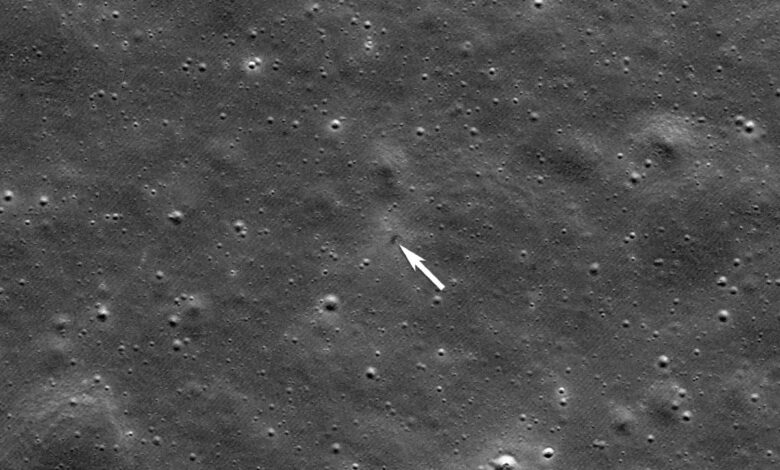
On June 11, NASA’s LRO (Lunar Reconnaissance Orbiter) captured photos of the site where the ispace Mission 2 SMBC x HAKUTO-R Venture Moon (RESILIENCE) lunar lander experienced a hard landing on June 5, 2025, UTC.

RESILIENCE lunar lander impact site, as seen by NASA’s Lunar Reconnaissance Orbiter Camera (LROC) on June 11, 2025. The lander created a dark smudge surrounded by a subtle bright halo.
Credit: NASA/Goddard/Arizona State University.
RESILIENCE was launched on Jan. 15 on a privately funded spacecraft.
LRO’s right Narrow Angle Camera (one in a suite of cameras known as LROC) captured the images featured here from about 50 miles above the surface of Mare Frigoris, a volcanic region interspersed with large-scale faults known as wrinkle ridges.
The dark smudge visible above the arrow in the photo formed as the vehicle impacted the surface, kicking up regolith — the rock and dust that make up Moon “soil.” The faint bright halo encircling the site resulted from low-angle regolith particles scouring the delicate surface.

This animation shows the RESILIENCE site before and after the impact. In the image, north is up. Looking from west to east, or left to right, the area pictured covers 2 miles.
Credit: NASA/Goddard/Arizona State University.
LRO is managed by NASA’s Goddard Space Flight Center in Greenbelt, Maryland, for the Science Mission Directorate at NASA Headquarters in Washington. Launched on June 18, 2009, LRO has collected a treasure trove of data with its seven powerful instruments, making an invaluable contribution to our knowledge about the Moon. NASA is returning to the Moon with commercial and international partners to expand human presence in space and bring back new knowledge and opportunities.
More on this story from Arizona State University’s LRO Camera website
About The Author