




Background
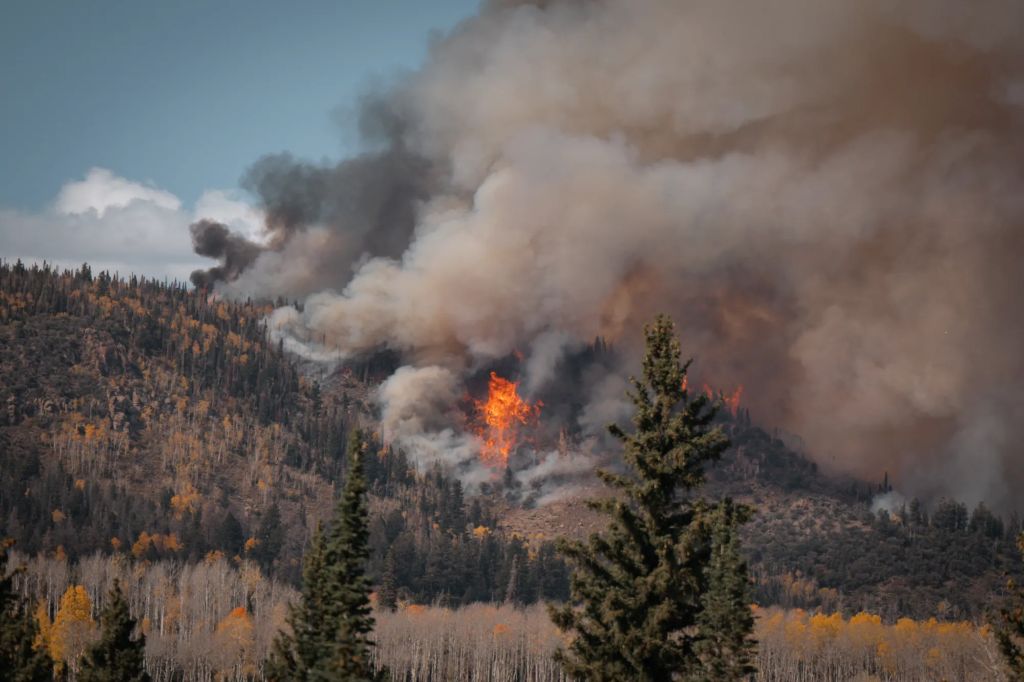
Fire is a natural occurrence in many ecosystems and can promote ecological health. However, wildfires are growing in scope and occurring more often than in the past. Among other causes this is due to human-caused climate impacts and the expansion of communities into areas with wildland vegetation. These blazes continue to significantly harm communities, public health, and natural ecosystems. NASA is leveraging cutting-edge science and technology to better understand wildland fire behavior and provide valuable tools for fire policy, response, and mitigation.
NASA’s Stake in Wildfire
NASA’s contributions to wildland fire management span decades. This includes research to better understand the role fire plays in Earth’s dynamic atmosphere, and airborne and spaceborne sensors to analyze fire lifecycles. Much of this research and technology is still used by wildfire agencies across the globe today. NASA is building on this research and technology development with the Wildland Fire Management Initiative (WMI).
WMI leverages expertise across the Agency in space technology, science, and aeronautics to improve wildfire research and response. Through this effort, NASA and its partners will continue to provide tools and technologies for improved predictive fire modeling, risk assessment, fire prevention, suppression and post-fire recovery operations. NASA’s WMI aims to equip responders with improved tools for managing these fires
How NASA is Tackling Wildfire
NASA is collaborating with other government agencies, academia, and commercial industries to build a concept of operations for the future of wildland fire management. This means identifying gaps in current wildland fire technologies and procedures and laying out clear solutions to address those challenges.
NASA will perform a demonstration of wildland fire technologies – including X – in the coming years.
To provide a well-rounded toolkit for improving wildland operations, NASA and is tackling every aspect of wildland fire response. These efforts include:
Pre-Fire
- Fuel fire maps with improved accuracy
- Tools that identify where and when safe, preventative burn treatments would be most effective
- Airspace management and safety technologies to enable mainstream use of uncrewed aircraft systems in prescribed burns
Active Fire
- Fire detection and tracking imagery
- Improved fire information management systems
- Models for changing fire conditions, including fire behavior, and wind and atmospheric tracking for quality forecasts
- Uncrewed aircraft and high-altitude balloons for real-time communications for fighting fires in harsh environments
- Uncrewed Aircraft Systems Traffic Management (UTM) to expand use of uncrewed aircraft systems in fire response, particularly in environments where traditional air traffic control technologies aren’t available
- An airspace awareness and communications system to enable remotely piloted aircraft to identify, monitor, and suppress wildfires 24 hours a day
Post-Fire
- Improved fire impact assessments, including fire severity, air and water quality, risks of landslides, debris flows, and burn scars
- Ground-based, airborne, and spaceborne observations to develop monitoring systems for air quality and map burn severity and develop and enhance models and predictions of post-fire hazards
NASA’s Disasters Response Coordination System (DRCS) supports all three fire response aspects listed above. The DRCS, developed under the Agency’s Earth Science Division’s Disasters Program, provides decisional support to international and domestic operational response agencies. This support includes products for understanding wildfire movement and potential pathways, burn-area maps, and impacts of fire, ash, and smoke to population and critical infrastructure. DCRS tools also provide assessments of post-fire flooding and debris flow susceptibility.
NASA’s Investment in New Wildland Fire Technologies
NASA’s WMI offers grants, contracts, and prizes to small businesses, research institutions, and other wildland technology innovators. Some related technology development activities underway include:
- Testing communications technologies for incident response teams in areas with no cellphone coverage via a high-altitude balloon 60,000 feet above ground level
- Developing wildfire detection systems and instruments for crewed and uncrewed aircraft
- Funding early-stage technology development for remote sensing instruments and sensor systems
- Developing and flight testing integrated, compact systems for small spacecraft and other platforms for autonomous detection, location tracking, and data collection of transient smoke plumes, early wildfires and other events
- Licensing technologies relevant to wildland fire management and hosting wildland fire webinars to promote NASA technology licensing
Partners
The NASA Wildland Fire Management Initiative team collaborates with industry, academia, philanthropic institutions, and other government agencies for a more fire-resilient future. These include:
- U.S. Forest Service
- The California Department of Forestry and Fire Protection
- The National Oceanic and Atmospheric Administration
- The Federal Aviation Administration
- The Department of Homeland Security
- The Department of Defense
- The National Wildfire Coordinating Group
WMI Deliverables
Through these combined efforts, NASA aims to address urgent wildland fire management challenges and ensure communities are better prepared for wildland fires. NASA will continue to expand partnerships within wildland fire management agencies for technology development and adoptions.
For more information, email: [email protected]
About The Author


Got a Questions?
Find us on Socials or Contact us and we’ll get back to you as soon as possible.