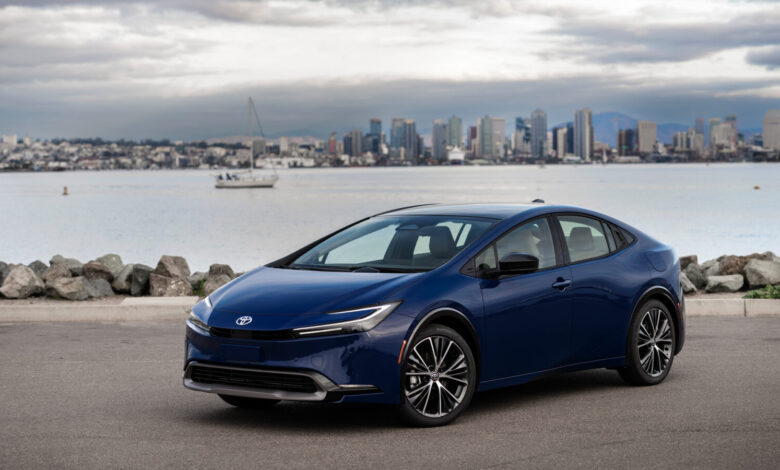
When the Prius burst into the U.S. market, it was nothing short of a revolution—a true trailblazer in the world of hybrid vehicles. It set the stage for the electrification movement, captivating environmentally conscious drivers with its innovative spirit. Fast forward 25 years, and the 2026 Toyota Prius has evolved into a striking embodiment of sportiness and aggression. With its bold, aerodynamic design, it not only turns heads but also continues to have exceptional fuel efficiency, proving that it remains firmly rooted in its pioneering legacy while embracing the future of driving.
For 2026, the Toyota Prius is available in four trims: LE, XLE, Nightshade and Limited. The fifth-generation Toyota Hybrid System (THS 5) is paired with a 2.0-liter, 4-cylinder DOHC engine delivering 194 net-combined horsepower on Front-Wheel Drive (FWD) equipped grades, and up to 196 net-combined horsepower on the Electronic On-Demand All-Wheel Drive (AWD) equipped models. It also has exceptional fuel economy with a manufacturer-estimated rating of up to 57 MPG combined on FWD models and a manufacturer-estimated 54 MPG combined rating on AWD models.
The 2026 Prius is expected to arrive at Toyota dealerships this summer. The Manufacturer’s Suggested Retail Price, excluding Dealer Processing and Handling, will start at $28,550 for the LE grade.
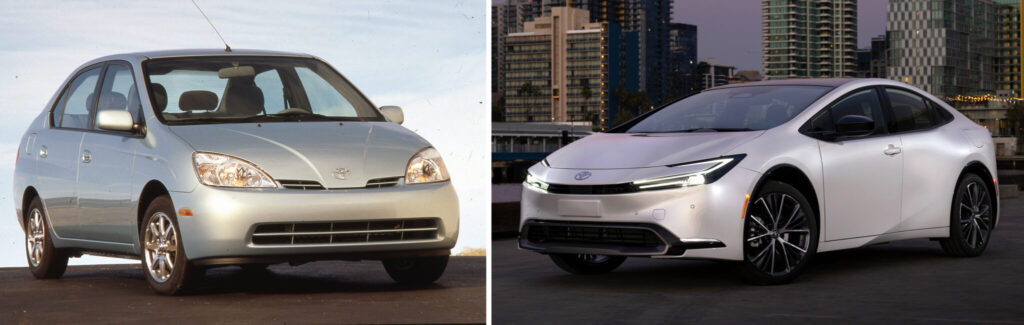
Through the Years
The Toyota Prius made its debut in the U.S. market in 2000, marking a significant milestone in automotive history as one of the first mass-produced hybrid vehicles. With its innovative combination of a gasoline engine and electric motors, the Prius offered an alternative to traditional vehicles, appealing to a growing demographic of environmentally conscious consumers. Its unique design and impressive fuel efficiency quickly garnered attention, establishing the Prius as a symbol of forward-thinking technology.
Over the years, the Prius has undergone several transformations, continually evolving and maintaining its commitment to environmental stewardship. As the vehicle has evolved, Toyota has introduced advancements in hybrid technology, enhancing performance and efficiency. Today, as it celebrates 25 years of innovation, the 2026 Toyota Prius stands as a testament to Toyota’s dedication to carbon reduction, blending sporty design with cutting-edge technology to redefine what a hybrid can be.
Toyota Hybrid System
The 2026 Toyota Prius pairs the fifth-generation Toyota Hybrid System (THS 5) with a M20A-FXS inline four-cylinder 2.0L gas engine with two motor-generators through a planetary-type continuously variable transmission. A compact high-output/low-loss drive motor for the transaxle/motor uses a six-magnet and electromagnetic steel plate configuration to support drive functions.
The engine, working in conjunction with the larger electric motor (MG2), helps provide responsive performance, while exemplary energy efficiency is achieved by using both electric motors (MG1 and MG2) to charge a lithium-ion battery. The result is an engaging acceleration experience with 194 net combined horsepower and an estimated 0-60 time of 7.2 seconds for FWD equipped models.
Another boost to Prius’ fuel efficiency comes from the Electronically Controlled Brake system, which coordinates operation between the regenerative braking force of the electric motors and the hydraulic braking system force to provide optimal stopping power. By proactively using the electric motors to recover as much electrical energy as possible from the regenerative braking system, this extremely efficient cooperative control is designed to help maximize fuel economy.
Prius also offers EV mode, which allows the vehicle to be operated as a pure electric vehicle for short distances, depending upon certain conditions, such as battery charge level and vehicle speed. This mode is useful for operating the vehicle in parking lots or indoor parking garages, for example. The Vehicle Proximity Notification feature is designed to alert pedestrians of the vehicle’s presence when running in EV mode.
With the push of a button, the 2026 Prius also comes with standard selectable Drive modes:
- NORMAL: Helps the hybrid system to maintain an ideal combination of fuel economy and vehicle acceleration. The accelerator opening amount changes linearly in response to accelerator pedal operation.
- ECO: Helps improve hybrid system efficiency by limiting power in response to light to moderate accelerator pedal input.
- SPORT: Helps enhance dynamic performance and acceleration.
Electronic On-Demand All-Wheel Drive
The 2026 Prius also has an available Electronic On-Demand All-Wheel Drive (AWD) system on all grades that gives it the capability of added traction when needed. The AWD system uses a motor to drive the rear wheels, helping enable stable driving performance when starting off, when driving on slippery road surfaces, and cornering.
AWD-equipped models employ a separate rear-mounted electric motor that powers the rear wheels when needed. Adding AWD to the Prius offers 196 net combined horsepower and a manufacturer-estimated 0-60 time of 7.0 seconds.
A high-output IPM (Interior Permanent Magnet) motor drives the rear wheels, allowing for a compact design that can reduce wheel spin in low traction situations and improve stability when turning. The system works seamlessly by preemptively distributing driving force to the rear wheels to help suppress front wheel slip during off-the-line starts. It also engages the rear motor in response to slippage at the front wheels and enhances cornering agility by helping to reduce understeer.
The AWD system performs precise electronic control of the front-rear torque distribution in accordance with the driving conditions. This motor-driven AWD system is capable of efficiently using the battery power for driving the front and rear wheels. Data from the wheel speed sensors and G-force sensors is processed by the vehicle computer system and sent to the rear motor as electrical signals to control the rear wheel torque. The system helps provide the optimal front-rear torque distribution based on the vehicle speed and accelerator operation amount and performs control according to the conditions, assisting stable driving.
About The Author