





Biofilms are communities of microorganisms that stick to one another and also adhere to a nearby surface. They are intricately associated with life on Earth, enabling functions essential to human and plant systems.
NASA’s Open Science Data Repository (OSDR) Analysis Working Groups study biofilms and many other biological phenomena in an environment that’s important to NASA: the environment of deep space. It’s not well understood how well biofilms react to the many stresses of spaceflight.
Now, a new study, performed in part by NASA volunteers, describes how biofilms adapt to space environments, exploring how biofilms may benefit human and plant health in space.
The volunteers, led by Dr. Katherine Baxter (University of Glasgow) and Dr. Nicholas Brereton (University College Dublin), are part of the Microbes Analysis Working Group. Their findings reframe biofilms from infection risks to essential structures supporting human gut health, immunity, and plant nutrient uptake. The group’s work synthesizes how spaceflight stressors alter biofilm architecture and host interaction.
Interested in collaborating with others to help terrestrial life thrive in space? You can join the OSDR-Analysis Working Groups and help plan the future of human space exploration.
Learn more about the AWGs.
Submit this form to join the OSDR AWGs
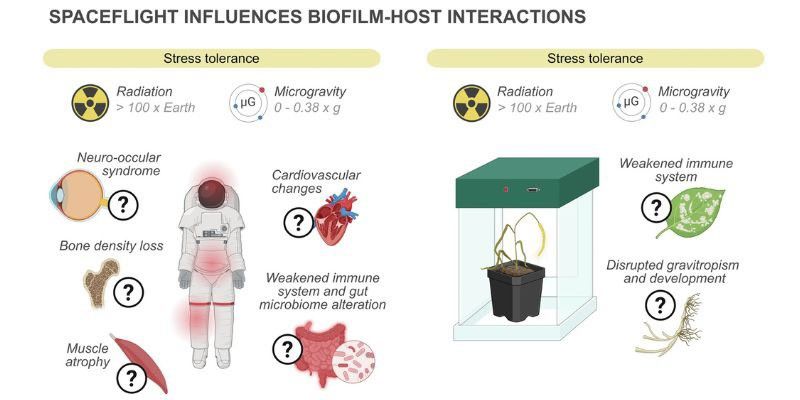
Biofilms support human and plant health on Earth. Spaceflight may disrupt these biofilm-host interactions, with implications for crew health and plant-based life support systems.
npj biofilms and microbiomes, Baxter et al. 2026
Learn More and Get Involved
Open Science Data Repository Analysis Working Groups (OSDR AWG)
Help astronauts and life thrive in space using space biology and health data. Laptop required. Data science knowledge is helpful.
About The Author


Got a Questions?
Find us on Socials or Contact us and we’ll get back to you as soon as possible.