




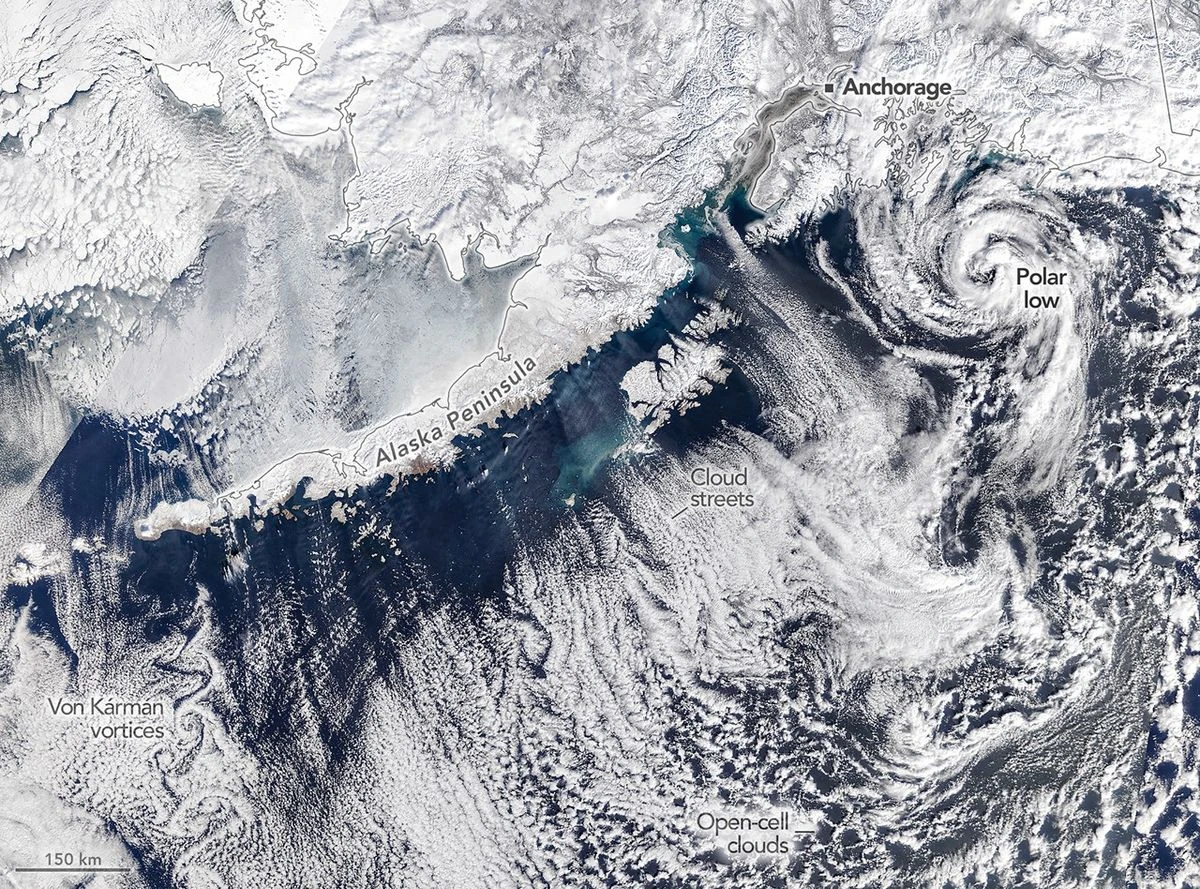
Winter 2026 roared to an end in southern Alaska as parts of the coast saw below-normal temperatures and bouts of moderate to heavy snow. Viewed from above, the region’s atmospheric instability was apparent in the striking display of cloud formations just offshore.
A NASA satellite captured this image of the clouds on March 19, 2026, the final day of astronomical winter. According to a NOAA weather briefing, low pressure over the Gulf of Alaska that day combined with high pressure over eastern Russia and northern Alaska, causing cold Arctic air to pour southeast over the Alaska Peninsula.
The setup led to the formation of cloud streets, visible in the middle of the scene, oriented in line with the direction of the wind. These parallel bands can occur when frigid, dry air moves over comparatively warm ocean water and gains moisture. Where the warm, moist air rises, water vapor condenses to form clouds. Where cooled air sinks adjacent to the clouds, skies are clear.
But the transformation does not happen right away; it takes the air mass some time over the sea surface to pick up heat and moisture, which is why the region close to shore is mostly cloud-free. (Note that the hazy area close to shore might be stratus or sea fog.) As the air moves farther over the gulf, the cloud streets continue to mature and change into open-cell clouds—a type of cloud that appears as thin wisps surrounding empty pockets.
Another compelling cloud type is visible toward the bottom-left on the lee side of Unimak Island, the easternmost of the Aleutian Islands. These trails of staggered, counterrotating swirls are von Kármán vortex streets. The cloud patterns can form when winds are diverted around elevated areas, often islands, rising from the ocean.
Finally, an especially striking feature in this scene is the larger cloud vortex about 180 miles (300 kilometers) southwest of Anchorage. According to a post from meteorologist Matthew Cappucci, the feature was a polar low—a small cyclonic formation that forms in cold polar air over relatively warm water. This instance, Cappucci wrote, carried tropical storm-force winds and produced snow and thunderstorms around its center.
Outside of March 19, the month overall brought persistent cold and bouts of storminess to the state. The weather had warmed by the end of April, but news reports indicated more unsettled, wet weather was on the way across Southcentral and Southeast Alaska as an atmospheric river approached the region.
NASA Earth Observatory image by Michala Garrison, using MODIS data from NASA EOSDIS LANCE and GIBS/Worldview. Story by Kathryn Hansen.
Downloads

March 19, 2026
JPEG (4.94 MB)
References & Resources
- EUMeTrain (2014) Cloud Streets. Accessed April 29, 2026.
- KTUU (2026, April 27) April showers just won’t quit. Accessed April 29, 2026.
- KTUU (2026, April 27) April ends on a wet and breezy note; heavy rain for coastal Southcentral. Accessed April 29, 2026.
- Matthew Cappucci and MyRadar Weather Radar via Facebook (2026, March 19) If you looked at satellite on Wednesday, you probably saw what looked like a tropical storm making landfall in Alaska. Accessed April 29, 2026.
- NWS Alaska Region (2026, March 19) March 19, 2026 – Marine Weather. Accessed April 29, 2026.
- NWS Anchorage (2026, March 19) March 19, 2026 Alaska Weather Daily Briefing. Accessed April 29, 2026.
- University of Alaska Fairbanks (2026, April 21) Alaska climate report: March 2026 saw dangerous weather. Accessed April 29, 2026.
About The Author


Got a Questions?
Find us on Socials or Contact us and we’ll get back to you as soon as possible.