




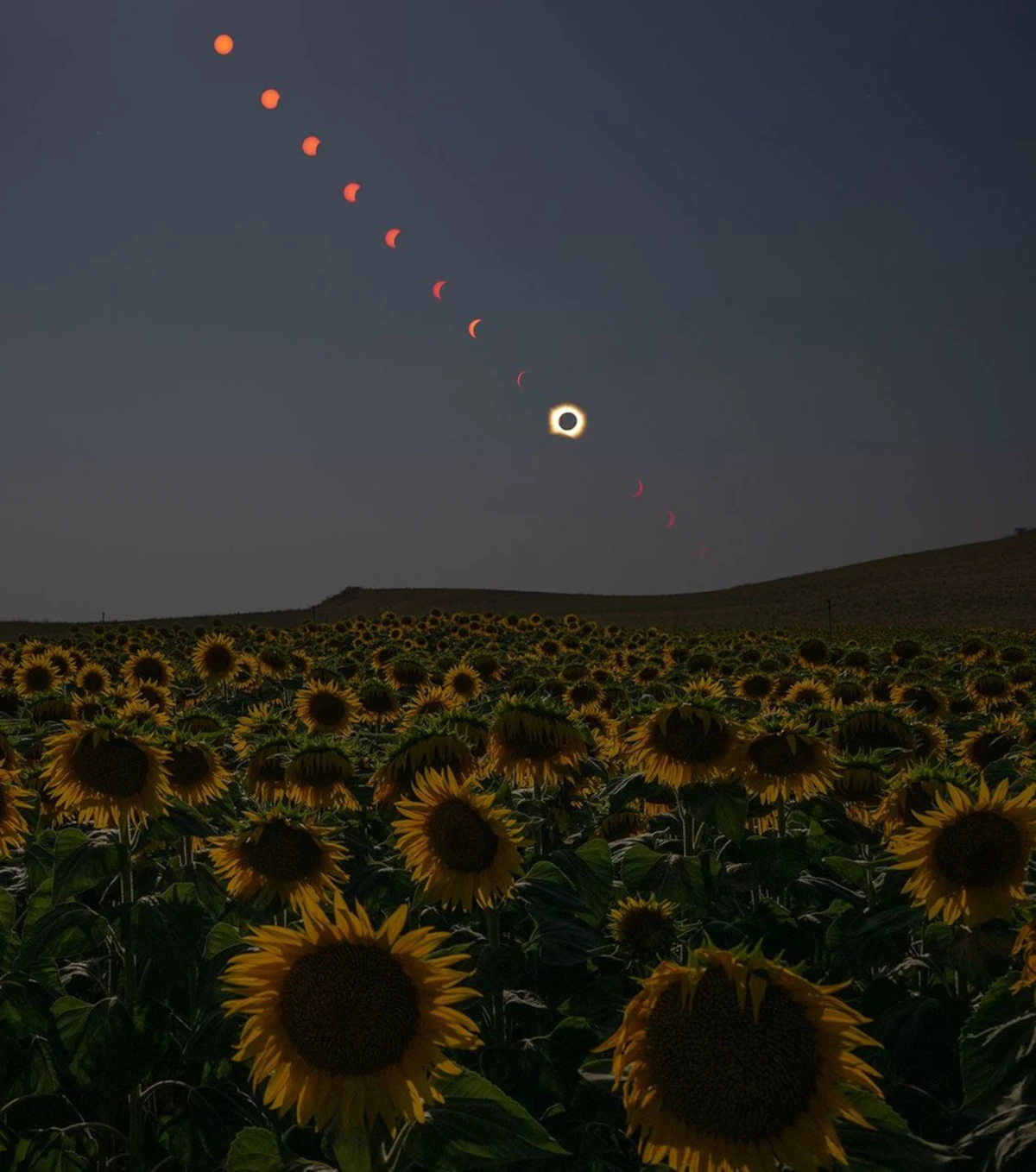
Skywatchers across a swath of northern Spain witnessed a total solar eclipse when the Moon lined up directly between the Sun and Earth on August 12, 2026. Those within the path of totality had the rare chance to glimpse the Sun’s active outer atmosphere, or corona, during the short time the Moon blocked the Sun.
This composite photo was taken before, during, and after the total eclipse from a field of appropriately themed flowers in San Millán de los Caballeros, a town about 40 kilometers (25 miles) south of León in northwestern Spain. Along with parts of Greenland and Iceland, Northern Spain was one of the few places on land that fell within this eclipse’s path of totality.
Sunset was approaching when the Moon’s shadow, or umbra, swept across Spain. In León, the partial eclipse began at 7:32 p.m. and ended at 9:22 p.m. local time, just minutes before the Sun dipped below the horizon. Totality lasted about two minutes, starting at 8:28 p.m. Farther east in Spain, the Sun set before the eclipse ended.
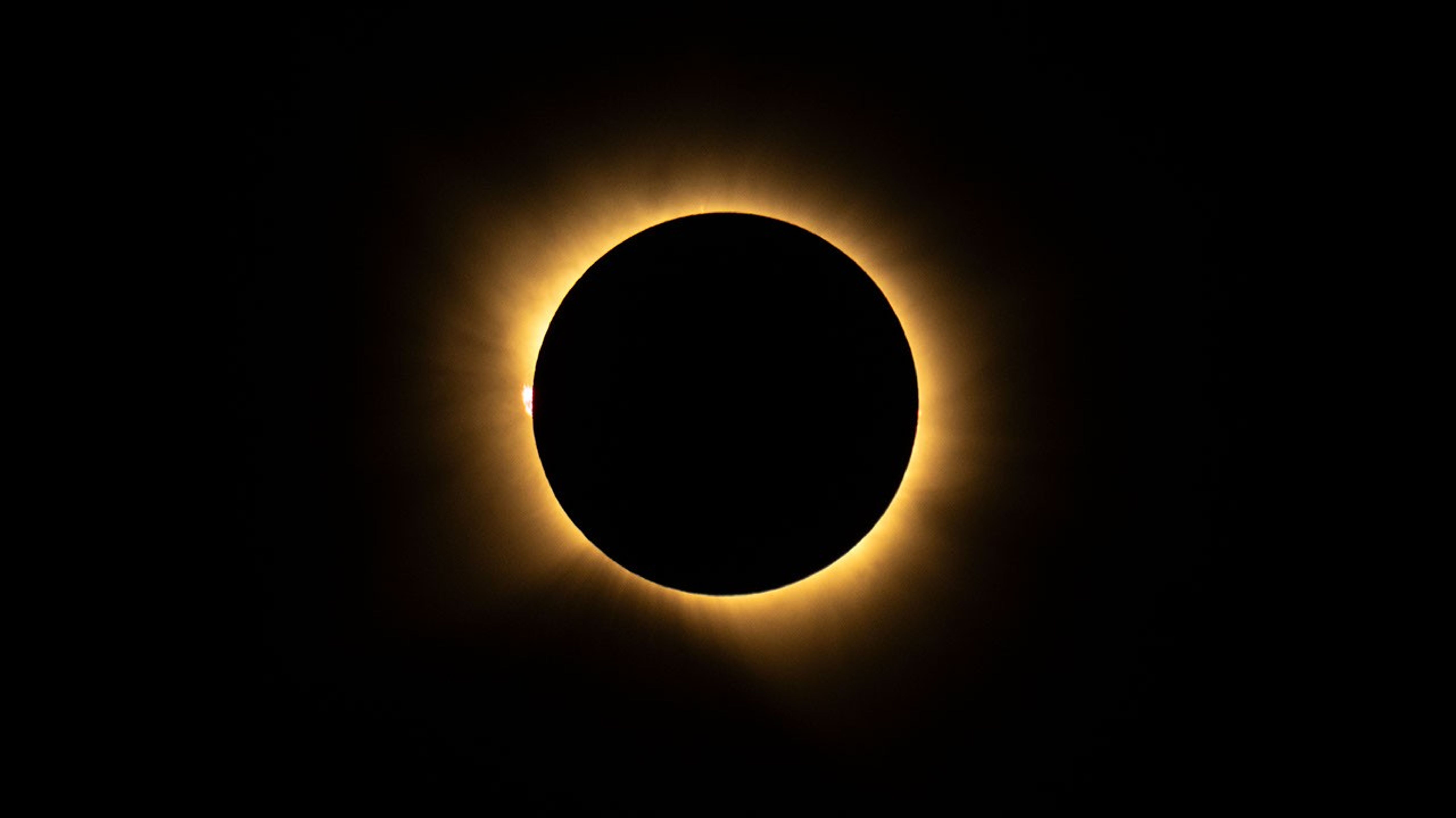
A total solar eclipse is seen from San Millán de los Caballeros, Spain, on August 12, 2026.
In the photo above, taken during totality, a glowing loop of plasma called a solar prominence is visible extending into the corona on the left. Plasma, a super-hot gas composed mostly of ionized hydrogen and helium, flows along the tangled and twisted structure of the Sun’s magnetic fields. Solar prominences, which can measure many times higher than Earth is wide, are sometimes visible to the naked eye during eclipses.
Solar eclipses offer NASA the opportunity to get a different look at the Sun and our own atmosphere. On August 12, science teams staged in Iceland to chase the Moon’s shadow in one of NASA’s WB-57 high-altitude jets and image the corona in visible and infrared light. And the NASA-supported Nationwide Eclipse Ballooning Project launched scientific balloons before, during, and after the eclipse to measure how Earth’s atmosphere changed when the Sun was temporarily blocked.
While viewing opportunities in the path of totality were limited, the rest of Europe and parts of Africa, Canada, and the U.S. experienced a partial eclipse. Photos and video from the total and partial eclipse are available in NASA’s image library. The next total solar eclipse will occur on August 2, 2027, with the path of totality crossing southern Spain, North Africa, Saudi Arabia, and Yemen.
NASA photos by Bill Ingalls. Story by Lindsey Doermann.
References & Resources
- NASA (2026) August 12, 2026, Total Solar Eclipse. Accessed August 13, 2026.
- NASA (2026, August 13) Eclipses. Accessed August 13, 2026.
- NASA (2026, July 27) NASA Science Soars During August Total Solar Eclipse. Accessed August 13, 2026.
- NASA Earth Observatory (2026, August 12) Stops Along the Path of Totality. Accessed August 13, 2026.
- NASA Scientific Visualization Studio (2025, July 13) Animations of the August 12, 2026, Total Solar Eclipse. Accessed August 13, 2026.
About The Author


Got a Questions?
Find us on Socials or Contact us and we’ll get back to you as soon as possible.