There comes a point in the life of almost every older truck when its owner has to make a decision. Repairs are becoming more frequent, the body is showing its age, and newer trucks offer technology and conveniences that were barely imaginable when the old one left the factory. Replacing it can seem like the obvious answer.
Yet age alone does not make a truck disposable. Plenty of older pickups still have solid frames, dependable drivetrains, readily available replacement parts, and decades of useful life ahead of them. Others have characteristics that simply aren’t easy to find in newer vehicles. Understanding why some older trucks are worth saving instead of replacing means looking beyond mileage and faded paint to consider what the vehicle still has to offer.
Older Trucks Can Be Surprisingly Durable
Many older pickups were built with relatively straightforward mechanical systems and an emphasis on utility. Their engines, transmissions, suspensions, and other major components may require attention after decades of use, but that doesn’t necessarily mean the entire vehicle has reached the end of its service life.
A truck with a healthy frame and drivetrain can often remain useful after worn components are repaired or replaced. Engines can be rebuilt. Suspension parts can be refreshed. Brakes, steering components, seals, hoses, and other wear items can be replaced as necessary.
This modular nature is part of what makes certain older pickups attractive to owners who are willing to maintain them. A failed component does not automatically condemn the entire truck. Instead, it becomes another repair in the ongoing process of keeping a fundamentally sound vehicle on the road.
Simplicity Has Its Advantages
Modern trucks provide impressive technology, but all that sophistication comes with additional complexity. Touchscreens, sensors, electronic modules, advanced driver-assistance systems, and interconnected vehicle networks can make newer trucks capable and comfortable. They can also make some repairs more complicated.
Older trucks tend to have fewer systems competing for attention. Depending on the model and year, an owner may be able to diagnose common problems without specialized electronic equipment. There is often more room in the engine bay, and individual components may be easier to access.
That simplicity is particularly valuable to owners who enjoy working on their own vehicles. An older pickup can provide an opportunity to understand how the vehicle works rather than treating every warning light as a reason to schedule a dealership appointment.
Replacement Costs Change the Equation
A large repair bill can make an older truck feel expensive until it is compared with the cost of replacing the vehicle. A newer pickup can bring years of monthly payments along with higher insurance costs and, depending on the vehicle, more expensive registration or taxes.
Suppose an older truck needs several thousand dollars of work. That expense may initially seem difficult to justify. But if the repairs produce another several years of dependable service, they could still cost considerably less than purchasing a newer vehicle.
The key is distinguishing between a truck that needs reasonable restoration and one suffering from extensive deterioration. Continually repairing a vehicle with severe structural damage and widespread mechanical problems can become financially impractical. Repairing a solid truck that simply needs overdue maintenance is a very different situation.
Structural Condition Matters More Than Appearance
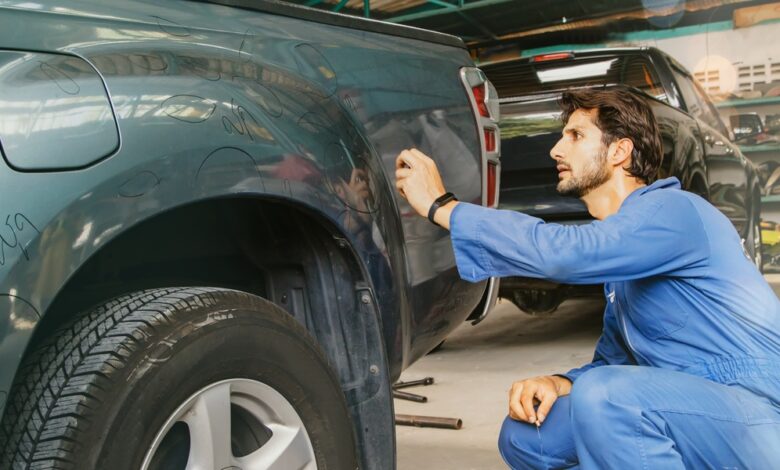
An old truck can look terrible and still be an excellent restoration candidate. Sun-faded paint, torn seats, dented body panels, worn wheels, and damaged trim are immediately noticeable, but they don’t necessarily tell you whether the vehicle has a strong foundation.
Structural corrosion deserves much closer attention. Rust can develop in frames, rocker panels, floor pans, wheel arches, mounting points, and other areas where moisture and debris collect. Surface corrosion may be manageable, while deeper deterioration can compromise the vehicle’s integrity.
Before investing heavily in cosmetic improvements, owners should understand the extent of the corrosion they are dealing with. Knowing the fundamentals of Toyota pickup restoration and rust repair can help illustrate why evaluating and addressing corrosion early matters when deciding whether an aging pickup has a viable future.
A shiny paint job cannot compensate for serious structural problems underneath. Starting with the foundation allows owners to spend restoration money where it matters most.
Parts Availability Can Keep an Older Truck Alive
A vehicle’s age isn’t necessarily the biggest obstacle to keeping it running. Parts availability often matters more.
Some older trucks continue to enjoy strong support from manufacturers, aftermarket suppliers, salvage yards, restoration specialists, and enthusiast communities. Common mechanical and body components may remain relatively easy to source decades after production ends.
This support can dramatically change the economics of ownership. A truck with accessible replacement parts is much easier to maintain than an obscure model requiring rare components to be hunted down every time something breaks.
Enthusiast popularity can help here as well. When enough people want to preserve a particular generation of trucks, businesses have an incentive to continue producing replacement and restoration components.
Familiarity Has Practical Value
Owners sometimes underestimate how useful it is to know a vehicle well. After years behind the wheel, you know how your truck normally sounds, feels, shifts, brakes, and handles. You may know its maintenance history down to individual repairs.
Buying another used truck means giving up much of that knowledge.
Even a newer used vehicle can come with unanswered questions. Was the oil changed consistently? Did the previous owner tow beyond the truck’s limits? Was it involved in an accident? Were repairs performed correctly? Has a developing problem been temporarily concealed?
An older truck you’ve owned for years may have imperfections, but at least they are familiar imperfections. A well-documented maintenance history can make an aging vehicle less of a gamble than an unknown replacement.
An Old Truck’s Future Depends on Its Foundation
Mileage and model year only tell part of a vehicle’s story. Maintenance history, structural integrity, mechanical condition, parts support, and intended use often provide a much clearer picture of whether a truck deserves another chapter.
That is why some older trucks are worth saving instead of replacing. A well-built pickup with a solid foundation doesn’t suddenly lose its usefulness because it reaches a certain age. With realistic expectations and thoughtful repairs, it can continue doing the job it was built to do while offering something increasingly difficult to find in a brand-new vehicle: simplicity, familiarity, and character.