

NASA

NASA Stennis Tool Enables Unified Collection of Test Data

Editor’s Note: The following is one of three related articles about the NASA Data Acquisition System and related efforts. Please visit Stennis News – NASA to access accompanying articles.

Just as a steady heartbeat is critical to staying alive, propulsion test data is vital to ensure engines and systems perform flawlessly.

The accuracy of the data produced during hot fire tests at NASA’s Stennis Space Center near Bay St. Louis, Mississippi, tells the performance story.

So, when NASA needed a standardized way to collect hot fire data across test facilities, an onsite team created an adaptable software tool to do it.

“The NASA Data Acquisition System (NDAS) developed at NASA Stennis is a forward-thinking solution,” said David Carver, acting chief of the Office of Test Data and Information Management. “It has unified NASA’s rocket propulsion testing under an adaptable software suite to meet needs with room for future expansion, both within NASA and potentially beyond.”

Before NDAS, contractors conducting test projects used various proprietary tools to gather performance data, which made cross-collaboration difficult. NDAS takes a one-size-fits-all approach, providing NASA with its own system to ensure consistency.

“Test teams in the past had to develop their own software tools, but now, they can focus on propulsion testing while the NDAS team focuses on developing the software that collects data,” said Carver.

A more efficient workflow has followed since the software system is designed to work with any test hardware. It allows engineers to seamlessly work between test areas, even when upgrades have been made and hardware has changed, to support hot fire requirements for the agency and commercial customers.

With the backing and resources of the NASA Rocket Propulsion Test (RPT) Program Office, a blended team of NASA personnel and contractors began developing NDAS in 2011 as part of the agency’s move to resume control of test operations at NASA Stennis. Commercial entities had conducted the operations on NASA’s behalf for several decades.

The NASA Stennis team wrote the NDAS software code with modular components that function independently and can be updated to meet the needs of each test facility. The team used LabVIEW, a graphical platform that allows developers to build software visually rather than using traditional text-based code.
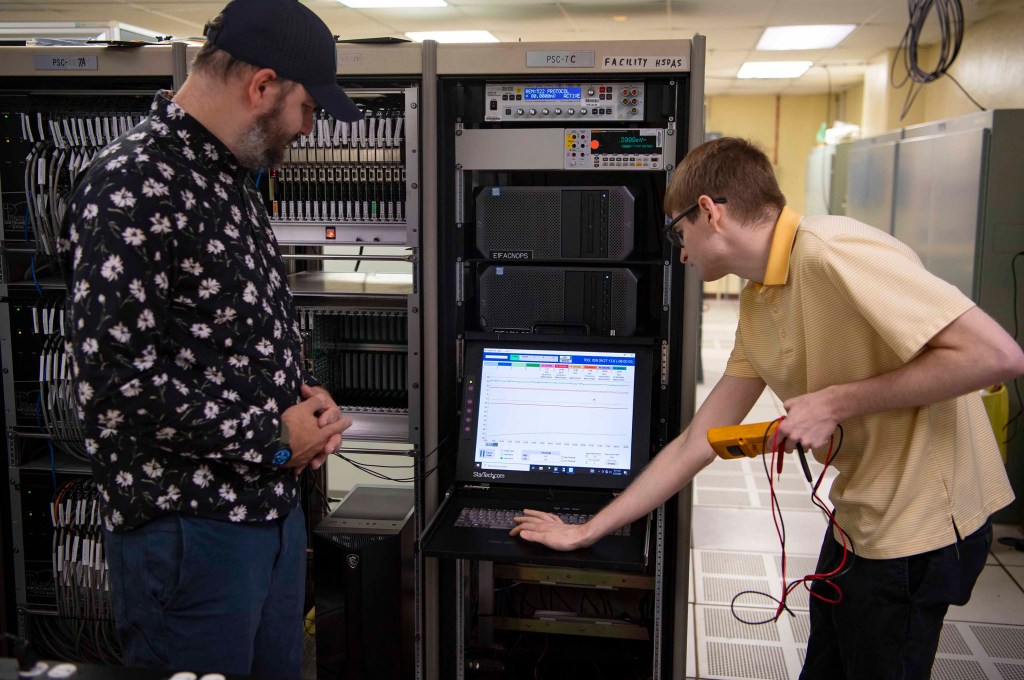
Two NASA engineers Steven Helmstetter, left, and Tristan Mooney work with the NASA Data Acquisition System in the E-1 Test Control Center
NASA engineers Steven Helmstetter, left, and Tristan Mooney work with the NASA Data Acquisition System in the E-1 Test Control Center, where the system is utilized for propulsion test activities.NASA/Danny Nowlin
a man wearing an orange shirts sits in front of large computer monitor
Syncom Space Services software engineer Richard Smith, front, analyzes test results using the NASA Data Acquisition System Displays interface at NASA’s Stennis Space Center while NASA software engineer Brandon Carver actively tests and develops laboratory equipment.NASA/Danny Nowlin
NASA engineers are shown in the E-1 Test Control Center
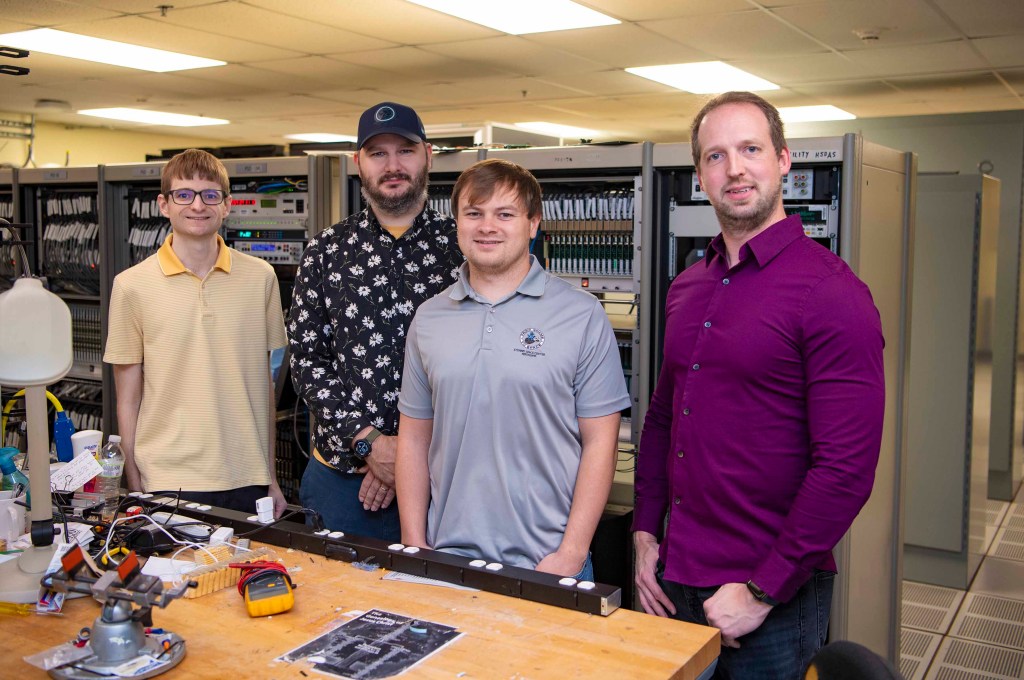
NASA engineers, from left to right, Tristan Mooney, Steven Helmstetter Chase Aubry, and Christoffer Barnett-Woods are shown in the E-1 Test Control Center where the NASA Data Acquisition System is utilized for propulsion test activities.NASA/Danny Nowlin
three NASA engineers perform checkouts on a large data acquisition system for the E-1 Test Stand
NASA engineers Steven Helmstetter, Christoffer Barnett-Woods, and Tristan Mooney perform checkouts on a large data acquisition system for the E-1 Test Stand at NASA’s Stennis Space Center. The data acquisition hardware, which supports testing for E Test Complex commercial customers, is controlled by NASA Data Acquisition System software that allows engineers to view real-time data while troubleshooting hardware configuration.NASA/Danny Nowlin
Two NASA engineers Steven Helmstetter, left, and Tristan Mooney work with the NASA Data Acquisition System in the E-1 Test Control Center
NASA engineers Steven Helmstetter, left, and Tristan Mooney work with the NASA Data Acquisition System in the E-1 Test Control Center, where the system is utilized for propulsion test activities.NASA/Danny Nowlin
a man wearing an orange shirts sits in front of large computer monitor
Syncom Space Services software engineer Richard Smith, front, analyzes test results using the NASA Data Acquisition System Displays interface at NASA’s Stennis Space Center while NASA software engineer Brandon Carver actively tests and develops laboratory equipment.NASA/Danny Nowlin
NASA engineers are shown in the E-1 Test Control Center
NASA engineers, from left to right, Tristan Mooney, Steven Helmstetter Chase Aubry, and Christoffer Barnett-Woods are shown in the E-1 Test Control Center where the NASA Data Acquisition System is utilized for propulsion test activities.NASA/Danny Nowlin
three NASA engineers perform checkouts on a large data acquisition system for the E-1 Test Stand
NASA engineers Steven Helmstetter, Christoffer Barnett-Woods, and Tristan Mooney perform checkouts on a large data acquisition system for the E-1 Test Stand at NASA’s Stennis Space Center. The data acquisition hardware, which supports testing for E Test Complex commercial customers, is controlled by NASA Data Acquisition System software that allows engineers to view real-time data while troubleshooting hardware configuration.NASA/Danny Nowlin
Two NASA engineers Steven Helmstetter, left, and Tristan Mooney work with the NASA Data Acquisition System in the E-1 Test Control Center
NASA engineers Steven Helmstetter, left, and Tristan Mooney work with the NASA Data Acquisition System in the E-1 Test Control Center, where the system is utilized for propulsion test activities.NASA/Danny Nowlin

CONTINUE READING

About The Author

Ben

I am the owner of Cerebral-overload.com and the Verizon Wireless Reviewer for Techburgh.com. My love of gadgets came from his lack of a Nintendo Game Boy when he was a child . I vowed from that day on to get his hands on as many tech products as possible. My approach to a review is to make it informative for the technofile while still making it understandable to everyone. Ben is a new voice in the tech industry and is looking to make a mark wherever he goes. When not reviewing products, I is also a 911 Telecommunicator just outside of Pittsburgh PA. Twitter: @gizmoboaks

Related Articles

Leave a Reply

This site uses Akismet to reduce spam. Learn how your comment data is processed.

Back to top button