




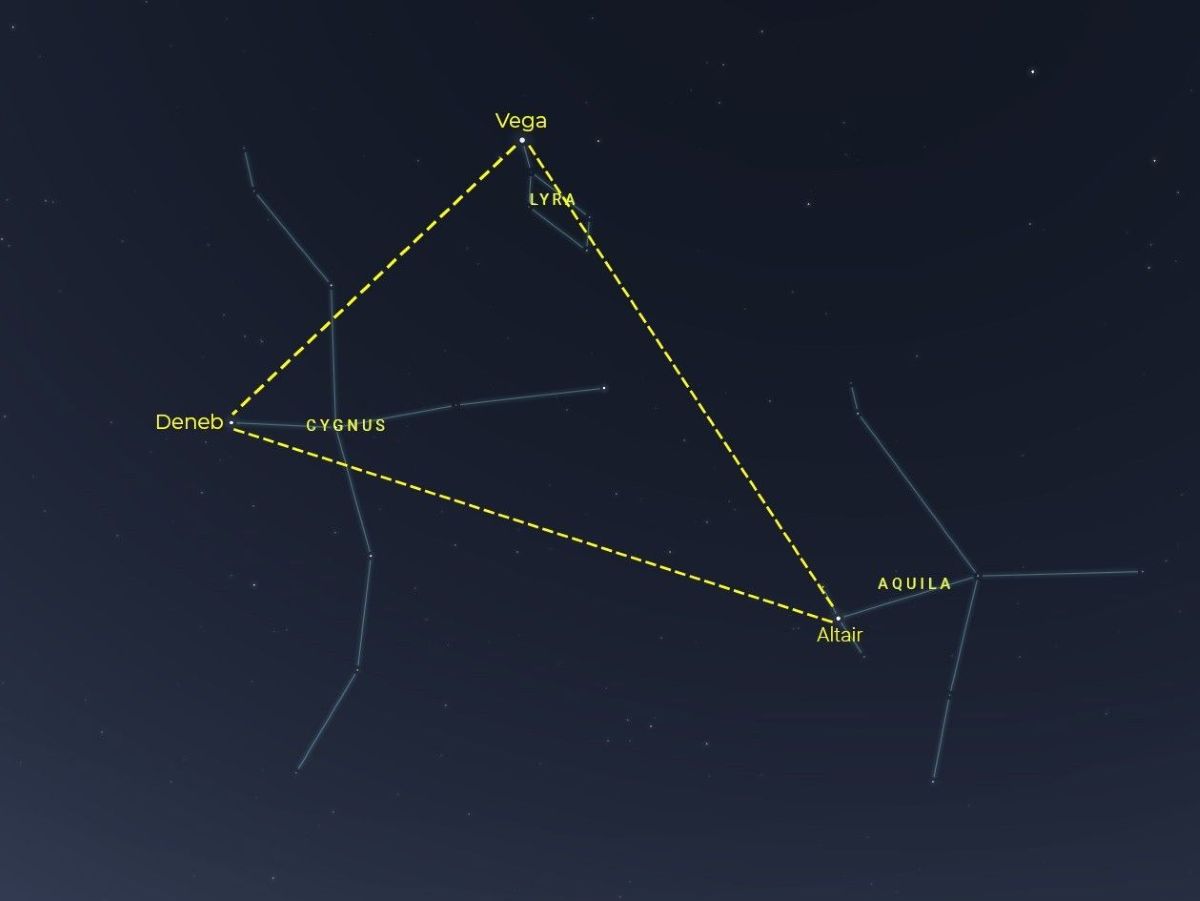
Altair is the last stop on our trip around the Summer Triangle! The last star in the asterism to rise for Northern Hemisphere observers before summer begins, brilliant Altair is high overhead at sunset at the end of the season in September. Altair might be the most unusual of the three stars of the Triangle, due to its great speed: this star spins so rapidly that it appears “squished.”
Altair is the brightest star in the constellation of Aquila, the Eagle. A very bright star, Altair holds a notable place in the mythologies of cultures around the world. As discussed in a previous article, Altair represents the cowherd in the ancient tale “Cowherd and the Weaver Girl.” While described as part of an eagle by ancient peoples around the Mediterranean, it was also seen as part of an eagle by the Koori people in Australia. They saw the star itself as representing a wedge-tailed eagle, and two nearby stars as his wives, a pair of black swans. More recently, one of the first home computers was named after the star: the Altair 8800.

A rapidly spinning star darkens and exhibits a bulge at the equator, as shown by the model at left. At right, an actual CHARA interferometer image of the star Altair.
NASA/NSF/Center for High Angular Resolution Astronomy/Zina Deretsky
Altair’s rapid spinning was first detected in the 1960s. The close observations that followed tested the limits of technology available to astronomers, eventually resulting in direct images of the star’s shape and surface by using a technique called interferometry, which combines the light from two or more instruments to produce a single image. Predictions about how the surface of a rapidly spinning massive star would appear held true to the observations; models predicted a squashed, almost “pumpkin-like” shape instead of a round sphere, along with a dimming effect along the widened equator, and the observations confirmed this!
This equatorial dimming is due to a phenomenon called gravity darkening. Altair is wider at the equator than it is at the poles due to centrifugal force, resulting in the star’s mass bulging outwards at the equator. This results in the denser poles of the star being hotter and brighter, and the less dense equator being cooler and therefore dimmer. This doesn’t mean that the equator of Altair or other rapidly spinning stars are actually dark, but rather that the equator is dark in comparison to the poles; this is similar in a sense to sunspots. If you were to observe a sunspot on its own, it would appear blindingly bright, but it is cooler than the surrounding plasma in the Sun and so appears dark in contrast.
As summer winds down, you can still take a Trip Around the Summer Triangle with this activity from the Night Sky Network. Mark some of the sights in and around the Summer Triangle at: bit.ly/TriangleTrip.
Originally posted by Dave Prosper: August 2020
Last Updated by Kat Troche: July 2025
About The Author


Got a Questions?
Find us on Socials or Contact us and we’ll get back to you as soon as possible.