BVIO Technology Unveils Violoop, the AI Device That Turns Any Computer Into An Autonomous Assistant

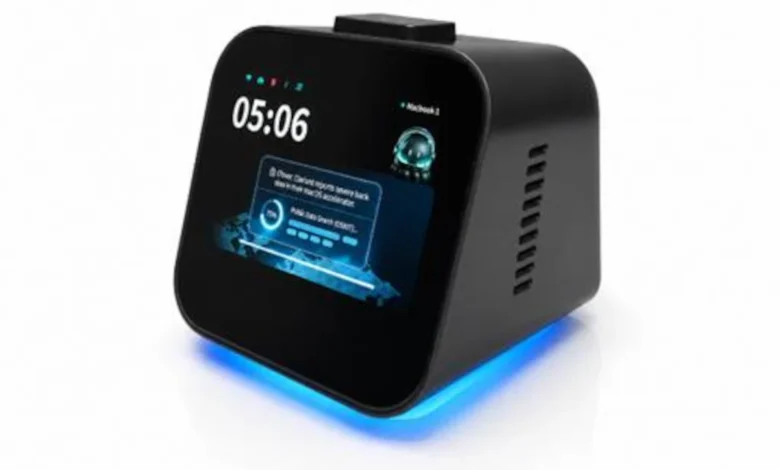
BVIO Technology, a company pioneering Personal Agentic Computing, today unveiled Violoop, a compact AI device that gives AI an unprecedented ability to see, understand and operate the computers people already own. Combining direct computer interaction, local intelligence, persistent memory and human-controlled permissions, Violoop enables AI to act across everyday workflows with greater context and continuity.
Unveiled at IFA 2026 and demonstrated throughout the show in Hall 25, booth 396, Violoop will launch on Kickstarter on September 15, following BVIO’s US$20 million seed round.
Unlike software-based agentic solutions, Violoop is dedicated hardware that connects directly to a computer through HDMI and USB, giving it the ability to interpret activity already underway on the screen, understand the tools in use and act toward the intended outcome without requiring users to repeatedly provide prompts or contextual information. Over time, it learns the user’s workflows, preferences and patterns, laying the foundation for BVIO’s long-term vision of artificial intuition: AI that can recognize connections, anticipate needs, surface possibilities and provide increasingly relevant assistance beyond explicit instructions.
“AI already has extraordinary capabilities, but people are still responsible for stitching together models, prompts, agents and software by hand,” said Jaylen He, co-founder and CEO of BVIO. “For decades, computers have been built around one active user. As AI becomes capable of understanding context, operating software and completing multi-step work, computers will need to support AI as a second participant. Violoop gives AI a coherent way to work across the computer: understanding what is happening, using the tools already available and helping carry work forward, while privacy, approval and ultimate authority remain with the user.”
One Agent. All Software.
Violoop is designed to be the universal gateway to all software, giving one AI a way to work across the entire computing environment rather than confining it to a single application or ecosystem. It can carry the same objective through browsers, documents, spreadsheets, email, creative tools, development environments, internal systems and legacy software without requiring the user to manage every handoff.
Users can bring their own API keys and connect Violoop to preferred services including ChatGPT, Claude, Gemini, Codex and other specialist models. Its intelligent routing system determines what each step requires, handling routine work locally, directing specialist tasks to the appropriate model and calling more powerful cloud services only when necessary. This gives users control over the intelligence they use while reducing unnecessary token consumption and cost.
The same routing logic determines how each action is completed. Where an API or script provides the most efficient path, Violoop can use it directly. Where no integration exists, Violoop can operate the computer much as a person would, reading what is on screen, navigating websites, opening and using software, entering information, accessing services and operating the keyboard and mouse. This allows a single objective to move across different models, applications and interfaces, including software and websites that were never designed to work with AI.
An incoming customer email, for example, could initiate an entire workflow. Violoop could retrieve the relevant account information, update the CRM, route the drafting task to the most appropriate model and place the finished response back into the email application for review. What would normally require several tools, repeated prompts and manual transfers of context becomes one connected piece of work.
This is powered by BVIO’s vertically integrated platform, combining proprietary models, agent software, trust and accountability infrastructure, and dedicated hardware. The system has been trained across more than 200 applications and 10,000 real-world software screens spanning research, writing, coding, design, customer relationship management and back-office administration.
Private by Architecture. Authority From Anywhere.
Persistent AI requires access to sensitive and continuously evolving context. Violoop therefore uses a local-first architecture in which screen data is processed on the device and never transmitted to the cloud. Its 8-billion-parameter local model and 26 TOPS of on-device AI acceleration support screen perception, routine inference and persistent memory, reducing latency while preserving core functionality when connectivity is limited.
When a task requires an external model or specialist service, Violoop sends only the information necessary to access that specific capability. The screen itself is never streamed, while visual context and personal memory remain on the device.
Violoop also separates intelligence from authorization. A dedicated STM32H563 security processor and physical approval control ensure that the AI system cannot independently authorize protected actions.
In Away Mode, users can permit supported work to continue after leaving the desk. When an action requires confirmation, Violoop pauses the workflow and sends a request to the mobile app, where the user can review, approve or reject it remotely. The workflow resumes only after the required authorization has been provided.
Together, these safeguards allow Violoop to maintain persistent context and continue approved work while preserving local privacy and ultimate human authority.
Availability
The Violoop Kickstarter campaign launches on September 15, 2026, at kickstarter.com/projects/bvio/violoop-plug-in-ai-for-your-computer. Kickstarter backers will be able to reserve Violoop from US$399, saving US$300 from the expected retail price of US$699. Shipping begins October 2026. For additional information, visit violoop.ai.
###
About BVIO Technology
Founded in 2025 by CEO Jaylen He and CTO King Zhu, BVIO Technology is building the computing platform and products for the age of personal AI.
Before founding BVIO, He was a serial entrepreneur and Y Combinator alumnus, while Zhu designed semiconductor chips at Analog Devices and contributed to Microsoft hardware products including Xbox and HoloLens.