
NASA
-

I Am Artemis: Doug Parkinson
Doug Parkinson’s face lights up as he starts telling his story, how someone from Wisconsin now plays a part in the team that will help land the first Artemis astronauts on to the Moon. Parkinson serves as NASA’s SLS (Space Launch System) rocket lead for Launch Integration and Mission Operations, guiding engineers responsible for monitoring the rocket during testing, pre-launch,…
Read More » -
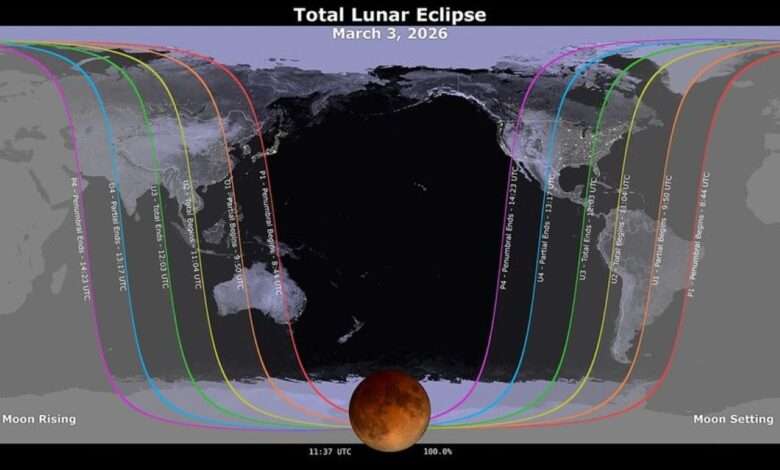
March 2026 Total Lunar Eclipse: Your Questions Answered
A total lunar eclipse will redden the Moon on March 3, 2026. Here’s what you need to know. How does a lunar eclipse work? A lunar eclipse occurs when Earth passes directly between the Sun and Moon, casting a gigantic shadow across the lunar surface and turning the Moon a deep reddish-orange. This alignment can only occur during a full Moon phase. Alignment…
Read More » -

NASA Researchers Probe Tangled Magnetospheres of Merging Neutron Stars
New simulations performed on a NASA supercomputer are providing scientists with the most comprehensive look yet into the maelstrom of interacting magnetic structures around city-sized neutron stars in the moments before they crash. The team identified potential signals emitted during the stars’ final moments that may be detectable by future observatories. “Just before neutron stars crash, the highly magnetized,…
Read More » -
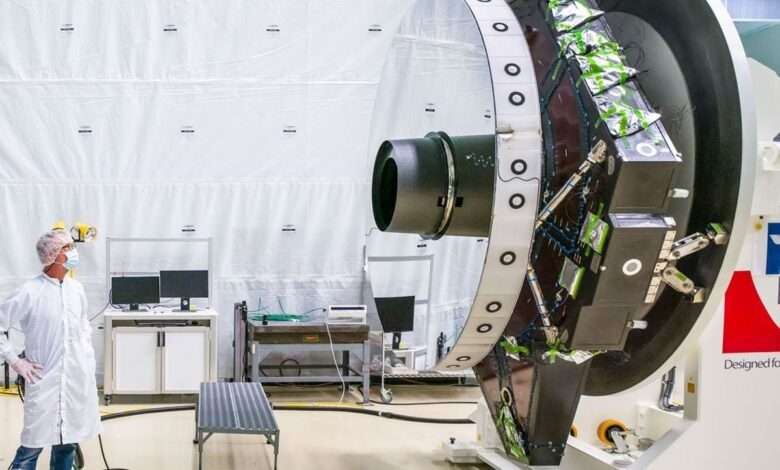
Building Roman
Technicians have completed the construction of NASA’s Nancy Grace Roman Space Telescope. The Roman observatory is slated to launch no later than May 2027, with the team aiming for as early as fall 2026. The mission will revolutionize our understanding of the universe with its deep, crisp, sweeping views of space. More than a thousand technicians and engineers assembled Roman…
Read More » -
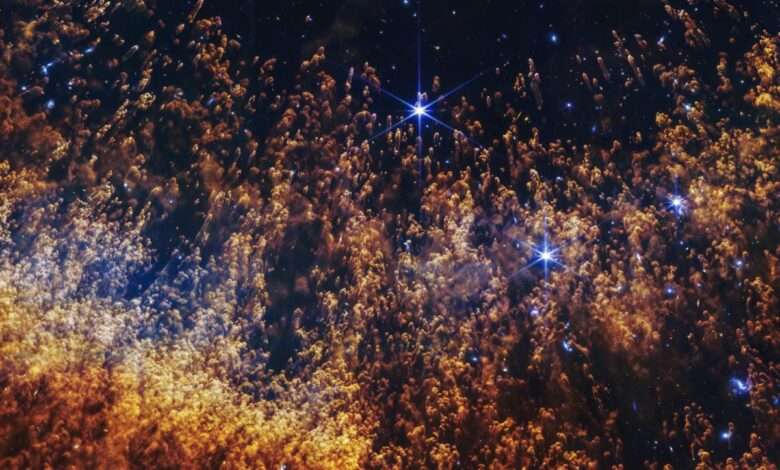
Webb Zooms into Helix Nebula
NASA’s James Webb Space Telescope has zoomed into the Helix Nebula to give an up-close view of the possible eventual fate of our own Sun and planetary system. In Webb’s high-resolution look, the structure of the gas being shed off by a dying star comes into full focus. The image reveals how stars recycle their material back into the cosmos,…
Read More » -
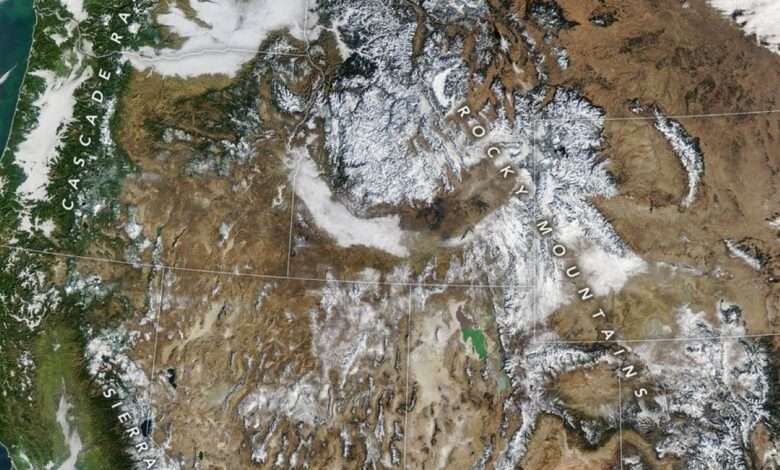
The West Faces Snow Drought
The mountains of the western United States are sporting thin winter coats in early 2026. Although most regions saw average or above-average precipitation in fall and early winter, warmer temperatures meant that much of it fell as rain. The result has been an unusually low snowpack for this time of year, constituting a snow drought. This image, acquired with the MODIS (Moderate Resolution…
Read More » -
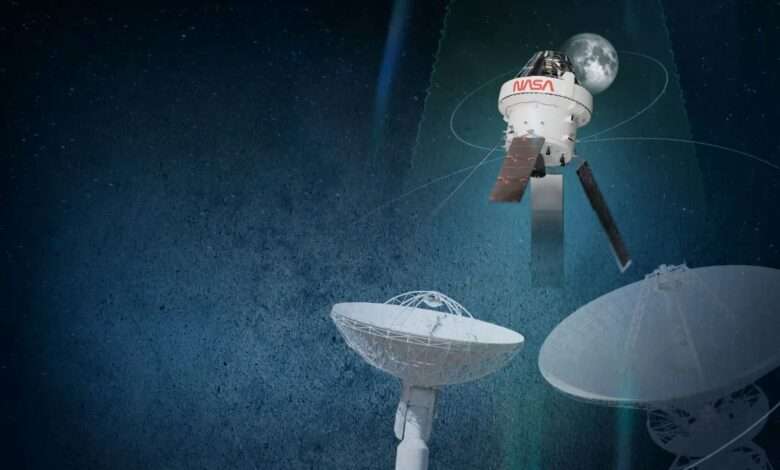
Networks Keeping NASA’s Artemis II Mission Connected
NASA’s Artemis II mission will transport four astronauts around the Moon, bringing the agency one step closer to sending the first astronauts to Mars. Throughout Artemis II, astronaut voice, images, video, and vital mission data must traverse thousands of miles, carried on signals from NASA’s communications systems. Through Artemis, NASA is establishing an enduring presence in space and exploring more of…
Read More » -

NASA Johnson Celebrates 25 Years in Space with Community Day
NASA’s Johnson Space Center brought the International Space Station’s 25-year legacy to the public on Jan. 24, 2026, during a community day event in Houston. Johnson’s visitor center, Space Center Houston, hosted the celebration commemorating 25 years of continuous human presence in space. For a quarter century, astronauts have lived and worked aboard the orbiting laboratory, advancing science, strengthening international partnerships, and shaping the future…
Read More » -

Toyota Brings Glow Up Classic to Super Bowl LX, Investing in the Future of Girls in Flag
At Super Bowl LX, Toyota Motor North America is supporting the athlete journey through season-long investment in flag football, highlighted by a pair of Super Bowl ads and a glow-in-the-dark game that marks a moment-defining step for females in flag. Super Bowl LX marks the apex of Toyota’s “All In. All Season.” campaign, which delivers community impact through regional and…
Read More » -

NASA Telescopes Spot Surprisingly Mature Cluster in Early Universe
A new discovery captures the cosmic moment when a galaxy cluster – among the largest structures in the universe – started to assemble only about a billion years after the big bang, one or two billion years earlier than previously thought. This result, made using NASA’s Chandra X-ray Observatory and James Webb Space Telescope, will lead astronomers to rethink when…
Read More »