
NASA
-

Cosmic Dawn Screening
Join NASA for a free screening of Cosmic Dawn, the incredible true story of the James Webb Space Telescope–humanity’s mission to unveil the early universe, against all odds. Cosmic Dawn is the incredible true story of the James Webb Space Telescope – humanity’s largest and most powerful space telescope – on a mission to unveil the early universe, against all odds. The…
Read More » -
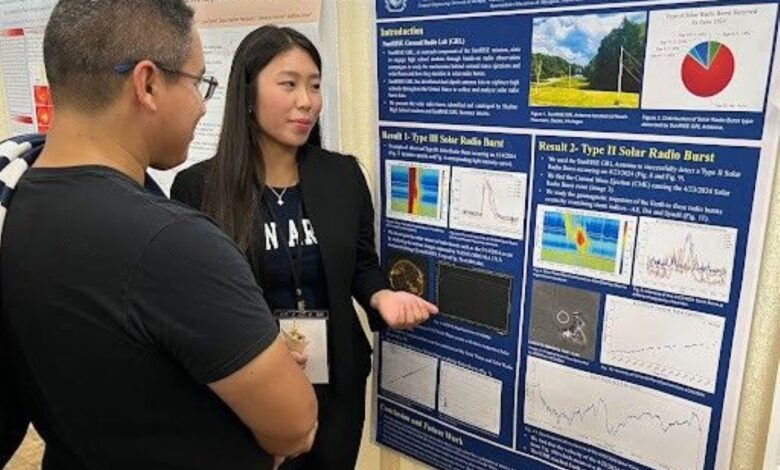
Summer Students Scan the Radio Skies with SunRISE
Solar radio bursts, intense blasts of radio emission associated with solar flares, can wreak havoc on global navigation systems. Now, as part of the Ground Radio Lab campaign led by the University of Michigan and NASA’s SunRISE (Sun Radio Interferometer Space Experiment) mission, which is managed by the agency’s Jet Propulsion Laboratory in Southern California, high school and college students…
Read More » -
How Do We Do Research in Zero Gravity? We Asked a NASA Expert: Episode 62
How do we do research in zero gravity? Actually when astronauts do experiments on the International Space Station, for instance, to environment on organisms, that environment is actually technically called microgravity. That is, things feel weightless, but we’re still under the influence of Earth’s gravity. Now, the very microgravity that we’re trying to study up there can make experiments actually…
Read More » -
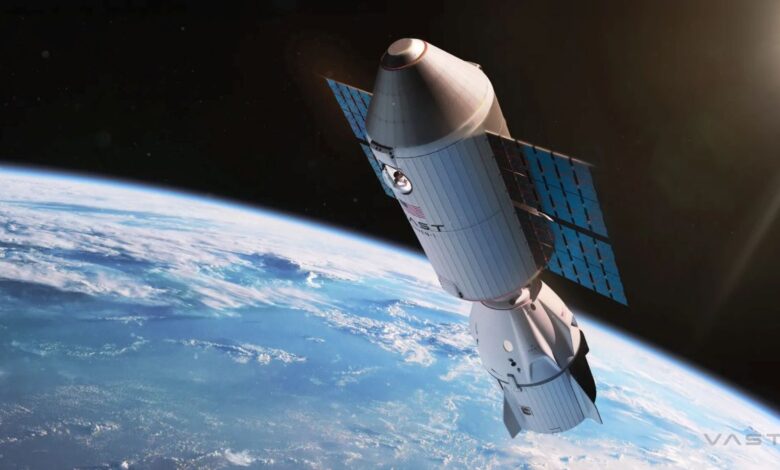
NASA Helps with Progress on Vast’s Haven-1 Commercial Space Station
NASA-supported commercial space station, Vast’s Haven-1, recently completed a test of a critical air filter system for keeping future astronauts healthy in orbit. Testing confirmed the system can maintain a safe and healthy atmosphere for all planned Haven-1 mission phases. Testing of the trace contaminant control system was completed at NASA’s Marshall Space Flight Center in Huntsville, Alabama, as part of…
Read More » -
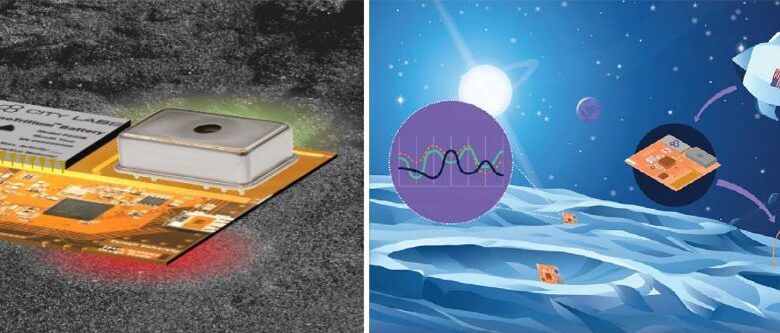
Autonomous Tritium Micropowered Sensors
Peter CabauyCity Labs, Inc. The NIAC Phase I study confirmed the feasibility of nuclear-micropowered probes (NMPs) using tritium betavoltaic power technology for autonomous exploration of the Moon’s permanently shadowed regions (PSRs). This work advanced the technology’s readiness level (TRL) from TRL 1 to TRL 2, validating theoretical models and feasibility assessments. Phase II will refine the technology, address challenges, and…
Read More » -

Breathing Beyond Earth: A Reliable Oxygen Production Architecture for Human Space Exploration
Alvaro Romero-CalvoGeorgia Tech Research Corporation The reliable and efficient operation of spacecraft life support systems is challenged in microgravity by the near absence of buoyancy. This impacts the electrolytic production of oxygen and hydrogen from water by forcing the adoption of complex multiphase flow management technologies. Still, water splitting plays an essential role in human spaceflight, closing the regenerative environmental…
Read More » -
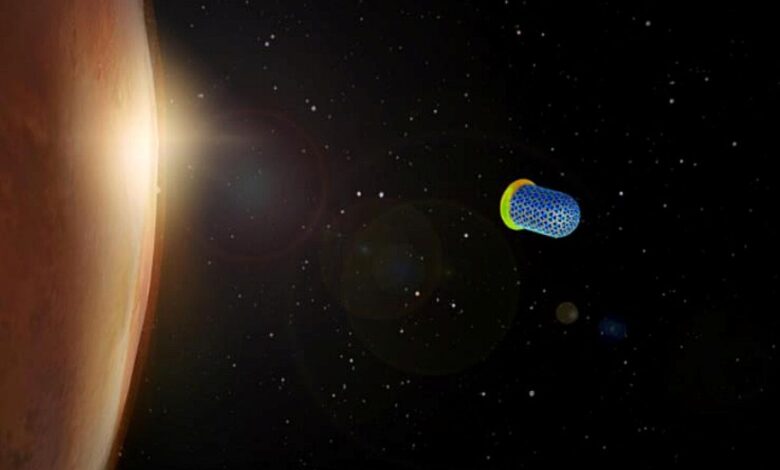
Mars Roundtrip Success Enabled by Integrated Cooling through Inductively Coupled LED Emission (MaRS ICICLE)
Aaswath Pattabhi RamanUniversity of California, Los Angeles Exploration of Mars has captivated the public in recent decades with high-profile robotic missions and the images they have acquired seeding our collective imagination. NASA is actively planning for human exploration of Mars and laid out some of the key capabilities that must be developed to execute successful, cost-effective programs that would put…
Read More » -
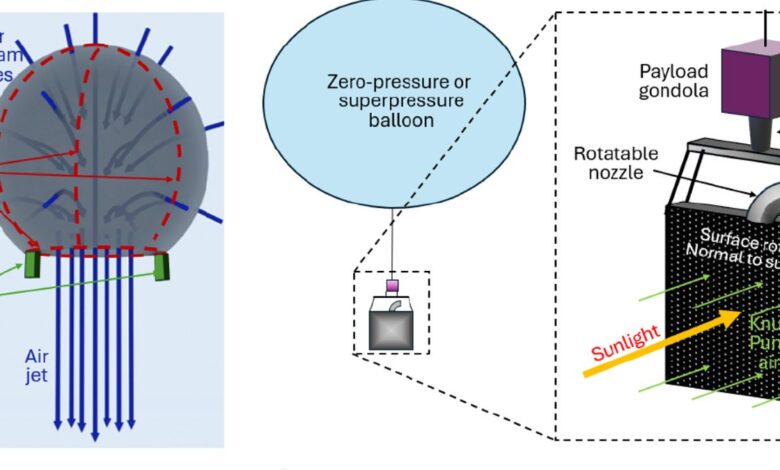
Photophoretic Propulsion Enabling Mesosphere Exploration
Igor BargatinUniversity of Pennsylvania We propose to use the photophoretic levitation and propulsion mechanism to create no-moving-parts flying vehicles that can be used to explore Earth’s upper atmosphere. The photophoretic force arises when a solid is heated relative to the ambient gas through illumination, inducing momentum exchange between the solid and the gas. The force creates lift in structures that…
Read More » -
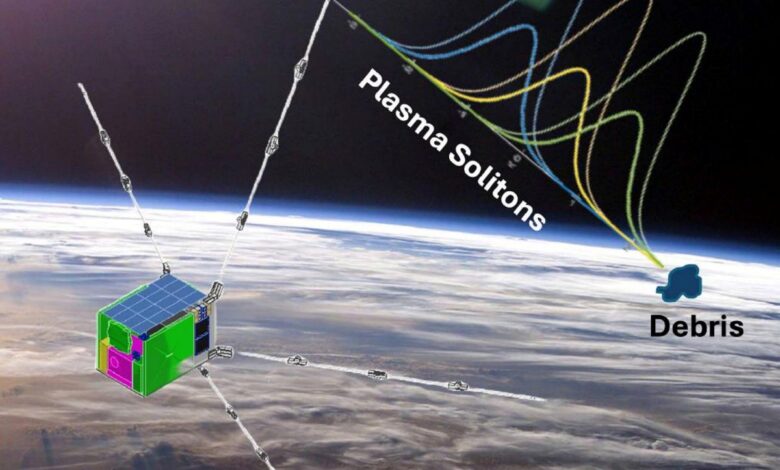
Addressing Key Challenges To Mapping Sub-cm Orbital Debris in LEO via Plasma Soliton Detection
Christine HartzellUniversity of Maryland, College Park The proposed investigation will address key technological challenges associated with a previously funded NIAC Phase I award titled “On-Orbit, Collision-Free Mapping of Small Orbital Debris”. Sub-cm orbital debris in LEO is not detectable or trackable using conventional technologies and poses a major hazard to crewed and un-crewed spacecraft. Orbital debris is a concern to…
Read More » -
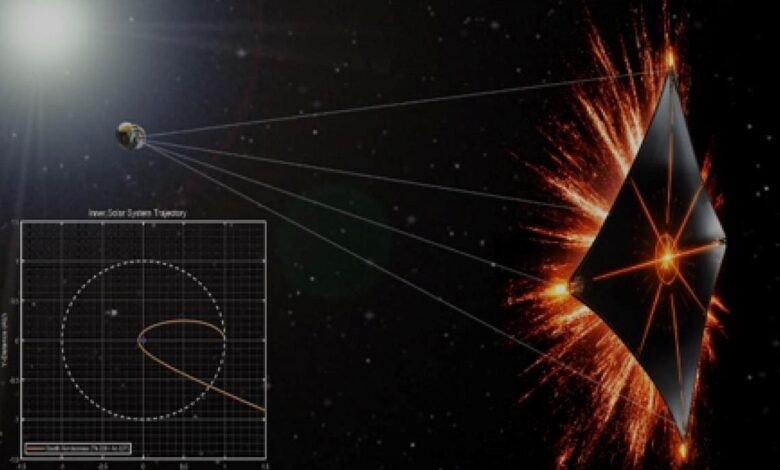
TFINER – Thin Film Isotope Nuclear Engine Rocket
James BickfordCharles Stark Draper Laboratory, Inc. The Thin-Film Nuclear Engine Rocket (TFINER) is a novel space propulsion technology that enables aggressive space exploration for missions that are impossible with existing approaches. The concept uses thin layers of energetic radioisotopes to directly generate thrust. The emission direction of its natural decay products is biased by a substrate to accelerate the spacecraft.…
Read More »