
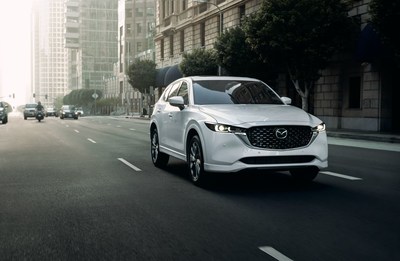
- For the first time in the North American market, Mazda offers the Rhodium White exterior premium paint option for the 2023 CX-5
- Mazda’s i-Activ AWD remains standard on all Mazda CX-5 models, enhancing performance on a variety of surfaces
- 2023 CX-5 goes on sale with a starting MSRP1 of $26,700 and will arrive at dealerships this fall
IRVINE, Calif., July 26, 2022 /PRNewswire/ — Mazda North American Operations announces pricing and packaging for the 2023 CX-5 – the brand’s best-selling vehicle in the U.S. For 2023, the CX-5 is available with an all-new Rhodium White exterior premium paint color, complimenting Mazda’s Kodo design. As with all of Mazda’s SUVs, all 2023 CX-5 models will retain standard i-Activ all-wheel drive in the U.S. when they arrive in dealerships nationwide this fall.
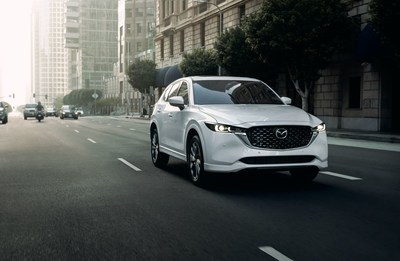
Offered for the first time in the U.S. market, the new Rhodium White premium paint option is a unique color born from Mazda’s exclusive Takuminuri painting technology, following Soul Red Crystal and Machine Gray Metallic. Rhodium White is a pure white inspired by Japanese aesthetics finding beauty in simplicity. The paint’s fine grain accentuates the shadows on the surface of the vehicle complimenting the CX-5’s sculpted body lines. Mazda believes that color is a critical part of vehicle design. It accentuates the vehicle’s dynamic and delicate expression while complimenting the Kodo – Soul of Motion – design theme, something Mazda takes great pride in offering its customers.
The critically acclaimed CX-5 has received numerous top industry and safety awards including the Insurance Institute for Highway Safety (IIHS) TOP SAFETY PICK+. In fact, the CX-5 was the first vehicle to earn a Good rating in IIHS’s new, tougher side impact test. To that end, all the engineering and safety features that contributed to these awards have been carried over to the 2023 model year as standard features. These include Mazda Radar Cruise Control with Stop and Go, Smart Brake Support, Advanced Smart City Brake Support, Blind Spot Monitoring, Rear Cross-Traffic Alert, and Lane Departure Warning with Lane Keep Assist. These features allow CX-5 drivers to feel confident and comfortable, from the city streets to the open highway.
The 2023 Mazda CX-5 will be available in eight packages. Each providing customers with a well-equipped vehicle with an impressive list of standard technology and safety features designed to meet their needs while providing the brand’s renowned driving dynamics.
CX-5 2.5 S
The CX-5 2.5 S features Mazda’s Skyactiv-G 2.5-liter, four-cylinder naturally aspirated engine with cylinder deactivation. This efficient powertrain delivers up to 187 horsepower and 186 lb-ft of torque with either regular 87 octane or premium 93 octane fuel and is paired with a quick-shifting six-speed automatic transmission with manual mode and sport mode. All CX-5 models will continue to be equipped with G-Vectoring Control Plus and the i-Activ AWD system as standard. This system continuously monitors weight distribution and shifts power to the appropriate wheels, providing drivers with near instant power delivery.
Drawing inspiration from our Kodo design philosophy, the CX-5 stands out in the city even at a standstill. The front bumper features a signature wing which extends outward from the front grill with a unique three-dimensional texture. The rear of the vehicle is complemented by sport inspired dual tailpipes that mesh seamlessly with the rear bumper for a premium look. The headlights and taillights each feature a pair of horizontally spaced, rectangular LED lights that are sure to draw the eye.
The CX-5 continues to be well-appointed at the standard level to help ensure the driver and its occupants have a driving experience that exceeds their expectations. Every CX-5 model includes complimentary Mazda Connected Services for three years, providing the ability to monitor and control the state of the CX-5 remotely by logging into the MyMazda app and includes in-car Wi-Fi hotspot for three-months or 2GB trial, whichever comes first2. The 10.25″ full-color center display features the latest Mazda Connect infotainment system that can be controlled with the multi-function commander knob and is integrated with Apple CarPlay and Android Auto. Other standard features include push button start, remote keyless entry system, leather-wrapped shifter and steering wheel with mounted audio, Bluetooth, and cruise control buttons, dual front USB inputs, four-speaker sound system, black cloth seats with six-way manual adjustable driver’s seat and four-way manual adjustable passenger seat, electronic parking brake, rearview camera, climate control, power door locks, and power windows with one-touch automatic up/down.
Additional features include automatic on/off LED headlights with High Beam Control, rear roof spoiler, roof-mounted shark fin antenna, and automatic rain-sensing windshield wipers.
CX-5 2.5 S SELECT
Moving up to the CX-5 2.5 S Select package adds more conveniences for the owner such as auto-leveling headlights, rear privacy glass, dual-zone automatic climate control, black or silk beige leatherette seats, and Mazda Advanced Keyless Entry. The front seats are upgraded with three-level heating, while the driver’s seat has six-way power adjustability, and the passenger has six-way manual adjustability. All occupants will enjoy the six-speaker sound system with rear passengers benefiting from rear air conditioning vents, rear seat center armrest, and two easily accessible USB ports.
CX-5 2.5 S PREFERRED
The CX-5 2.5 S Preferred package adds a power moonroof and inside are black or silk beige leather seats with both driver and passenger power adjustability in eight-way and six-way, respectively. The driver’s seat also includes two-position memory. Auto-dimming rearview mirrors with Homelink is also added to this package.
CX-5 2.5 S CARBON EDITION
The 2023 CX-5 2.5 S Carbon Edition continues to offer exclusive styling with Polymetal Gray exterior paint color and an option between black leather with red stitching or red leather interior. Carbon Edition also features black metallic 19-inch aluminum alloy wheels with matching gloss black side mirrors and front signature wing. The leather-wrapped steering wheel and shifter has red stitching that is complemented with gloss black instrument panel and door trim styling.
CX-5 2.5 S PREMIUM
For the CX-5 2.5 S Premium package, Mazda Intelligent Drive Select (Mi-Drive) is added. Mi-Drive enables drivers to select the most appropriate drive mode with a simple switch, offering greater control over the driving experience in a wide variety of conditions. The CX-5 features Normal, Off-Road, and Sport Modes.
This model also adds LED daytime running lights and combination taillights along with black metallic finish with machine cut 19-inch aluminum alloy wheels, Adaptive Front-lighting System, dual heated door mirrors, a seven-inch LCD multi-information meter display and paddle shifters.
CX-5 2.5 S PREMIUM PLUS
The CX-5 2.5 S Premium Plus package adds full-color windshield-projected Active Driving Display with available Traffic Sign Recognition with the optional Mazda Navigation System accessory installed, ventilated front seats, heated steering wheel, three-level heated rear seats, windshield wiper de-icer, and automatic power-folding door mirrors.
Building off the CX-5 2.5 S Premium package, this model also adds a Bose 10-speaker premium audio system with SiriusXM satellite radio complete with a three-month trial. Additionally, this package includes a power rear liftgate with programable height adjustment based on customer needs.
CX-5 2.5 TURBO
The CX-5 2.5 Turbo provides performance-minded customers with a powerful, sporty crossover option. The Skyactiv-G 2.5 Turbo engine delivers 256 horsepower and 320 lb-ft of torque with premium 93 octane fuel. On regular, 87 octane fuel, the engine will provide 227 horsepower and 310 lb-ft of torque, enough to put a smile on any enthusiast’s face.
The exterior features sleek finishes throughout to support an athletic look with a gloss black front grille, signature wing, door mirrors, lower bumper, wheel arches, and rocker molding. Completing the theme are black metallic finish 19-inch aluminum alloy wheels. The interior features black or parchment leather seats that feature red accents and stitching on the instrument panel, door trim, leather-wrapped steering wheel, and shifter that supports a sporty atmosphere through the cabin. All CX-5 Turbo models include a wireless phone charger.
CX-5 2.5 TURBO SIGNATURE
Elevating to the CX-5 2.5 Turbo Signature perfectly blends premium style and sporty performance. The cladding on the exterior of this model adopts the same unified color scheme as the rest of the body and is contrasted by bright silver finish 19-inch aluminum alloy wheels with matching front grille and signature wing.
The interior is appointed with premium quality materials such as Caturra Brown Nappa leather and genuine woodgrain. The bright silver finish is also found throughout, which is highlighted by LED interior lighting and ambient foot illumination. The black headliner and unique steering wheel are among other sophisticated styling found in the cabin of the CX-5 2.5 Turbo Signature. The Mazda Navigation System is installed in this model, allowing the Active Driving Display to include Traffic Sign Recognition. Owners can also benefit from the complementary three-year SiriusXM Traffic & Travel Link subscription that provides current information for traffic, weather, sports scores, fuel prices, and nearby parking, which are all very useful features to use in the city.
Finally, this model is fully equipped with Mazda’s latest i-Activsense safety features which add the 360° View Monitor with front and rear parking sensors, Rear Smart City Brake Support, Traffic Jam Assist, and Driver Attention Alert.
MSRP3 FOR THE 2023 MAZDA CX-5 IS AS FOLLOWS:
| Model | Starting MSRP1 |
| CX-5 2.5 S | $26,700 |
| CX-5 2.5 S Select | $28,500 |
| CX-5 2.5 S Preferred | $29,590 |
| CX-5 2.5 S Carbon Edition | $30,500 |
| CX-5 2.5 S Premium | $32,400 |
| CX-5 2.5 S Premium Plus | $35,500 |
| CX-5 2.5 Turbo | $36,850 |
| CX-5 2.5 Turbo Signature | $39,650 |
PREMIUM PAINT COLORS:
| Soul Red Crystal Metallic | $595 |
| Machine Gray Premium | $595 |
| Rhodium White Premium | $595 |
Mazda North American Operations is headquartered in Irvine, California, and oversees the sales, marketing, parts and customer service support of Mazda vehicles in the United States, Canada and Mexico through approximately 780 dealers. Operations in Canada are managed by Mazda Canada Inc. in Richmond Hill, Ontario, and operations in Mexico are managed by Mazda Motor de Mexico in Mexico City. For more information on Mazda vehicles, including photography and B-roll, please visit the online Mazda media center at news.mazdausa.com..
Follow MNAO’s social media channels through Twitter and Instagram at @MazdaUSA and Facebook at Facebook.com/MazdaUSA.
1 MSRP does not include $1,275 for destination and handling ($1,320 in Alaska), taxes, title or additional fees. Dealers set actual sale prices.
2 Mazda Connect 4G LTE Wi-Fi powered by AT&T is available during 3-month/2GB trial period (whichever comes first); monthly subscription.
3 MSRP does not include $1,275 for destination and handling ($1,320 in Alaska), taxes, title or additional fees. Dealers set actual sale prices.