




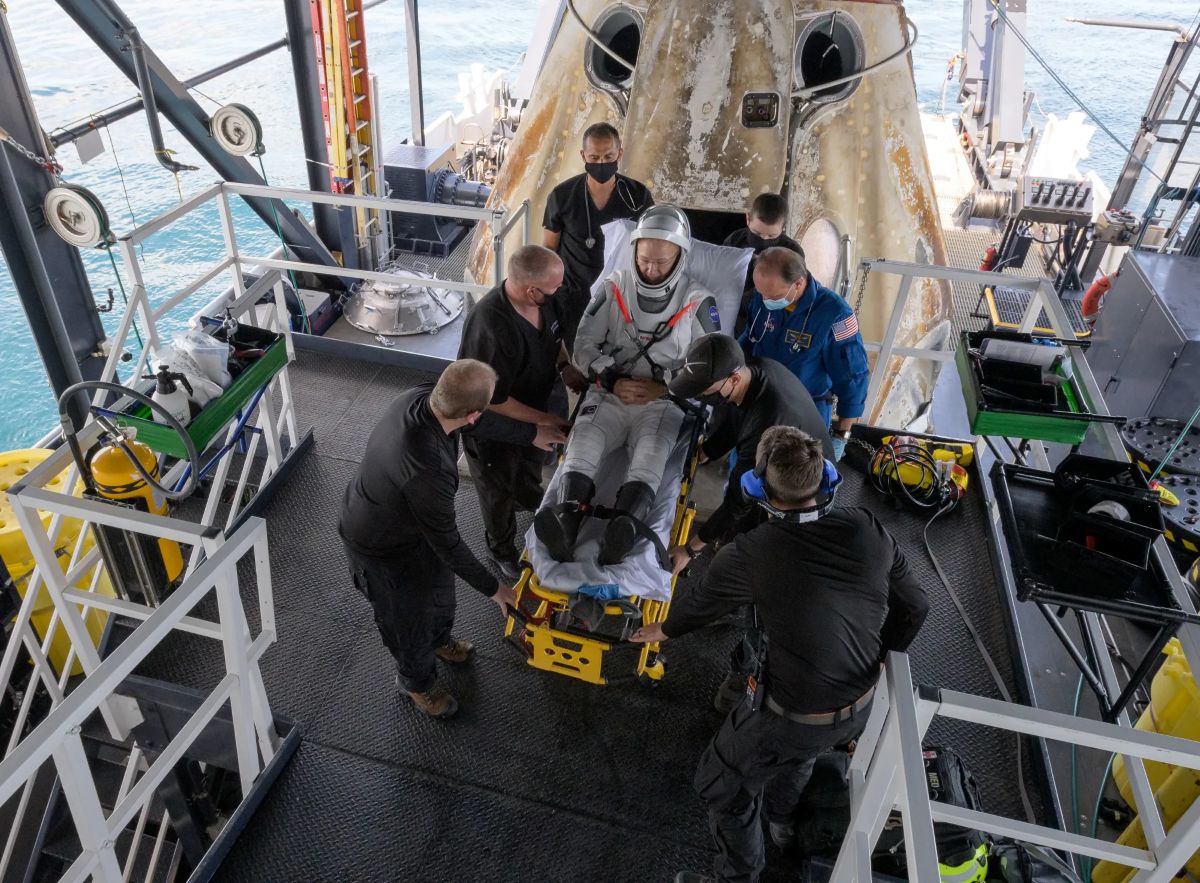
New spacecraft that will transport crews to the Lunar and Martian surfaces and return them to Earth may have diverse landing modalities which will function in different landing environments. Additionally, the crew may be deconditioned on landing, impacting their ability to independently egress the vehicles, perform post-landing tasks in a timely manner, and perform surface EVAs post-landing -including those required for emergencies.

Boeing and NASA teams work around Boeing’s CST-100 Starliner spacecraft after it landed at White Sands Missile Range’s Space Harbor, Wednesday, May 25, 2022, in New Mexico. Boeing’s Orbital Flight Test-2 (OFT-2) is Starliner’s second uncrewed flight test to the International Space Station as part of NASA’s Commercial Crew Program. OFT-2 serves as an end-to-end test of the system’s capabilities. Photo Credit: (NASA/Bill Ingalls)
Directed Acyclic Graph Files
+ DAG File Information (HSRB Home Page)
+ Crew Egress Risk DAG and Narrative (PDF)
+ Crew Egress Risk DAG Code (TXT)
About The Author


Got a Questions?
Find us on Socials or Contact us and we’ll get back to you as soon as possible.