In 2025, NASA’s Armstrong Flight Research Center in Edwards, California, advanced work across aeronautics, Earth science, exploration technologies, and emerging aviation systems, reinforcing its role as one of the agency’s primary test sites for aeronautics research. From early concept evaluations to full flight test campaigns, teams enhanced measurement tools, refined safety systems, and generated data that supported missions across NASA. Operating from the Mojave Desert, NASA Armstrong continued applying engineering design with real-world performance, carrying forward research that informs how aircraft operate today and how new systems may function in the future.
The year’s progress also reflects the people behind the work – engineers, technicians, pilots, operators, and mission support staff who navigate complex tests and ensure each mission advances safely and deliberately. Their efforts strengthened partnerships with industry, small businesses, and universities while expanding opportunities for students and early career professionals. Together they sustained NASA Armstrong’s long-standing identity as a center where innovation is proven in flight and where research helps chart the course for future aviation and exploration.
“We executed our mission work safely, including flight of the first piloted NASA X-plane in decades, while under challenging conditions,” said Brad Flick, center director of NASA Armstrong. “It tells me our people embrace the work we do and are willing to maintain high levels of professionalism while enduring personal stress and uncertainty. It’s a testimony to the dedication of our NASA and contractor workforce.”
Teams continued advancing key projects, supporting partners, and generating data that contributes to NASA’s broader mission.
Quiet supersonic flight and the Quesst mission
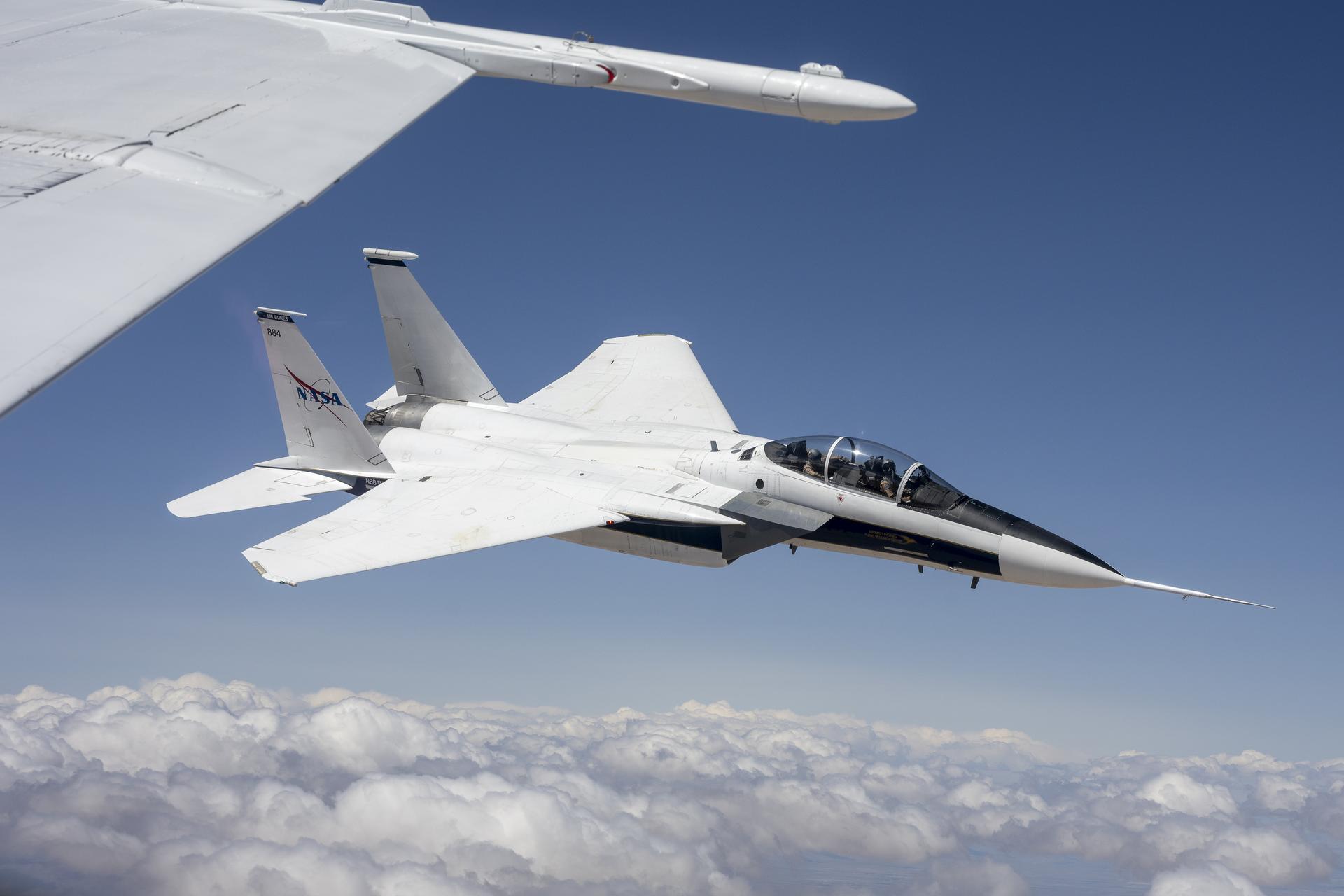
NASA’s F-15D research aircraft conducts a calibration flight of a shock-sensing probe near NASA’s Armstrong Flight Research Center in Edwards, California. The shock-sensing probe is designed to measure the signature and strength of shock waves in flight. The probe was validated during dual F-15 flights and will be flown behind NASA’s X-59 to measure small pressure changes caused by shock waves in support of the agency’s Quesst mission.
NASA/Jim Ross
NASA Armstrong continued its quiet supersonic research, completing a series of activities in support of NASA’s Quesst mission. On the X-59 quiet supersonic research aircraft, the team performed electromagnetic interference tests and ran engine checks to prepare the aircraft for taxi tests. The Schlieren, Airborne Measurements, and Range Operations for Quesst (SCHAMROQ) team completed aircraft integration and shock-sensing probe calibration flights, refining the tools needed to characterize shock waves from the X-59. These efforts supported the aircraft’s progression toward its first flight on Oct. 28, marking a historic milestone and the beginning of its transition to NASA Armstrong for continued testing.
The center’s Commercial Supersonic Technology (CST) team also conducted airborne validation flights using NASA F-15s, confirming measurement systems essential for Quesst’s next research phase. Together, this work forms the technical backbone for upcoming community response studies, where NASA will evaluate whether quieter supersonic thumps could support future commercial applications.
- The X-59 team completed electromagnetic interference testing on the aircraft, verifying system performance and confirming that all its systems could reliably operate together.
- NASA’s X-59 engine testing concluded with a maximum afterburner test that demonstrated the engine’s ability to generate the thrust required for supersonic flight.
- Engineers conducted engine speed-hold evaluations to assess how the X-59’s engine responds under sustained throttle conditions, generating data used to refine control settings for upcoming flight profiles.
- NASA Armstrong’s SCHAMROQ team calibrated a second shock-sensing probe to expand measurement capability for future quiet supersonic flight research.
- NASA Armstrong’s CST team validated the tools that will gather airborne data in support the second phase of the agency’s Quesst mission.
- NASA’s X-59 team advanced preparations on the aircraft through taxi tests, ensuring aircraft handling systems performed correctly ahead of its first flight.
- NASA Armstrong’s photo and video team documented X-59 taxi tests as the aircraft moved under its own power for the first time.
- The X-59 team evaluated braking, steering, and integrated systems performance after the completion of the aircraft’s low-speed taxi tests marking one of the final steps before flight.
- NASA Armstrong teams advanced the X-59 toward first flight by prioritizing safety at every step, completing checks, evaluations, and system verifications to ensure the aircraft was ready when the team was confident it could move forward.
- NASA and the Lockheed Martin contractor team completed the X-59’s historic first flight, delivering the aircraft to NASA Armstrong for the start of its next phase of research.
Ultra-efficient and high-speed aircraft research
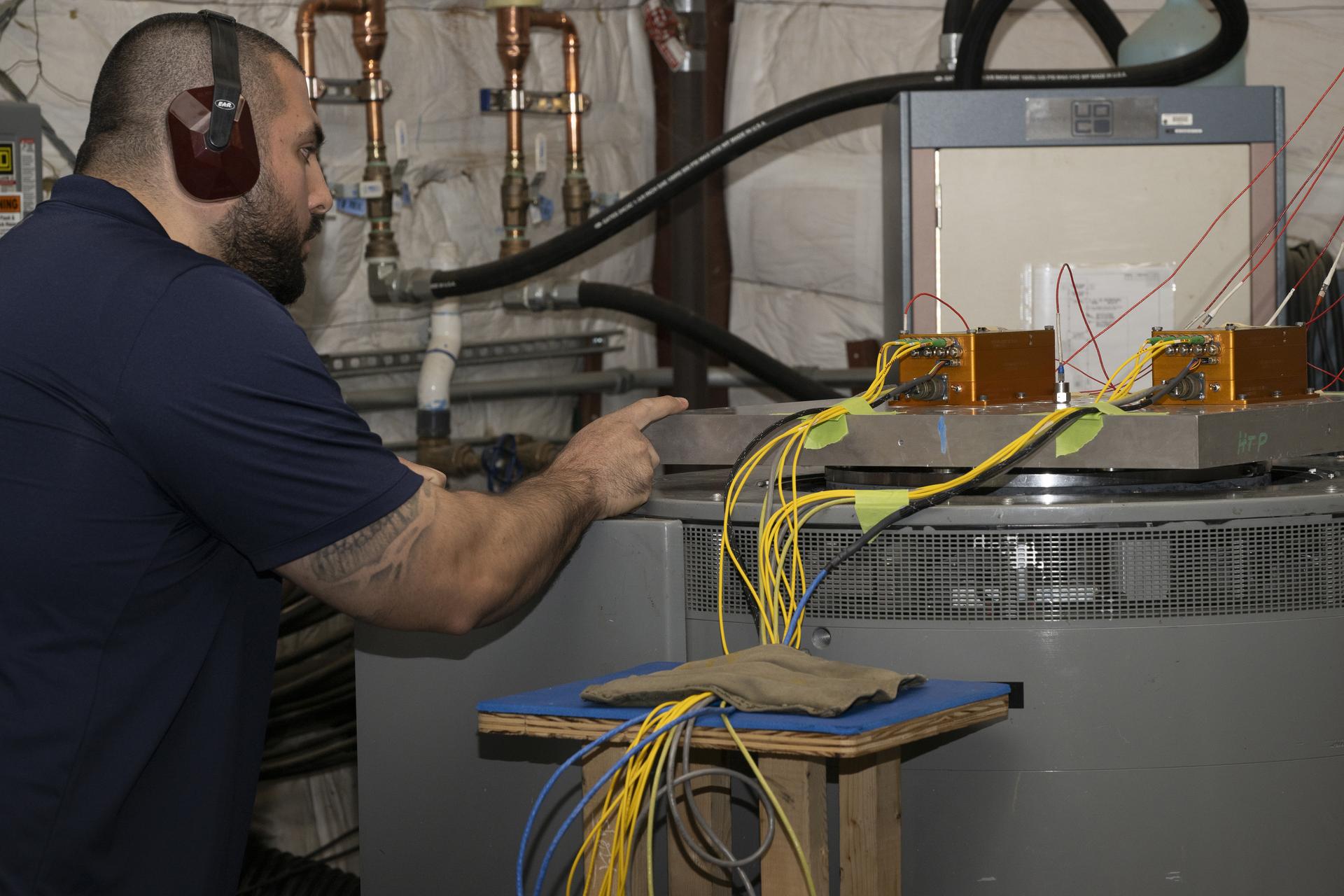
Jonathan Lopez prepares the hypersonic Fiber Optic Sensing System for vibration tests in the Environmental Laboratory at NASA’s Armstrong Flight Research Center in Edwards, California. Testing on a machine called a shaker proved that the system could withstand the severe vibration it will endure in hypersonic flight, or travel at five times the speed of sound.
NASA/Jim Ross
Across aeronautics programs, Armstrong supported work that strengthens NASA’s ability to study sustainable, efficient, and high-performance aircraft. Teams conducted aerodynamic measurements and improved test-article access for instrumentation, enabling more precise evaluations of advanced aircraft concepts. Engineers continued developing tools and techniques to study aircraft performance under high-speed and high-temperature conditions, supporting research in hypersonic flight.
- The Sustainable Flight Demonstrator research team measured airflow over key wing surfaces in a series of wind tunnel tests, generating data used to refine future sustainable aircraft designs.
- Technicians at NASA Armstrong installed a custom structural floor inside the X-66 demonstrator, improving access for instrumentation work and enabling more efficient modification and evaluation.
- Armstrong engineers advanced high-speed research by maturing an optical measurement system that tracks heat and structural strain during hypersonic flight, supporting future test missions.